

cables cover 70% of the entire field and the 4D seismic
data quality is excellent. The fact that more than 10
surveys have been recorded into exactly the same
receiver positions, opens for alternative and new
ways (exploiting the multiplicity that more than
2 datasets offers) of analysing time-lapse seismic
data. Other advantages offered by permanent receiver
systems are:
– cheaper to increase the shot time interval in order to
reduce the effect of shot generated noise
– continuous monitoring of background noise
– passive seismic
– possible to design a dedicated monitoring survey
close to a problem well at short notice.
Despite all these advantages that permanent
systems offer, there has not been a marked increase
in such surveys so far, probably because of the relatively high upfront costs and the difficulty in
quantifying in advance the extra value it would bring.
19.7 Geomechanical effects
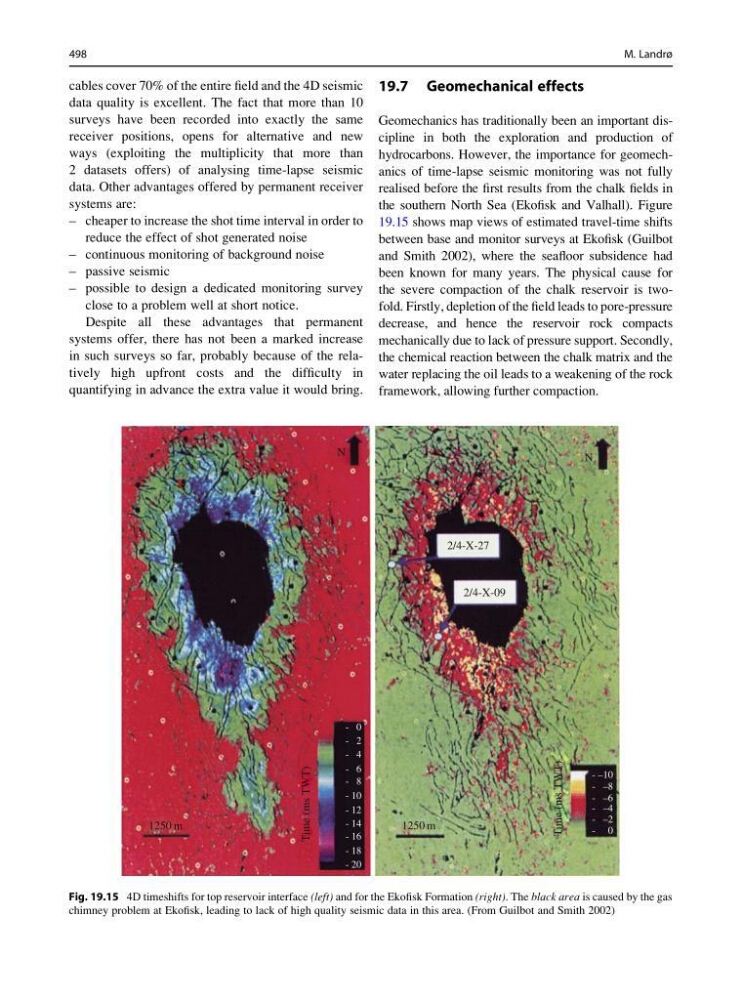
Geomechanics has traditionally been an important discipline in both the exploration and production of
hydrocarbons. However, the importance for geomechanics of time-lapse seismic monitoring was not fully
realised before the first results from the chalk fields in
the southern North Sea (Ekofisk and Valhall). Figure
19.15 shows map views of estimated travel-time shifts
between base and monitor surveys at Ekofisk (Guilbot
and Smith 2002), where the seafloor subsidence had
been known for many years. The physical cause for
the severe compaction of the chalk reservoir is twofold. Firstly, depletion of the field leads to pore-pressure
decrease, and hence the reservoir rock compacts
mechanically due to lack of pressure support. Secondly,
the chemical reaction between the chalk matrix and the
water replacing the oil leads to a weakening of the rock
framework, allowing further compaction.
2/4-X-27
1250 m
1250 m
- 0
- 2
- 4
- 6
- 8
- 10
- –10
- –8
- –6
- –4
- –2
- 0
- 12
- 14
- 16
- 18
- 20
Time (ms TWT)
Time (ms TWT)
N
N
2/4-X-09
Fig. 19.15 4D timeshifts for top reservoir interface (left) and for the Ekofisk Formation (right). The black area is caused by the gas
chimney problem at Ekofisk, leading to lack of high quality seismic data in this area. (From Guilbot and Smith 2002)
498
M. Landrø
data quality is excellent. The fact that more than 10
surveys have been recorded into exactly the same
receiver positions, opens for alternative and new
ways (exploiting the multiplicity that more than
2 datasets offers) of analysing time-lapse seismic
data. Other advantages offered by permanent receiver
systems are:
– cheaper to increase the shot time interval in order to
reduce the effect of shot generated noise
– continuous monitoring of background noise
– passive seismic
– possible to design a dedicated monitoring survey
close to a problem well at short notice.
Despite all these advantages that permanent
systems offer, there has not been a marked increase
in such surveys so far, probably because of the relatively high upfront costs and the difficulty in
quantifying in advance the extra value it would bring.
19.7 Geomechanical effects
Geomechanics has traditionally been an important discipline in both the exploration and production of
hydrocarbons. However, the importance for geomechanics of time-lapse seismic monitoring was not fully
realised before the first results from the chalk fields in
the southern North Sea (Ekofisk and Valhall). Figure
19.15 shows map views of estimated travel-time shifts
between base and monitor surveys at Ekofisk (Guilbot
and Smith 2002), where the seafloor subsidence had
been known for many years. The physical cause for
the severe compaction of the chalk reservoir is twofold. Firstly, depletion of the field leads to pore-pressure
decrease, and hence the reservoir rock compacts
mechanically due to lack of pressure support. Secondly,
the chemical reaction between the chalk matrix and the
water replacing the oil leads to a weakening of the rock
framework, allowing further compaction.
2/4-X-27
1250 m
1250 m
- 0
- 2
- 4
- 6
- 8
- 10
- –10
- –8
- –6
- –4
- –2
- 0
- 12
- 14
- 16
- 18
- 20
Time (ms TWT)
Time (ms TWT)
N
N
2/4-X-09
Fig. 19.15 4D timeshifts for top reservoir interface (left) and for the Ekofisk Formation (right). The black area is caused by the gas
chimney problem at Ekofisk, leading to lack of high quality seismic data in this area. (From Guilbot and Smith 2002)
498
M. Landrø