

into account diagenesis and tectonic events, we can
predict compaction trends and associated seismic
velocities in areas with more complex burial history
involving both mechanical and chemical compaction,
as well as uplift episodes and corresponding erosion.
The resulting rock physics trends help us to better
constrain AVO inversion and classification under
such circumstances.
Lehocki et al. (2012) proposed a methodology for
statistical classification of fluids and facies in areas
with tectonic uplift based on rock physics depth
trends, and they demonstrated the methodology on
seismic AVO data from the Loppa High area in the
Barents Sea, where there has been significant tectonic
uplift. The main objective of that study was to perform
seismic reservoir prediction and hunt for Upper Cretaceous Kolmule Formation sands with good reservoir
quality in a structural setting near the Loppa High.
Furthermore, the goal was to do both pre- and postdrill predictions of a prospect. A neighbouring well
(Fig. 18.32) was used for local calibration. This well is
located down-flank of the structural high of interest,
and Kolmule Formation sands are not encountered in
it. Note, however, the sudden jump in velocity as we
go from Torsk Formation shales to Kolmule Formation shales. The gamma ray log and density log show
only small changes at this interface. Regional work
has indicated that this is the transition from the
mechanical to chemical compaction domain, and is
in agreement with observations made by Storvoll
et al. (2005) and Thyberg et al. (2009).
Rock physics models are compared and calibrated
to the observed velocities, for both domains. The
Hertz-Mindlin contact theory is used for the loose
sediments above the onset of cement, whereas the
Dvorkin-Nur contact cement model was utilised to
model the velocities of sandstones in the chemical
compaction domain. The rock physics models are
furthermore adjusted in depth until we obtain an
optimal match between observed sonic well log data
and modelled velocities. A maximum burial depth of
c. 2,500 m is estimated, implying that the net uplift is
around 1,300 m. We therefore expect the reservoirs to
have been buried at temperatures high enough to initiate chemical compaction.
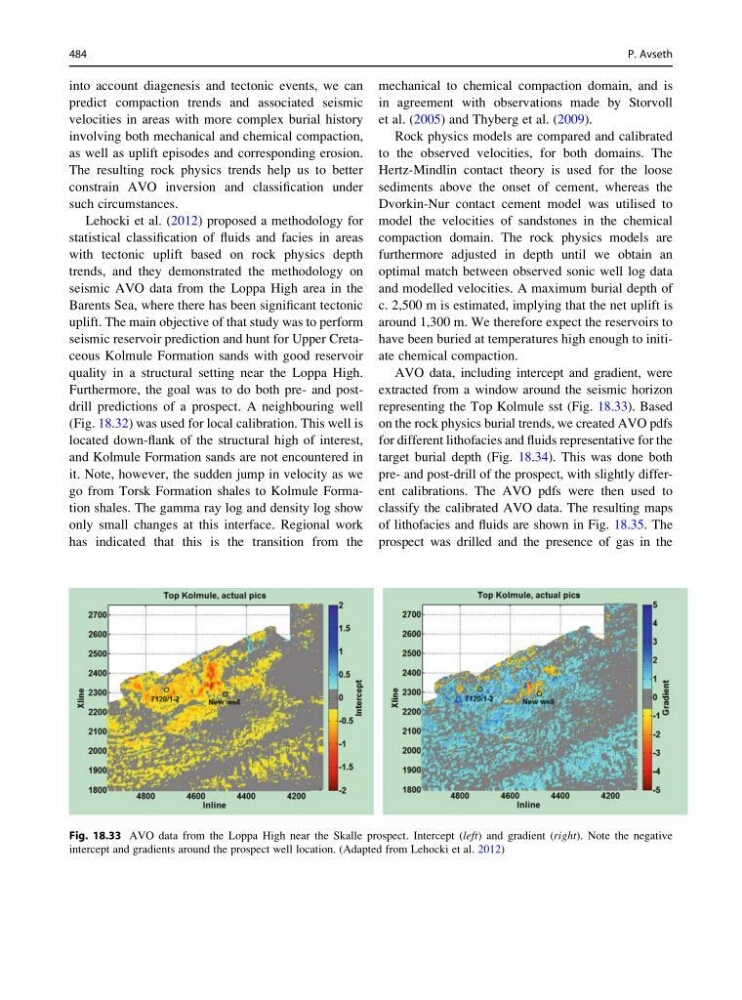
AVO data, including intercept and gradient, were
extracted from a window around the seismic horizon
representing the Top Kolmule sst (Fig. 18.33). Based
on the rock physics burial trends, we created AVO pdfs
for different lithofacies and fluids representative for the
target burial depth (Fig. 18.34). This was done both
pre- and post-drill of the prospect, with slightly different calibrations. The AVO pdfs were then used to
classify the calibrated AVO data. The resulting maps
of lithofacies and fluids are shown in Fig. 18.35. The
prospect was drilled and the presence of gas in the
Fig. 18.33 AVO data from the Loppa High near the Skalle prospect. Intercept (left) and gradient (right). Note the negative
intercept and gradients around the prospect well location. (Adapted from Lehocki et al. 2012)
484
P. Avseth
predict compaction trends and associated seismic
velocities in areas with more complex burial history
involving both mechanical and chemical compaction,
as well as uplift episodes and corresponding erosion.
The resulting rock physics trends help us to better
constrain AVO inversion and classification under
such circumstances.
Lehocki et al. (2012) proposed a methodology for
statistical classification of fluids and facies in areas
with tectonic uplift based on rock physics depth
trends, and they demonstrated the methodology on
seismic AVO data from the Loppa High area in the
Barents Sea, where there has been significant tectonic
uplift. The main objective of that study was to perform
seismic reservoir prediction and hunt for Upper Cretaceous Kolmule Formation sands with good reservoir
quality in a structural setting near the Loppa High.
Furthermore, the goal was to do both pre- and postdrill predictions of a prospect. A neighbouring well
(Fig. 18.32) was used for local calibration. This well is
located down-flank of the structural high of interest,
and Kolmule Formation sands are not encountered in
it. Note, however, the sudden jump in velocity as we
go from Torsk Formation shales to Kolmule Formation shales. The gamma ray log and density log show
only small changes at this interface. Regional work
has indicated that this is the transition from the
mechanical to chemical compaction domain, and is
in agreement with observations made by Storvoll
et al. (2005) and Thyberg et al. (2009).
Rock physics models are compared and calibrated
to the observed velocities, for both domains. The
Hertz-Mindlin contact theory is used for the loose
sediments above the onset of cement, whereas the
Dvorkin-Nur contact cement model was utilised to
model the velocities of sandstones in the chemical
compaction domain. The rock physics models are
furthermore adjusted in depth until we obtain an
optimal match between observed sonic well log data
and modelled velocities. A maximum burial depth of
c. 2,500 m is estimated, implying that the net uplift is
around 1,300 m. We therefore expect the reservoirs to
have been buried at temperatures high enough to initiate chemical compaction.
AVO data, including intercept and gradient, were
extracted from a window around the seismic horizon
representing the Top Kolmule sst (Fig. 18.33). Based
on the rock physics burial trends, we created AVO pdfs
for different lithofacies and fluids representative for the
target burial depth (Fig. 18.34). This was done both
pre- and post-drill of the prospect, with slightly different calibrations. The AVO pdfs were then used to
classify the calibrated AVO data. The resulting maps
of lithofacies and fluids are shown in Fig. 18.35. The
prospect was drilled and the presence of gas in the
Fig. 18.33 AVO data from the Loppa High near the Skalle prospect. Intercept (left) and gradient (right). Note the negative
intercept and gradients around the prospect well location. (Adapted from Lehocki et al. 2012)
484
P. Avseth