

18.6 Seismic Fluid Sensitivity and
Gassmann Theory for Fluid
Substitution
Seismic fluid sensitivity is determined by a combination of porosity and pore-space stiffness. A softer rock
will have a larger sensitivity to fluids than a stiffer
rock at the same porosity. The most common theory
for fluid substitution is the so-called Gassmann theory
(Gassmann 1951, Mavko et al. 2009, Avseth et al.
2005), which describes the fluid sensitivity of porous,
isotropic rocks at seismic frequency (i.e. when no
grain-scale viscous flow effects will stiffen the rock
frame). The Gassmann theory is very important in all
rock physics modelling, therefore both the formulation
and workflow of the theory are included in this overview chapter.
For the fluid substitution problem there are two
fluid effects that must be considered: the change in
rock bulk density, and the change in rock compressibility. The compressibility of a dry rock (reciprocal of
the rock bulk modulus) can be expressed quite generally as the sum of the mineral compressibility and an
extra compressibility due to the pore space:
1
K dry
¼
1
K mineral
þ
ϕ
K ϕ
ð18:11Þ
where ϕ is the porosity, K dry is the dry rock bulk
modulus, K mineral is the mineral bulk modulus, and
K ϕ is the pore space stiffness defined by:
1
K ϕ
¼
1
v pore
∂v pore
∂σ
ð18:12Þ
Here, v pore is the pore volume, and σ is the increment
of hydrostatic confining stress from the passing wave.
Poorly consolidated rocks, rocks with microcracks,
and rocks at low effective pressure, are generally soft
and compressible and have a small K ϕ . Stiff rocks that
are well cemented, lacking microcracks, or at high
effective pressure have a large K ϕ . In terms of the
popular, but idealised, ellipsoidal crack models, low
aspect ratio cracks have small K ϕ and rounder large
aspect ratio pores have large K ϕ .
Similarly, the compressibility of a saturated rock
can be expressed as:
1
K sat
¼
1
K mineral
þ
ϕ
K ϕ þ
K fluid K mineral
K fluid þK mineral
ð18:13Þ
or approximately as:
1
K sat
%
1
K mineral
þ
ϕ
K ϕ þ K fluid
ð18:14Þ
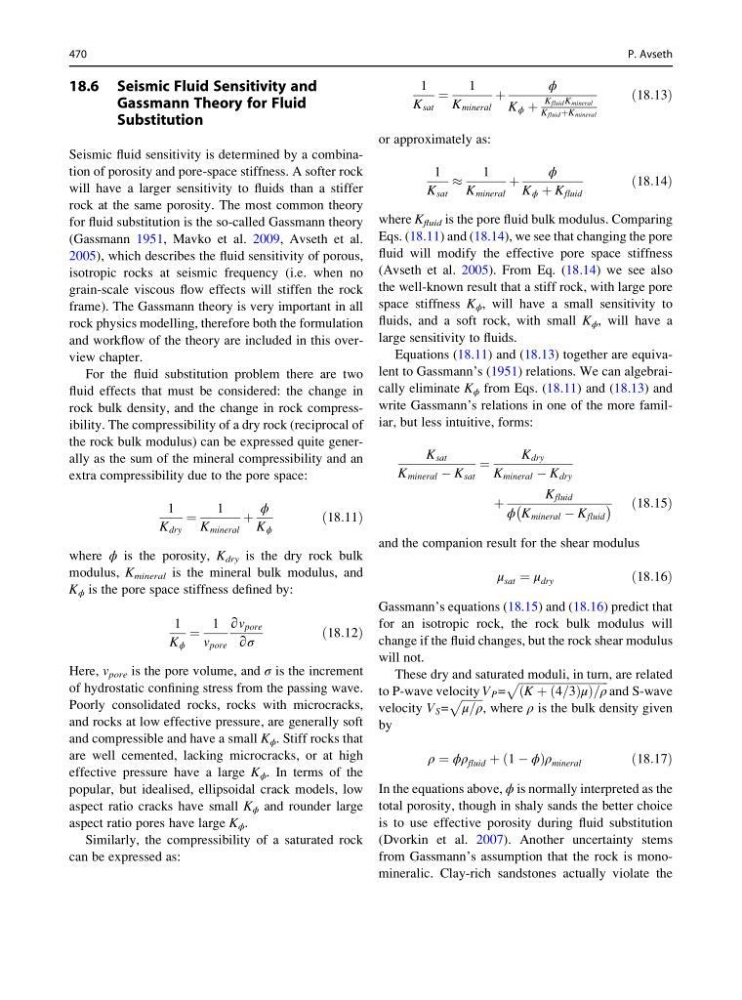
where K fluid is the pore fluid bulk modulus. Comparing
Eqs. (18.11) and (18.14), we see that changing the pore
fluid will modify the effective pore space stiffness
(Avseth et al. 2005). From Eq. (18.14) we see also
the well-known result that a stiff rock, with large pore
space stiffness K ϕ , will have a small sensitivity to
fluids, and a soft rock, with small K ϕ , will have a
large sensitivity to fluids.
Equations (18.11) and (18.13) together are equivalent to Gassmann’s (1951) relations. We can algebraically eliminate K ϕ from Eqs. (18.11) and (18.13) and
write Gassmann’s relations in one of the more familiar, but less intuitive, forms:
K sat
K mineral À K sat
¼
K dry
K mineral À K dry
þ
K fluid
ϕ K mineral À K fluid
À
Á ð18:15Þ
and the companion result for the shear modulus
μ sat ¼ μ dry
ð18:16Þ
Gassmann’s equations (18.15) and (18.16) predict that
for an isotropic rock, the rock bulk modulus will
change if the fluid changes, but the rock shear modulus
will not.
These dry and saturated moduli, in turn, are related
to P-wave velocity V P =
ffiffiffiffiffiffiffiffiffiffiffiffiffiffiffiffiffiffiffiffiffiffiffiffiffiffiffiffiffiffiffi ffi
K þ 4=3
ð
Þμ
ð
Þ =ρ
p
and S-wave
velocity V S =
ffiffiffiffiffiffiffi ffi
μ=ρ
p
, where ρ is the bulk density given
by
ρ ¼ ϕρ fluid þ 1 À ϕ
ð
Þρ mineral
ð18:17Þ
In the equations above, ϕ is normally interpreted as the
total porosity, though in shaly sands the better choice
is to use effective porosity during fluid substitution
(Dvorkin et al. 2007). Another uncertainty stems
from Gassmann’s assumption that the rock is monomineralic. Clay-rich sandstones actually violate the
470
P. Avseth
Gassmann Theory for Fluid
Substitution
Seismic fluid sensitivity is determined by a combination of porosity and pore-space stiffness. A softer rock
will have a larger sensitivity to fluids than a stiffer
rock at the same porosity. The most common theory
for fluid substitution is the so-called Gassmann theory
(Gassmann 1951, Mavko et al. 2009, Avseth et al.
2005), which describes the fluid sensitivity of porous,
isotropic rocks at seismic frequency (i.e. when no
grain-scale viscous flow effects will stiffen the rock
frame). The Gassmann theory is very important in all
rock physics modelling, therefore both the formulation
and workflow of the theory are included in this overview chapter.
For the fluid substitution problem there are two
fluid effects that must be considered: the change in
rock bulk density, and the change in rock compressibility. The compressibility of a dry rock (reciprocal of
the rock bulk modulus) can be expressed quite generally as the sum of the mineral compressibility and an
extra compressibility due to the pore space:
1
K dry
¼
1
K mineral
þ
ϕ
K ϕ
ð18:11Þ
where ϕ is the porosity, K dry is the dry rock bulk
modulus, K mineral is the mineral bulk modulus, and
K ϕ is the pore space stiffness defined by:
1
K ϕ
¼
1
v pore
∂v pore
∂σ
ð18:12Þ
Here, v pore is the pore volume, and σ is the increment
of hydrostatic confining stress from the passing wave.
Poorly consolidated rocks, rocks with microcracks,
and rocks at low effective pressure, are generally soft
and compressible and have a small K ϕ . Stiff rocks that
are well cemented, lacking microcracks, or at high
effective pressure have a large K ϕ . In terms of the
popular, but idealised, ellipsoidal crack models, low
aspect ratio cracks have small K ϕ and rounder large
aspect ratio pores have large K ϕ .
Similarly, the compressibility of a saturated rock
can be expressed as:
1
K sat
¼
1
K mineral
þ
ϕ
K ϕ þ
K fluid K mineral
K fluid þK mineral
ð18:13Þ
or approximately as:
1
K sat
%
1
K mineral
þ
ϕ
K ϕ þ K fluid
ð18:14Þ
where K fluid is the pore fluid bulk modulus. Comparing
Eqs. (18.11) and (18.14), we see that changing the pore
fluid will modify the effective pore space stiffness
(Avseth et al. 2005). From Eq. (18.14) we see also
the well-known result that a stiff rock, with large pore
space stiffness K ϕ , will have a small sensitivity to
fluids, and a soft rock, with small K ϕ , will have a
large sensitivity to fluids.
Equations (18.11) and (18.13) together are equivalent to Gassmann’s (1951) relations. We can algebraically eliminate K ϕ from Eqs. (18.11) and (18.13) and
write Gassmann’s relations in one of the more familiar, but less intuitive, forms:
K sat
K mineral À K sat
¼
K dry
K mineral À K dry
þ
K fluid
ϕ K mineral À K fluid
À
Á ð18:15Þ
and the companion result for the shear modulus
μ sat ¼ μ dry
ð18:16Þ
Gassmann’s equations (18.15) and (18.16) predict that
for an isotropic rock, the rock bulk modulus will
change if the fluid changes, but the rock shear modulus
will not.
These dry and saturated moduli, in turn, are related
to P-wave velocity V P =
ffiffiffiffiffiffiffiffiffiffiffiffiffiffiffiffiffiffiffiffiffiffiffiffiffiffiffiffiffiffiffi ffi
K þ 4=3
ð
Þμ
ð
Þ =ρ
p
and S-wave
velocity V S =
ffiffiffiffiffiffiffi ffi
μ=ρ
p
, where ρ is the bulk density given
by
ρ ¼ ϕρ fluid þ 1 À ϕ
ð
Þρ mineral
ð18:17Þ
In the equations above, ϕ is normally interpreted as the
total porosity, though in shaly sands the better choice
is to use effective porosity during fluid substitution
(Dvorkin et al. 2007). Another uncertainty stems
from Gassmann’s assumption that the rock is monomineralic. Clay-rich sandstones actually violate the
470
P. Avseth