

the velocities for sands increase drastically as we go
from the unconsolidated regime with only mechanical
compaction to the cemented regime with predominantly chemical compaction. The onset of quartz
cement happens at about 70
C corresponding to
about 2 km burial depth, in accordance with the observations made in Fig. 18.8, and as documented from
thin-section analysis (Fig. 18.9).
We apply the Shale Compaction Model (Dræge
et al. 2006, Ruud et al. 2003) to estimate the anisotropic effective properties in mechanically compacted
shales. The first seismically important mineral reaction in shales is commonly the smectite to illite reaction. This reaction has several implications for the
shale; the soft smectite is replaced by stiffer illite,
which might be distributed differently in the rock,
the reaction produces water, the volume of solids is
decreased (i.e. illite has a denser mineral structure than
smectite), quartz is generated as a by-product, and
porosity is reduced by chemical compaction. Where
the shales lie within the chemical compaction regime,
a new set of rock physics models is applied to estimate
the seismic properties. The anisotropic version of a
Differential Effective Medium (DEM) model and Self
Consistent Approximation (SCA) are used to approximate the elongated pores and grains in shales (Hornby
et al. 1994). In the present discussion, pores in chemically compacted shales are considered to be isolated,
while the pores in the mechanical compaction regime
are connected (cf. Dræge et al. 2006). We define a
transition zone, where the properties change from the
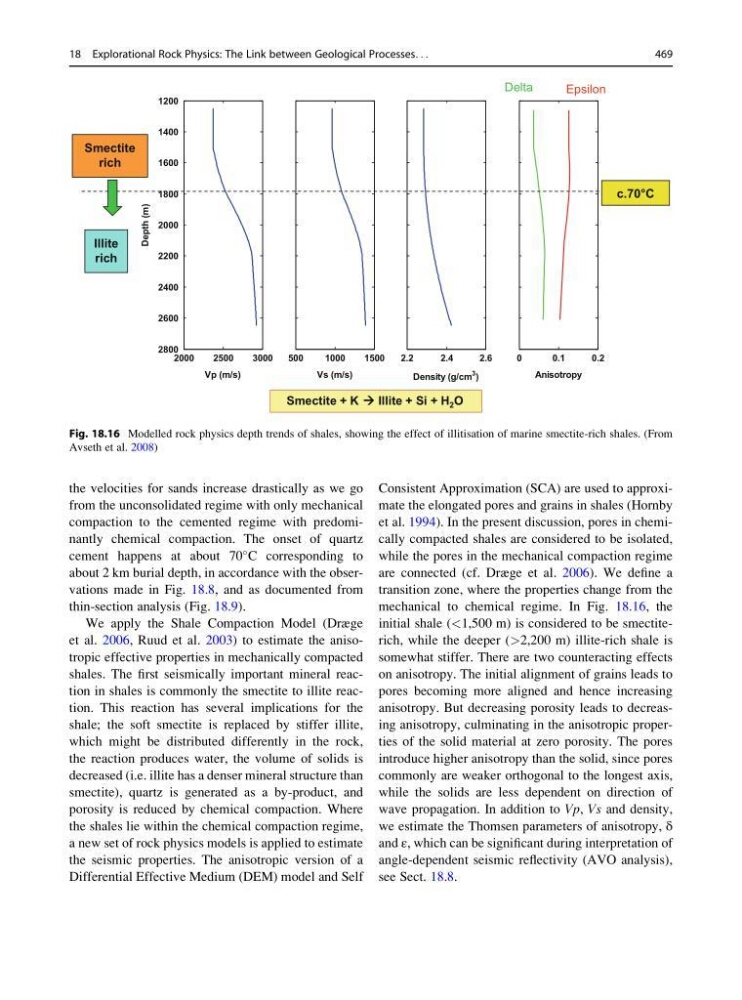
mechanical to chemical regime. In Fig. 18.16, the
initial shale (<1,500 m) is considered to be smectiterich, while the deeper (>2,200 m) illite-rich shale is
somewhat stiffer. There are two counteracting effects
on anisotropy. The initial alignment of grains leads to
pores becoming more aligned and hence increasing
anisotropy. But decreasing porosity leads to decreasing anisotropy, culminating in the anisotropic properties of the solid material at zero porosity. The pores
introduce higher anisotropy than the solid, since pores
commonly are weaker orthogonal to the longest axis,
while the solids are less dependent on direction of
wave propagation. In addition to Vp, Vs and density,
we estimate the Thomsen parameters of anisotropy, δ
and ε, which can be significant during interpretation of
angle-dependent seismic reflectivity (AVO analysis),
see Sect. 18.8.
2000
2500
3000
1200
1400
1600
1800
2000
2200
2400
2600
2800
Vp (m/s)
Depth (m)
500
1000
1500
Vs (m/s)
2.2
2.4
2.6
Density (g/cm
3 )
0
0.1
0.2
Anisotropy
Epsilon
Delta
Smectite
rich
Illite
rich
c.70°C
Smectite + K
Illite + Si + H 2 O
Fig. 18.16 Modelled rock physics depth trends of shales, showing the effect of illitisation of marine smectite-rich shales. (From
Avseth et al. 2008)
18 Explorational Rock Physics: The Link between Geological Processes. . .
469
from the unconsolidated regime with only mechanical
compaction to the cemented regime with predominantly chemical compaction. The onset of quartz
cement happens at about 70
C corresponding to
about 2 km burial depth, in accordance with the observations made in Fig. 18.8, and as documented from
thin-section analysis (Fig. 18.9).
We apply the Shale Compaction Model (Dræge
et al. 2006, Ruud et al. 2003) to estimate the anisotropic effective properties in mechanically compacted
shales. The first seismically important mineral reaction in shales is commonly the smectite to illite reaction. This reaction has several implications for the
shale; the soft smectite is replaced by stiffer illite,
which might be distributed differently in the rock,
the reaction produces water, the volume of solids is
decreased (i.e. illite has a denser mineral structure than
smectite), quartz is generated as a by-product, and
porosity is reduced by chemical compaction. Where
the shales lie within the chemical compaction regime,
a new set of rock physics models is applied to estimate
the seismic properties. The anisotropic version of a
Differential Effective Medium (DEM) model and Self
Consistent Approximation (SCA) are used to approximate the elongated pores and grains in shales (Hornby
et al. 1994). In the present discussion, pores in chemically compacted shales are considered to be isolated,
while the pores in the mechanical compaction regime
are connected (cf. Dræge et al. 2006). We define a
transition zone, where the properties change from the
mechanical to chemical regime. In Fig. 18.16, the
initial shale (<1,500 m) is considered to be smectiterich, while the deeper (>2,200 m) illite-rich shale is
somewhat stiffer. There are two counteracting effects
on anisotropy. The initial alignment of grains leads to
pores becoming more aligned and hence increasing
anisotropy. But decreasing porosity leads to decreasing anisotropy, culminating in the anisotropic properties of the solid material at zero porosity. The pores
introduce higher anisotropy than the solid, since pores
commonly are weaker orthogonal to the longest axis,
while the solids are less dependent on direction of
wave propagation. In addition to Vp, Vs and density,
we estimate the Thomsen parameters of anisotropy, δ
and ε, which can be significant during interpretation of
angle-dependent seismic reflectivity (AVO analysis),
see Sect. 18.8.
2000
2500
3000
1200
1400
1600
1800
2000
2200
2400
2600
2800
Vp (m/s)
Depth (m)
500
1000
1500
Vs (m/s)
2.2
2.4
2.6
Density (g/cm
3 )
0
0.1
0.2
Anisotropy
Epsilon
Delta
Smectite
rich
Illite
rich
c.70°C
Smectite + K
Illite + Si + H 2 O
Fig. 18.16 Modelled rock physics depth trends of shales, showing the effect of illitisation of marine smectite-rich shales. (From
Avseth et al. 2008)
18 Explorational Rock Physics: The Link between Geological Processes. . .
469