

2007, Mondol et al. 2007, Marcussen et al. 2009). As
with sands, we can distinguish between depositional
and diagenetic trends in shales. Depositional trends
will affect clay mineralogy, but more particularly,
the silt content will have great impact on the seismic
properties. Avseth et al. (2005) used simple isotropic
lower Reuss bound to model vertical velocities of silty
shales. More rigorous anisotropic modelling of shales
has been performed by Hornby et al. (1994), Ruud
et al. (2003), Johansen et al. (2002) and Dræge et al.
(2006), among others.
One of the fundamental aspects of this chapter is to
establish a link between rock physics and sedimentology. More specifically, we want to relate lithofacies to
rock physics properties. This will improve our ability
to use seismic amplitude information to interpret
depositional systems, as facies have a major control
on depositional geometries and porosity distributions.
Furthermore, facies occur in predictable patterns in
terms of their lateral and vertical distribution, and
can also be linked to sedimentary processes. Hence,
facies represent an important parameter in seismic
exploration and reservoir characterisation.
Avseth et al. (2001a) defined seismic lithofacies as
a seismic-scale sedimentary unit which is characterised by its lithology (sand, silt and clay), bedding
configuration (massive, interbedded or chaotic),
petrography (grain size, clay location and cementation) and seismic properties (P-wave velocity, Swave velocity, and density). Using the concept that
seismic lithofacies represent seismic-scale sedimentary units, we can improve our lateral facies prediction, as we can link facies observed in vertical well
logs to seismic attribute maps in accordance with
Walther’s law of facies (e.g. Middleton 1973).
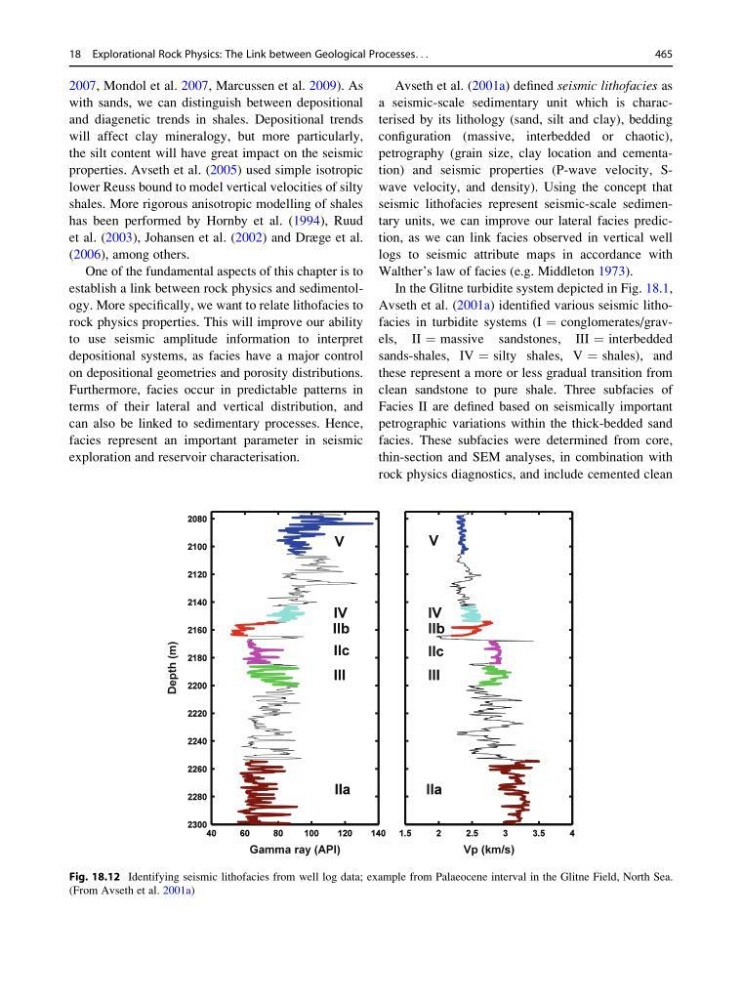
In the Glitne turbidite system depicted in Fig. 18.1,
Avseth et al. (2001a) identified various seismic lithofacies in turbidite systems (I ¼ conglomerates/gravels, II ¼ massive sandstones, III ¼ interbedded
sands-shales, IV ¼ silty shales, V ¼ shales), and
these represent a more or less gradual transition from
clean sandstone to pure shale. Three subfacies of
Facies II are defined based on seismically important
petrographic variations within the thick-bedded sand
facies. These subfacies were determined from core,
thin-section and SEM analyses, in combination with
rock physics diagnostics, and include cemented clean
Fig. 18.12 Identifying seismic lithofacies from well log data; example from Palaeocene interval in the Glitne Field, North Sea.
(From Avseth et al. 2001a)
18 Explorational Rock Physics: The Link between Geological Processes. . .
465
with sands, we can distinguish between depositional
and diagenetic trends in shales. Depositional trends
will affect clay mineralogy, but more particularly,
the silt content will have great impact on the seismic
properties. Avseth et al. (2005) used simple isotropic
lower Reuss bound to model vertical velocities of silty
shales. More rigorous anisotropic modelling of shales
has been performed by Hornby et al. (1994), Ruud
et al. (2003), Johansen et al. (2002) and Dræge et al.
(2006), among others.
One of the fundamental aspects of this chapter is to
establish a link between rock physics and sedimentology. More specifically, we want to relate lithofacies to
rock physics properties. This will improve our ability
to use seismic amplitude information to interpret
depositional systems, as facies have a major control
on depositional geometries and porosity distributions.
Furthermore, facies occur in predictable patterns in
terms of their lateral and vertical distribution, and
can also be linked to sedimentary processes. Hence,
facies represent an important parameter in seismic
exploration and reservoir characterisation.
Avseth et al. (2001a) defined seismic lithofacies as
a seismic-scale sedimentary unit which is characterised by its lithology (sand, silt and clay), bedding
configuration (massive, interbedded or chaotic),
petrography (grain size, clay location and cementation) and seismic properties (P-wave velocity, Swave velocity, and density). Using the concept that
seismic lithofacies represent seismic-scale sedimentary units, we can improve our lateral facies prediction, as we can link facies observed in vertical well
logs to seismic attribute maps in accordance with
Walther’s law of facies (e.g. Middleton 1973).
In the Glitne turbidite system depicted in Fig. 18.1,
Avseth et al. (2001a) identified various seismic lithofacies in turbidite systems (I ¼ conglomerates/gravels, II ¼ massive sandstones, III ¼ interbedded
sands-shales, IV ¼ silty shales, V ¼ shales), and
these represent a more or less gradual transition from
clean sandstone to pure shale. Three subfacies of
Facies II are defined based on seismically important
petrographic variations within the thick-bedded sand
facies. These subfacies were determined from core,
thin-section and SEM analyses, in combination with
rock physics diagnostics, and include cemented clean
Fig. 18.12 Identifying seismic lithofacies from well log data; example from Palaeocene interval in the Glitne Field, North Sea.
(From Avseth et al. 2001a)
18 Explorational Rock Physics: The Link between Geological Processes. . .
465