

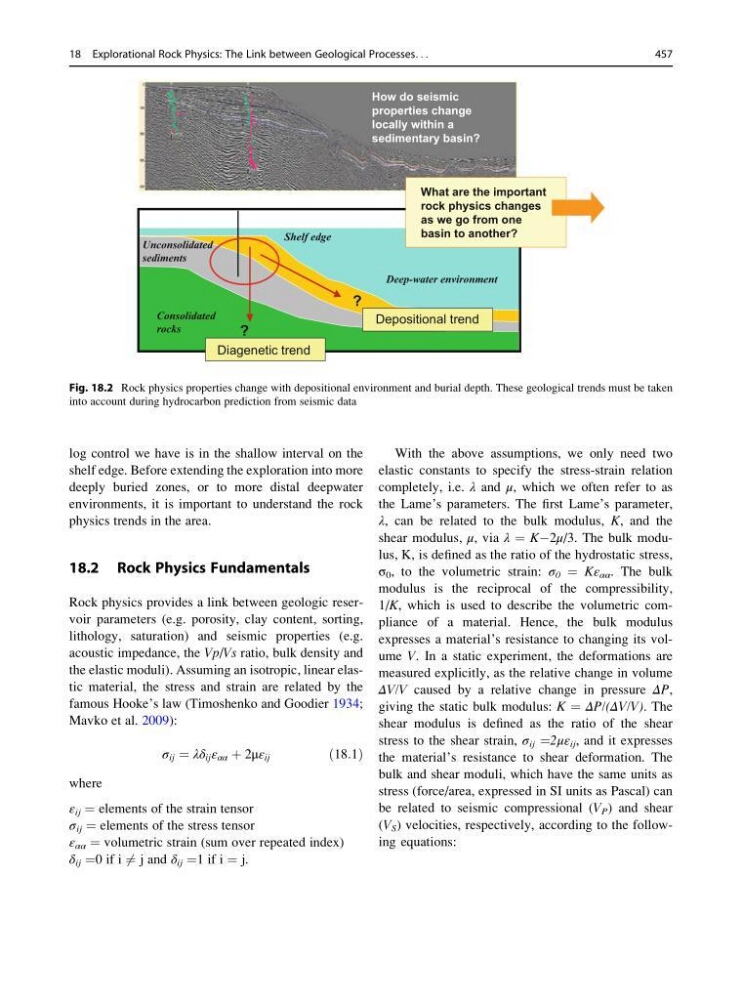
log control we have is in the shallow interval on the
shelf edge. Before extending the exploration into more
deeply buried zones, or to more distal deepwater
environments, it is important to understand the rock
physics trends in the area.
18.2 Rock Physics Fundamentals
Rock physics provides a link between geologic reservoir parameters (e.g. porosity, clay content, sorting,
lithology, saturation) and seismic properties (e.g.
acoustic impedance, the Vp/Vs ratio, bulk density and
the elastic moduli). Assuming an isotropic, linear elastic material, the stress and strain are related by the
famous Hooke’s law (Timoshenko and Goodier 1934;
Mavko et al. 2009):
σ ij ¼ λδ ij ε αα þ 2με ij
ð18:1Þ
where
ε ij ¼ elements of the strain tensor
σ ij ¼ elements of the stress tensor
ε αα ¼ volumetric strain (sum over repeated index)
δ ij ¼0 if i 6 ¼ j and δ ij ¼1 if i ¼ j.
With the above assumptions, we only need two
elastic constants to specify the stress-strain relation
completely, i.e. λ and μ, which we often refer to as
the Lame’s parameters. The first Lame’s parameter,
λ, can be related to the bulk modulus, K, and the
shear modulus, μ, via λ ¼ KÀ2μ/3. The bulk modulus, K, is defined as the ratio of the hydrostatic stress,
σ 0 , to the volumetric strain: σ 0 ¼ Kε αα . The bulk
modulus is the reciprocal of the compressibility,
1/K, which is used to describe the volumetric compliance of a material. Hence, the bulk modulus
expresses a material’s resistance to changing its volume V. In a static experiment, the deformations are
measured explicitly, as the relative change in volume
ΔV/V caused by a relative change in pressure ΔP,
giving the static bulk modulus: K ¼ ΔP/(ΔV/V). The
shear modulus is defined as the ratio of the shear
stress to the shear strain, σ ij ¼2με ij , and it expresses
the material’s resistance to shear deformation. The
bulk and shear moduli, which have the same units as
stress (force/area, expressed in SI units as Pascal) can
be related to seismic compressional (V P ) and shear
(V S ) velocities, respectively, according to the following equations:
Shelf edge
Deep-water environment
Consolidated
rocks
Unconsolidated
sediments
?
Diagenetic trend
?
Depositional trend
How do seismic
properties change
locally within a
sedimentary basin?
What are the important
rock physics changes
as we go from one
basin to another?
Fig. 18.2 Rock physics properties change with depositional environment and burial depth. These geological trends must be taken
into account during hydrocarbon prediction from seismic data
18 Explorational Rock Physics: The Link between Geological Processes. . .
457
shelf edge. Before extending the exploration into more
deeply buried zones, or to more distal deepwater
environments, it is important to understand the rock
physics trends in the area.
18.2 Rock Physics Fundamentals
Rock physics provides a link between geologic reservoir parameters (e.g. porosity, clay content, sorting,
lithology, saturation) and seismic properties (e.g.
acoustic impedance, the Vp/Vs ratio, bulk density and
the elastic moduli). Assuming an isotropic, linear elastic material, the stress and strain are related by the
famous Hooke’s law (Timoshenko and Goodier 1934;
Mavko et al. 2009):
σ ij ¼ λδ ij ε αα þ 2με ij
ð18:1Þ
where
ε ij ¼ elements of the strain tensor
σ ij ¼ elements of the stress tensor
ε αα ¼ volumetric strain (sum over repeated index)
δ ij ¼0 if i 6 ¼ j and δ ij ¼1 if i ¼ j.
With the above assumptions, we only need two
elastic constants to specify the stress-strain relation
completely, i.e. λ and μ, which we often refer to as
the Lame’s parameters. The first Lame’s parameter,
λ, can be related to the bulk modulus, K, and the
shear modulus, μ, via λ ¼ KÀ2μ/3. The bulk modulus, K, is defined as the ratio of the hydrostatic stress,
σ 0 , to the volumetric strain: σ 0 ¼ Kε αα . The bulk
modulus is the reciprocal of the compressibility,
1/K, which is used to describe the volumetric compliance of a material. Hence, the bulk modulus
expresses a material’s resistance to changing its volume V. In a static experiment, the deformations are
measured explicitly, as the relative change in volume
ΔV/V caused by a relative change in pressure ΔP,
giving the static bulk modulus: K ¼ ΔP/(ΔV/V). The
shear modulus is defined as the ratio of the shear
stress to the shear strain, σ ij ¼2με ij , and it expresses
the material’s resistance to shear deformation. The
bulk and shear moduli, which have the same units as
stress (force/area, expressed in SI units as Pascal) can
be related to seismic compressional (V P ) and shear
(V S ) velocities, respectively, according to the following equations:
Shelf edge
Deep-water environment
Consolidated
rocks
Unconsolidated
sediments
?
Diagenetic trend
?
Depositional trend
How do seismic
properties change
locally within a
sedimentary basin?
What are the important
rock physics changes
as we go from one
basin to another?
Fig. 18.2 Rock physics properties change with depositional environment and burial depth. These geological trends must be taken
into account during hydrocarbon prediction from seismic data
18 Explorational Rock Physics: The Link between Geological Processes. . .
457