

one. The limit of seismic resolution usually makes us
wonder, how thin a bed can we see? Normally we
think of resolution in the vertical sense, but there is
also a limit to the horizontal width of an object that we
can interpret from seismic data.
17.6.1 Horizontal Resolution
The horizontal dimension of seismic resolution is
described by the Fresnel zone. The Fresnel zone is a
frequency and range dependent area of a reflector from
which most of the energy of a reflection is returned and
arrival times differ by less than half a period from the
first break (Fig. 17.27). Waves with such arrival times
will interfere constructively and so be detected as a
single arrival. Subsurface features smaller than the
Fresnel zone usually cannot be detected using seismic
waves. At spacing greater than one-quarter of the
wavelength, the event begins to be resolvable as two
separate events. Migration can improve lateral resolution by reducing the size of the Fresnel zone. For a
plane reflecting interface and coincident source and
receiver, the Fresnel zone will be circular and with a
radius of R f is
R f ¼
ffiffiffiffiffi
λZ
2
r
(17.6)
where λ is the dominant wavelength and Z is the depth
down to the target surface. Horizontal resolution
depends on the frequency and velocity of seismic
waves. If we introduce the centre frequency f c of the
pulse (i.e. representing the most energetic part), we
have λ % V=f c , with V being the wave velocity. Hence,
we can rewrite the formula for the Fresnel zone as
R f ¼
ffiffiffiffiffiffi
VZ
2f c
s
(17.7)
17.6.2 Vertical Resolution
Vertical resolution is the ability to separate two
features that are close together. A seismic wave can
be considered as a propagating energy pulse. If such a
a
b
1
2
3
4
5
6
3 km
3 km
Time [s]
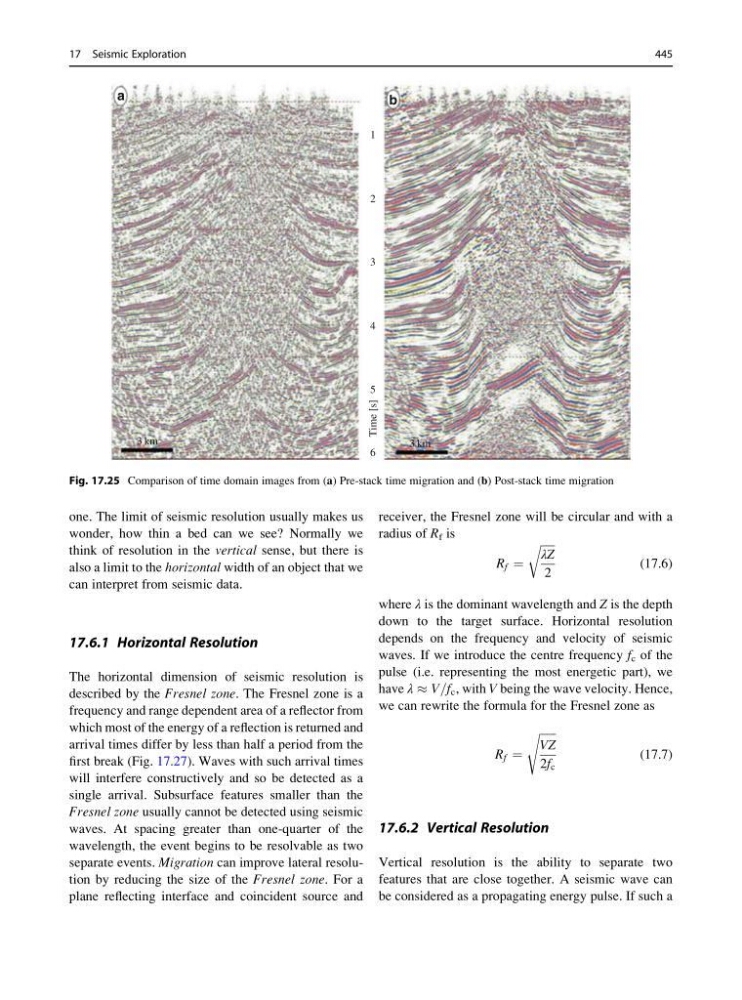
Fig. 17.25 Comparison of time domain images from (a) Pre-stack time migration and (b) Post-stack time migration
17 Seismic Exploration
445
wonder, how thin a bed can we see? Normally we
think of resolution in the vertical sense, but there is
also a limit to the horizontal width of an object that we
can interpret from seismic data.
17.6.1 Horizontal Resolution
The horizontal dimension of seismic resolution is
described by the Fresnel zone. The Fresnel zone is a
frequency and range dependent area of a reflector from
which most of the energy of a reflection is returned and
arrival times differ by less than half a period from the
first break (Fig. 17.27). Waves with such arrival times
will interfere constructively and so be detected as a
single arrival. Subsurface features smaller than the
Fresnel zone usually cannot be detected using seismic
waves. At spacing greater than one-quarter of the
wavelength, the event begins to be resolvable as two
separate events. Migration can improve lateral resolution by reducing the size of the Fresnel zone. For a
plane reflecting interface and coincident source and
receiver, the Fresnel zone will be circular and with a
radius of R f is
R f ¼
ffiffiffiffiffi
λZ
2
r
(17.6)
where λ is the dominant wavelength and Z is the depth
down to the target surface. Horizontal resolution
depends on the frequency and velocity of seismic
waves. If we introduce the centre frequency f c of the
pulse (i.e. representing the most energetic part), we
have λ % V=f c , with V being the wave velocity. Hence,
we can rewrite the formula for the Fresnel zone as
R f ¼
ffiffiffiffiffiffi
VZ
2f c
s
(17.7)
17.6.2 Vertical Resolution
Vertical resolution is the ability to separate two
features that are close together. A seismic wave can
be considered as a propagating energy pulse. If such a
a
b
1
2
3
4
5
6
3 km
3 km
Time [s]
Fig. 17.25 Comparison of time domain images from (a) Pre-stack time migration and (b) Post-stack time migration
17 Seismic Exploration
445