

17.4.6 Permanent Seismic Monitoring
Permanent seismic monitoring is becoming an important tool in the reservoir management toolkit. It is a 4C
fiber-optic advanced seismic acquisition technology
that is installed permanently on the seabed over a
producing field (Fig. 17.18). It reduces acquisition
time and cost. Permanent seismic monitoring helps to
improve data quality by employing more accurate
survey orientation and acquisition geometry (receiver
locations) within the repeated 3D seismic surveys
compared to conventional OBS 4D survey. Such a
method is important in monitoring a reservoir injection process employed to enhance recovery from a
producing reservoir.
17.5 Seismic Processing
Seismic technology has achieved amazing feats in
exploration and production activities in the past few
decades. What we record in the acquisition stage is
Fig. 17.16 Land seismic acquisition
7.00
6.50
Time (sec.)
Time (sec.)
6.00
5.50
5.00
4.50
3.75
3.50
3.25
3.00
2.75
2.50
2.25
Conventional 3D data
S
N
3 km
1/9-3R
1/9-1
1/9-3R
1/9-1
X-component
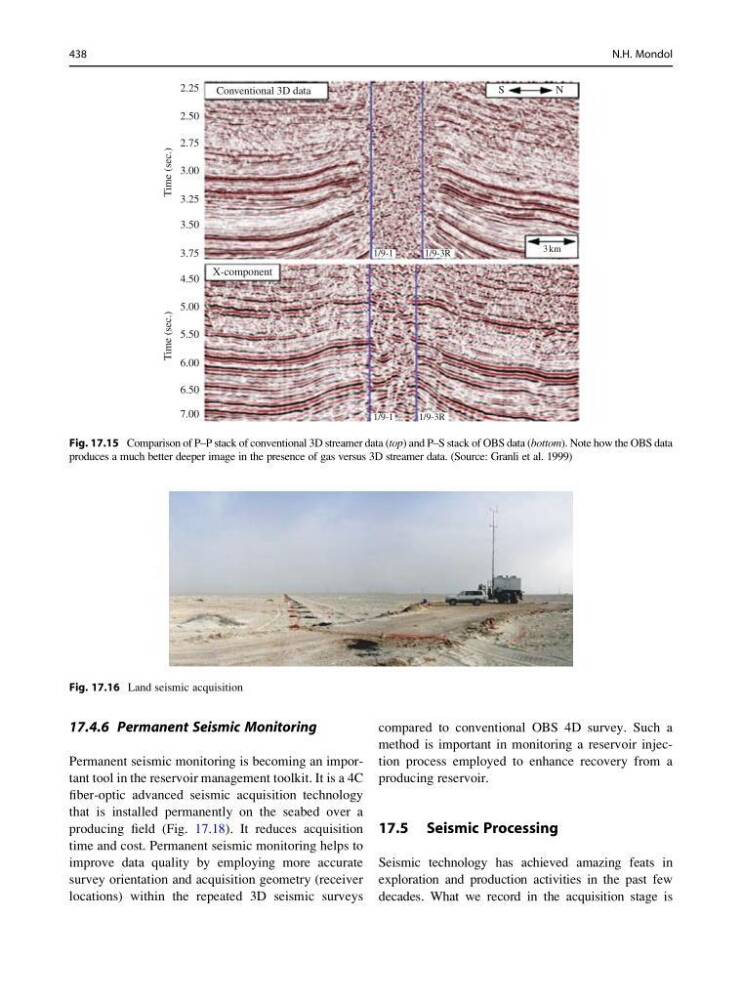
Fig. 17.15 Comparison of P–P stack of conventional 3D streamer data (top) and P–S stack of OBS data (bottom). Note how the OBS data
produces a much better deeper image in the presence of gas versus 3D streamer data. (Source: Granli et al. 1999)
438
N.H. Mondol
Permanent seismic monitoring is becoming an important tool in the reservoir management toolkit. It is a 4C
fiber-optic advanced seismic acquisition technology
that is installed permanently on the seabed over a
producing field (Fig. 17.18). It reduces acquisition
time and cost. Permanent seismic monitoring helps to
improve data quality by employing more accurate
survey orientation and acquisition geometry (receiver
locations) within the repeated 3D seismic surveys
compared to conventional OBS 4D survey. Such a
method is important in monitoring a reservoir injection process employed to enhance recovery from a
producing reservoir.
17.5 Seismic Processing
Seismic technology has achieved amazing feats in
exploration and production activities in the past few
decades. What we record in the acquisition stage is
Fig. 17.16 Land seismic acquisition
7.00
6.50
Time (sec.)
Time (sec.)
6.00
5.50
5.00
4.50
3.75
3.50
3.25
3.00
2.75
2.50
2.25
Conventional 3D data
S
N
3 km
1/9-3R
1/9-1
1/9-3R
1/9-1
X-component
Fig. 17.15 Comparison of P–P stack of conventional 3D streamer data (top) and P–S stack of OBS data (bottom). Note how the OBS data
produces a much better deeper image in the presence of gas versus 3D streamer data. (Source: Granli et al. 1999)
438
N.H. Mondol