

they are deployed. VSP uses the reflected energy
contained in the recorded trace at each receiver position as well as the first direct path from source to
receiver. VSPs include the zero-offset VSP, offset
VSP, walkaway VSP, walk-above VSP, salt-proximity
VSP, shear-wave VSP, and drill-noise or seismicwhile-drilling VSP.
17.4.5 4D Seismic
The acquisition of 4D or time-lapse seismic has
opened new horizons for monitoring reservoir
properties such as fluids, temperature, saturation and
pressure changes during the productive life of a field
(Aronsen et al. 2004). 4D seismic is based on the
analysis of repeated 3D seismic data. The differences
in seismic attributes over time are caused by changes
in pore fluid and pore pressure associated with the
drainage of a reservoir under production. Detection
of areas with significant changes or with virtually
unchanged hydrocarbon-indicating attributes helps to
determine new drilling sites in an already existing
production field. For this method it is critical that the
observed seismic changes can be related to the fluid
flow. Differences in data acquisition, survey orientation, processing and data quality can introduce significant noise in a 4D analysis. Hence, such differences
must be corrected for as best as possible. Further
details of 4D seismic are discussed in Chap. 19. The
known applications of 4D seismic can be summarised
as:
(1) Monitoring the spatial extent of steam injection
used for thermal recovery.
(2) Monitoring the spatial extent of the injected water
front used for secondary recovery.
(3) Imaging bypassed oil or gas.
(4) Determining the flow properties of sealing or
leaking faults.
(5) Detecting changes in oil-water contact.
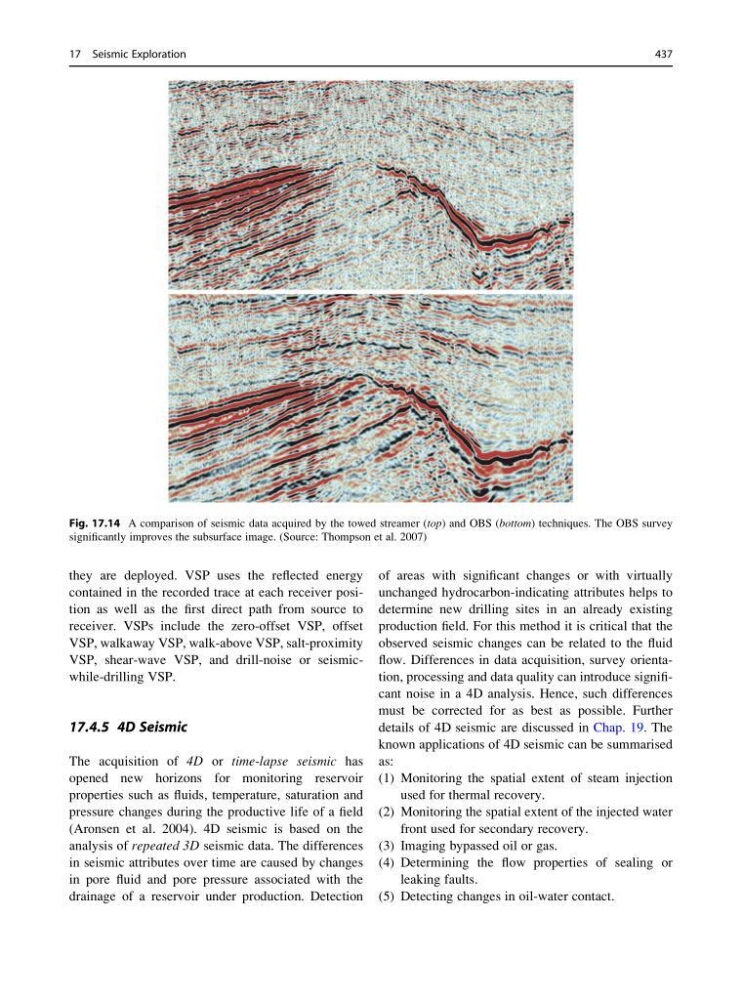
Fig. 17.14 A comparison of seismic data acquired by the towed streamer (top) and OBS (bottom) techniques. The OBS survey
significantly improves the subsurface image. (Source: Thompson et al. 2007)
17 Seismic Exploration
437
contained in the recorded trace at each receiver position as well as the first direct path from source to
receiver. VSPs include the zero-offset VSP, offset
VSP, walkaway VSP, walk-above VSP, salt-proximity
VSP, shear-wave VSP, and drill-noise or seismicwhile-drilling VSP.
17.4.5 4D Seismic
The acquisition of 4D or time-lapse seismic has
opened new horizons for monitoring reservoir
properties such as fluids, temperature, saturation and
pressure changes during the productive life of a field
(Aronsen et al. 2004). 4D seismic is based on the
analysis of repeated 3D seismic data. The differences
in seismic attributes over time are caused by changes
in pore fluid and pore pressure associated with the
drainage of a reservoir under production. Detection
of areas with significant changes or with virtually
unchanged hydrocarbon-indicating attributes helps to
determine new drilling sites in an already existing
production field. For this method it is critical that the
observed seismic changes can be related to the fluid
flow. Differences in data acquisition, survey orientation, processing and data quality can introduce significant noise in a 4D analysis. Hence, such differences
must be corrected for as best as possible. Further
details of 4D seismic are discussed in Chap. 19. The
known applications of 4D seismic can be summarised
as:
(1) Monitoring the spatial extent of steam injection
used for thermal recovery.
(2) Monitoring the spatial extent of the injected water
front used for secondary recovery.
(3) Imaging bypassed oil or gas.
(4) Determining the flow properties of sealing or
leaking faults.
(5) Detecting changes in oil-water contact.
Fig. 17.14 A comparison of seismic data acquired by the towed streamer (top) and OBS (bottom) techniques. The OBS survey
significantly improves the subsurface image. (Source: Thompson et al. 2007)
17 Seismic Exploration
437