

important phenomenon and caused by three major
factors: (a) Geometric spreading: progressive diminution of amplitude (proportional to the inverse of propagation distance) caused by the increase in wavefront
area, (b) Intrinsic attenuation: energy losses due to
internal friction and (c) Transmission losses: reduction
in wave amplitude due to reflection at interfaces.
17.4.1 Terminology Used in Seismic
Acquisition
A Trace is a seismic time measurement corresponding
to one source-receiver pair, and offset is the distance
between source and receiver for a given trace. In
practice, traces from one source are simultaneously
recorded at several receivers. Then, sources and
receivers are moved along the survey line and another
set of recordings is made. When a seismic wave travels
from a source to a reflector and then back to receiver,
the elapsed time is called the two-way traveltime. The
common depth point (CDP) is the halfway point of the
path only where the Earth is horizontally layered; it is
situated vertically below the common midpoint
(CMP). A gather is a family of traces (e.g. shot-point
gather is the family of all traces corresponding to the
same source firing). Sorting of traces by collecting
traces that have the same midpoint (CMP) is called a
common midpoint gather (CMP-gather). The number
of traces summed or stacked is called a fold. For
instance, in 24-fold data, every stacked trace
represents the average of 24 traces. The nominal fold
(F) is the maximum number of traces in a CMPgather. For a standard marine seismic acquisition
folds (F) is given by the formula:
F ¼
NΔg
2Δs
(17.4)
where N is the number of channels, Δg is the group
interval and Δs is the source interval. The rate of
repetition of complete wavelengths of seismic waves
is referred to as frequency (f) and is measured in cycles
per second or hertz.
17.4.2 Marine Acquisition
Marine seismic acquisition is generally accomplished
using large ships with one or multiple air-gun arrays
for sources (Fig. 17.10). Air-guns are deployed behind
the seismic vessel and generate a seismic signal by
forcing highly pressurised air into the water at a given
interval. Receivers are towed behind the ship in one or
several long streamer(s) that are several kilometres
long. Marine receivers are composed of piezoelectric
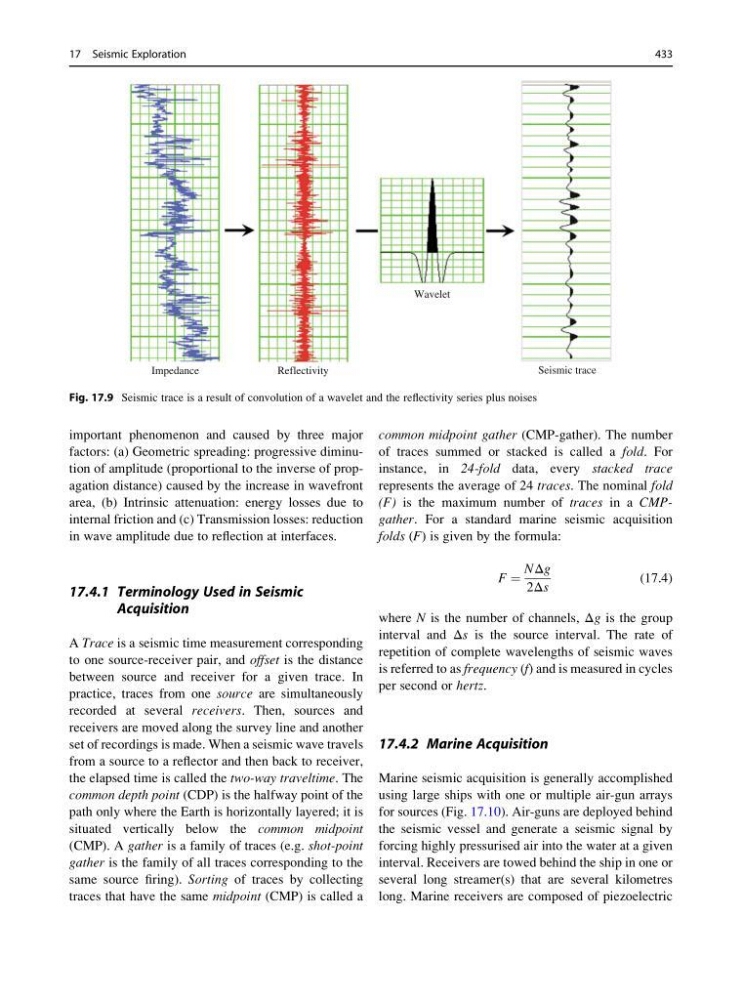
Impedance
Reflectivity
Wavelet
Seismic trace
Fig. 17.9 Seismic trace is a result of convolution of a wavelet and the reflectivity series plus noises
17 Seismic Exploration
433
factors: (a) Geometric spreading: progressive diminution of amplitude (proportional to the inverse of propagation distance) caused by the increase in wavefront
area, (b) Intrinsic attenuation: energy losses due to
internal friction and (c) Transmission losses: reduction
in wave amplitude due to reflection at interfaces.
17.4.1 Terminology Used in Seismic
Acquisition
A Trace is a seismic time measurement corresponding
to one source-receiver pair, and offset is the distance
between source and receiver for a given trace. In
practice, traces from one source are simultaneously
recorded at several receivers. Then, sources and
receivers are moved along the survey line and another
set of recordings is made. When a seismic wave travels
from a source to a reflector and then back to receiver,
the elapsed time is called the two-way traveltime. The
common depth point (CDP) is the halfway point of the
path only where the Earth is horizontally layered; it is
situated vertically below the common midpoint
(CMP). A gather is a family of traces (e.g. shot-point
gather is the family of all traces corresponding to the
same source firing). Sorting of traces by collecting
traces that have the same midpoint (CMP) is called a
common midpoint gather (CMP-gather). The number
of traces summed or stacked is called a fold. For
instance, in 24-fold data, every stacked trace
represents the average of 24 traces. The nominal fold
(F) is the maximum number of traces in a CMPgather. For a standard marine seismic acquisition
folds (F) is given by the formula:
F ¼
NΔg
2Δs
(17.4)
where N is the number of channels, Δg is the group
interval and Δs is the source interval. The rate of
repetition of complete wavelengths of seismic waves
is referred to as frequency (f) and is measured in cycles
per second or hertz.
17.4.2 Marine Acquisition
Marine seismic acquisition is generally accomplished
using large ships with one or multiple air-gun arrays
for sources (Fig. 17.10). Air-guns are deployed behind
the seismic vessel and generate a seismic signal by
forcing highly pressurised air into the water at a given
interval. Receivers are towed behind the ship in one or
several long streamer(s) that are several kilometres
long. Marine receivers are composed of piezoelectric
Impedance
Reflectivity
Wavelet
Seismic trace
Fig. 17.9 Seismic trace is a result of convolution of a wavelet and the reflectivity series plus noises
17 Seismic Exploration
433