

(3C) geophone is used for direct measurements of
shear waves at the seafloor. An essential feature of a
seafloor seismic acquisition is the four-component
(4C) detector unit, which includes a hydrophone and
a three-component (3C) geophone (Fig. 17.7c). The
hydrophone and the vertical geophone measure pressure waves, whereas the two extra horizontal
geophones measure particle velocity associated with
shear wave energy.
17.4 Seismic Acquisition
The seismic survey is an essential part of the whole
cycle of petroleum exploration and production. Seismic surveys are carried out on land and in transition
zone, shallow marine and marine environments in
different ways. The basic principle is an impulse
source such as dynamite, air-gun or vibrator that
sends acoustic energy into the Earth. This energy
propagates in many directions. Downward travelling
energy reflects and refracts when it encounters
boundaries between two layers with different acoustic
properties (Fig. 17.3). Sensors or geophones placed on
the surface measure the reflected acoustic energy,
converting it into an electrical signal that is displayed
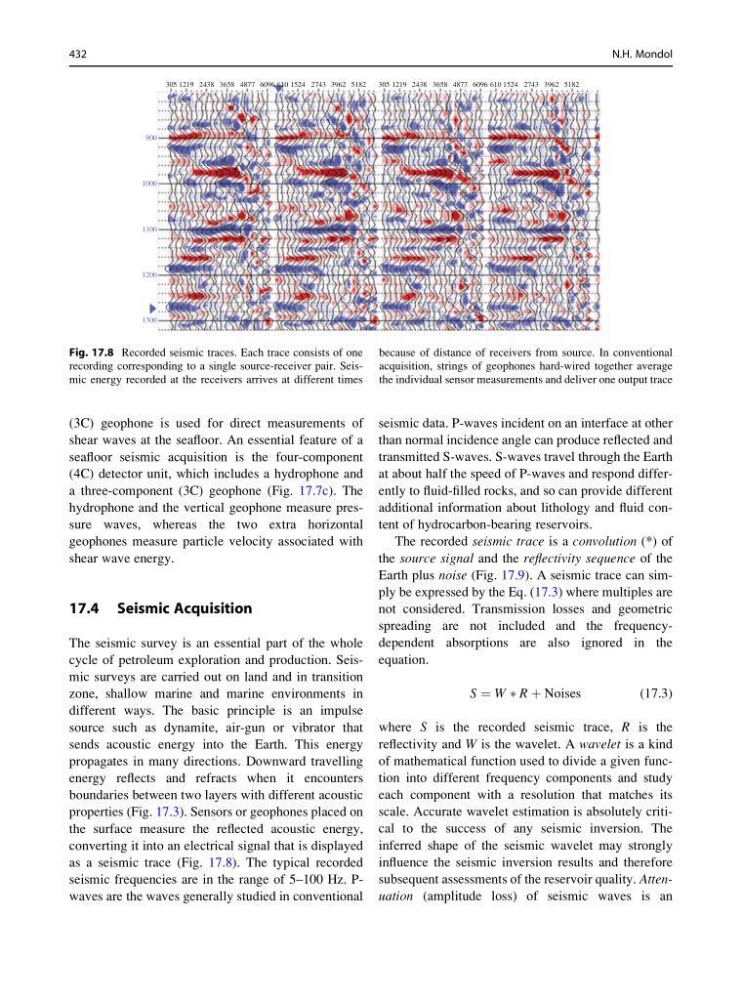
as a seismic trace (Fig. 17.8). The typical recorded
seismic frequencies are in the range of 5–100 Hz. Pwaves are the waves generally studied in conventional
seismic data. P-waves incident on an interface at other
than normal incidence angle can produce reflected and
transmitted S-waves. S-waves travel through the Earth
at about half the speed of P-waves and respond differently to fluid-filled rocks, and so can provide different
additional information about lithology and fluid content of hydrocarbon-bearing reservoirs.
The recorded seismic trace is a convolution (*) of
the source signal and the reflectivity sequence of the
Earth plus noise (Fig. 17.9). A seismic trace can simply be expressed by the Eq. (17.3) where multiples are
not considered. Transmission losses and geometric
spreading are not included and the frequencydependent absorptions are also ignored in the
equation.
S ¼ W Ã R þ Noises
(17.3)
where S is the recorded seismic trace, R is the
reflectivity and W is the wavelet. A wavelet is a kind
of mathematical function used to divide a given function into different frequency components and study
each component with a resolution that matches its
scale. Accurate wavelet estimation is absolutely critical to the success of any seismic inversion. The
inferred shape of the seismic wavelet may strongly
influence the seismic inversion results and therefore
subsequent assessments of the reservoir quality. Attenuation (amplitude loss) of seismic waves is an
1300
1200
1100
1000
900
305 1219 2438 3658 4877 6096 610 1524 2743 3962 5182
305 1219 2438 3658 4877 6096 610 1524 2743 3962 5182
Fig. 17.8 Recorded seismic traces. Each trace consists of one
recording corresponding to a single source-receiver pair. Seismic energy recorded at the receivers arrives at different times
because of distance of receivers from source. In conventional
acquisition, strings of geophones hard-wired together average
the individual sensor measurements and deliver one output trace
432
N.H. Mondol
shear waves at the seafloor. An essential feature of a
seafloor seismic acquisition is the four-component
(4C) detector unit, which includes a hydrophone and
a three-component (3C) geophone (Fig. 17.7c). The
hydrophone and the vertical geophone measure pressure waves, whereas the two extra horizontal
geophones measure particle velocity associated with
shear wave energy.
17.4 Seismic Acquisition
The seismic survey is an essential part of the whole
cycle of petroleum exploration and production. Seismic surveys are carried out on land and in transition
zone, shallow marine and marine environments in
different ways. The basic principle is an impulse
source such as dynamite, air-gun or vibrator that
sends acoustic energy into the Earth. This energy
propagates in many directions. Downward travelling
energy reflects and refracts when it encounters
boundaries between two layers with different acoustic
properties (Fig. 17.3). Sensors or geophones placed on
the surface measure the reflected acoustic energy,
converting it into an electrical signal that is displayed
as a seismic trace (Fig. 17.8). The typical recorded
seismic frequencies are in the range of 5–100 Hz. Pwaves are the waves generally studied in conventional
seismic data. P-waves incident on an interface at other
than normal incidence angle can produce reflected and
transmitted S-waves. S-waves travel through the Earth
at about half the speed of P-waves and respond differently to fluid-filled rocks, and so can provide different
additional information about lithology and fluid content of hydrocarbon-bearing reservoirs.
The recorded seismic trace is a convolution (*) of
the source signal and the reflectivity sequence of the
Earth plus noise (Fig. 17.9). A seismic trace can simply be expressed by the Eq. (17.3) where multiples are
not considered. Transmission losses and geometric
spreading are not included and the frequencydependent absorptions are also ignored in the
equation.
S ¼ W Ã R þ Noises
(17.3)
where S is the recorded seismic trace, R is the
reflectivity and W is the wavelet. A wavelet is a kind
of mathematical function used to divide a given function into different frequency components and study
each component with a resolution that matches its
scale. Accurate wavelet estimation is absolutely critical to the success of any seismic inversion. The
inferred shape of the seismic wavelet may strongly
influence the seismic inversion results and therefore
subsequent assessments of the reservoir quality. Attenuation (amplitude loss) of seismic waves is an
1300
1200
1100
1000
900
305 1219 2438 3658 4877 6096 610 1524 2743 3962 5182
305 1219 2438 3658 4877 6096 610 1524 2743 3962 5182
Fig. 17.8 Recorded seismic traces. Each trace consists of one
recording corresponding to a single source-receiver pair. Seismic energy recorded at the receivers arrives at different times
because of distance of receivers from source. In conventional
acquisition, strings of geophones hard-wired together average
the individual sensor measurements and deliver one output trace
432
N.H. Mondol