

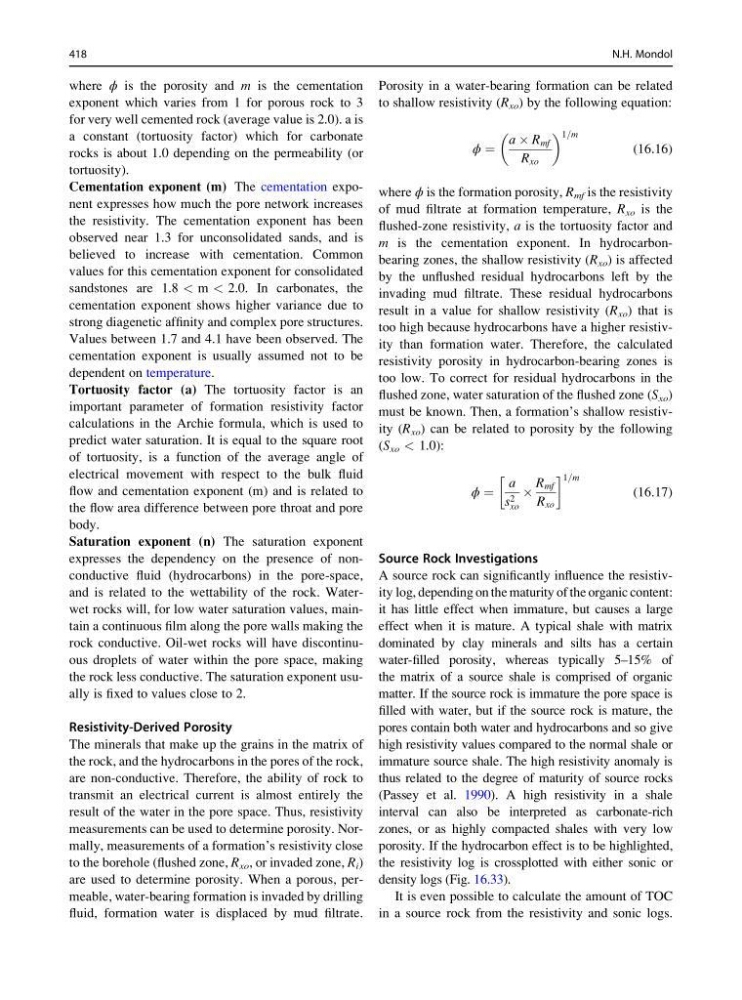
where ϕ is the porosity and m is the cementation
exponent which varies from 1 for porous rock to 3
for very well cemented rock (average value is 2.0). a is
a constant (tortuosity factor) which for carbonate
rocks is about 1.0 depending on the permeability (or
tortuosity).
Cementation exponent (m) The cementation exponent expresses how much the pore network increases
the resistivity. The cementation exponent has been
observed near 1.3 for unconsolidated sands, and is
believed to increase with cementation. Common
values for this cementation exponent for consolidated
sandstones are 1.8 < m < 2.0. In carbonates, the
cementation exponent shows higher variance due to
strong diagenetic affinity and complex pore structures.
Values between 1.7 and 4.1 have been observed. The
cementation exponent is usually assumed not to be
dependent on temperature.
Tortuosity factor (a) The tortuosity factor is an
important parameter of formation resistivity factor
calculations in the Archie formula, which is used to
predict water saturation. It is equal to the square root
of tortuosity, is a function of the average angle of
electrical movement with respect to the bulk fluid
flow and cementation exponent (m) and is related to
the flow area difference between pore throat and pore
body.
Saturation exponent (n) The saturation exponent
expresses the dependency on the presence of nonconductive fluid (hydrocarbons) in the pore-space,
and is related to the wettability of the rock. Waterwet rocks will, for low water saturation values, maintain a continuous film along the pore walls making the
rock conductive. Oil-wet rocks will have discontinuous droplets of water within the pore space, making
the rock less conductive. The saturation exponent usually is fixed to values close to 2.
Resistivity-Derived Porosity
The minerals that make up the grains in the matrix of
the rock, and the hydrocarbons in the pores of the rock,
are non-conductive. Therefore, the ability of rock to
transmit an electrical current is almost entirely the
result of the water in the pore space. Thus, resistivity
measurements can be used to determine porosity. Normally, measurements of a formation’s resistivity close
to the borehole (flushed zone, R xo , or invaded zone, R i )
are used to determine porosity. When a porous, permeable, water-bearing formation is invaded by drilling
fluid, formation water is displaced by mud filtrate.
Porosity in a water-bearing formation can be related
to shallow resistivity (R xo ) by the following equation:
ϕ ¼
a  R mf
R xo
1=m
(16.16)
where ϕ is the formation porosity, R mf is the resistivity
of mud filtrate at formation temperature, R xo is the
flushed-zone resistivity, a is the tortuosity factor and
m is the cementation exponent. In hydrocarbonbearing zones, the shallow resistivity (R xo ) is affected
by the unflushed residual hydrocarbons left by the
invading mud filtrate. These residual hydrocarbons
result in a value for shallow resistivity (R xo ) that is
too high because hydrocarbons have a higher resistivity than formation water. Therefore, the calculated
resistivity porosity in hydrocarbon-bearing zones is
too low. To correct for residual hydrocarbons in the
flushed zone, water saturation of the flushed zone (S xo )
must be known. Then, a formation’s shallow resistivity (R xo ) can be related to porosity by the following
(S xo < 1.0):
ϕ ¼
a
s 2
xo
Â
R mf
R xo
! 1=m
(16.17)
Source Rock Investigations
A source rock can significantly influence the resistivity log, depending on the maturity of the organic content:
it has little effect when immature, but causes a large
effect when it is mature. A typical shale with matrix
dominated by clay minerals and silts has a certain
water-filled porosity, whereas typically 5–15% of
the matrix of a source shale is comprised of organic
matter. If the source rock is immature the pore space is
filled with water, but if the source rock is mature, the
pores contain both water and hydrocarbons and so give
high resistivity values compared to the normal shale or
immature source shale. The high resistivity anomaly is
thus related to the degree of maturity of source rocks
(Passey et al. 1990). A high resistivity in a shale
interval can also be interpreted as carbonate-rich
zones, or as highly compacted shales with very low
porosity. If the hydrocarbon effect is to be highlighted,
the resistivity log is crossplotted with either sonic or
density logs (Fig. 16.33).
It is even possible to calculate the amount of TOC
in a source rock from the resistivity and sonic logs.
418
N.H. Mondol
exponent which varies from 1 for porous rock to 3
for very well cemented rock (average value is 2.0). a is
a constant (tortuosity factor) which for carbonate
rocks is about 1.0 depending on the permeability (or
tortuosity).
Cementation exponent (m) The cementation exponent expresses how much the pore network increases
the resistivity. The cementation exponent has been
observed near 1.3 for unconsolidated sands, and is
believed to increase with cementation. Common
values for this cementation exponent for consolidated
sandstones are 1.8 < m < 2.0. In carbonates, the
cementation exponent shows higher variance due to
strong diagenetic affinity and complex pore structures.
Values between 1.7 and 4.1 have been observed. The
cementation exponent is usually assumed not to be
dependent on temperature.
Tortuosity factor (a) The tortuosity factor is an
important parameter of formation resistivity factor
calculations in the Archie formula, which is used to
predict water saturation. It is equal to the square root
of tortuosity, is a function of the average angle of
electrical movement with respect to the bulk fluid
flow and cementation exponent (m) and is related to
the flow area difference between pore throat and pore
body.
Saturation exponent (n) The saturation exponent
expresses the dependency on the presence of nonconductive fluid (hydrocarbons) in the pore-space,
and is related to the wettability of the rock. Waterwet rocks will, for low water saturation values, maintain a continuous film along the pore walls making the
rock conductive. Oil-wet rocks will have discontinuous droplets of water within the pore space, making
the rock less conductive. The saturation exponent usually is fixed to values close to 2.
Resistivity-Derived Porosity
The minerals that make up the grains in the matrix of
the rock, and the hydrocarbons in the pores of the rock,
are non-conductive. Therefore, the ability of rock to
transmit an electrical current is almost entirely the
result of the water in the pore space. Thus, resistivity
measurements can be used to determine porosity. Normally, measurements of a formation’s resistivity close
to the borehole (flushed zone, R xo , or invaded zone, R i )
are used to determine porosity. When a porous, permeable, water-bearing formation is invaded by drilling
fluid, formation water is displaced by mud filtrate.
Porosity in a water-bearing formation can be related
to shallow resistivity (R xo ) by the following equation:
ϕ ¼
a  R mf
R xo
1=m
(16.16)
where ϕ is the formation porosity, R mf is the resistivity
of mud filtrate at formation temperature, R xo is the
flushed-zone resistivity, a is the tortuosity factor and
m is the cementation exponent. In hydrocarbonbearing zones, the shallow resistivity (R xo ) is affected
by the unflushed residual hydrocarbons left by the
invading mud filtrate. These residual hydrocarbons
result in a value for shallow resistivity (R xo ) that is
too high because hydrocarbons have a higher resistivity than formation water. Therefore, the calculated
resistivity porosity in hydrocarbon-bearing zones is
too low. To correct for residual hydrocarbons in the
flushed zone, water saturation of the flushed zone (S xo )
must be known. Then, a formation’s shallow resistivity (R xo ) can be related to porosity by the following
(S xo < 1.0):
ϕ ¼
a
s 2
xo
Â
R mf
R xo
! 1=m
(16.17)
Source Rock Investigations
A source rock can significantly influence the resistivity log, depending on the maturity of the organic content:
it has little effect when immature, but causes a large
effect when it is mature. A typical shale with matrix
dominated by clay minerals and silts has a certain
water-filled porosity, whereas typically 5–15% of
the matrix of a source shale is comprised of organic
matter. If the source rock is immature the pore space is
filled with water, but if the source rock is mature, the
pores contain both water and hydrocarbons and so give
high resistivity values compared to the normal shale or
immature source shale. The high resistivity anomaly is
thus related to the degree of maturity of source rocks
(Passey et al. 1990). A high resistivity in a shale
interval can also be interpreted as carbonate-rich
zones, or as highly compacted shales with very low
porosity. If the hydrocarbon effect is to be highlighted,
the resistivity log is crossplotted with either sonic or
density logs (Fig. 16.33).
It is even possible to calculate the amount of TOC
in a source rock from the resistivity and sonic logs.
418
N.H. Mondol