

water-bearing zones. Because the rock’s matrix or
grains are non-conductive and any hydrocarbons in the
pores are also non-conductive, the ability of the rock to
transmit a current is almost entirely a function of formation brine in the pores. As the hydrocarbon saturation
of the pores increases (causing the water saturation to
decrease), the formation’s resistivity increases. As the
salinity of the water in the pores decreases (as R w
increases), the rock’s resistivity also increases.
When sufficient quantities of hydrocarbons are
present, the deep resistivity (ILD) will show extremely
high resistivity because of the high saturation in
hydrocarbons (Fig. 16.32). When hydrocarbons are
present, the borehole environment becomes three
phase and much more complex compared to a water
zone. The freshwater mud will replace the
hydrocarbons immediately around the borehole,
essentially replacing them through the flushed and
invaded zones, while the original hydrocarbon saturation is only found in the uninvaded (virgin) zone.
Determination of Water Saturation (S w )
Archie’s law laid the foundation for modern well log
interpretation as it relates borehole electrical resistivity measurements to hydrocarbon saturations. It is a
purely empirical law attempting to describe flow in
clean, consolidated sandstones, with varying intergranular porosity. Archie’s law relates the in-situ electrical resistivity of a rock to its porosity and brine
saturation and is expressed by the following equation:
R t ¼ aϕ
Àm S
Àn
w R w
(16.11)
S w
a  R w
R t  ϕ
m
1=n
(16.12)
where S w is the water saturation, a is the tortuosity
factor, m is the cementation exponent (usually in the
range 1.8–2.0 for sandstones), n is the saturation exponent (usually close to 2), R w is the resistivity of formation water, ϕ is the porosity and R t is the true
formation resistivity as derived from a deep resistivity
log (e.g. ILD). A geoscientist, by knowing (or determining) several parameters (F, a, m, and n described in
the following paragraphs), and by determining from
logs the porosity (ϕ), formation water resistivity (R w )
and true formation resistivity (R t ), can determine the
formation’s water saturation (S w ) using the Archie
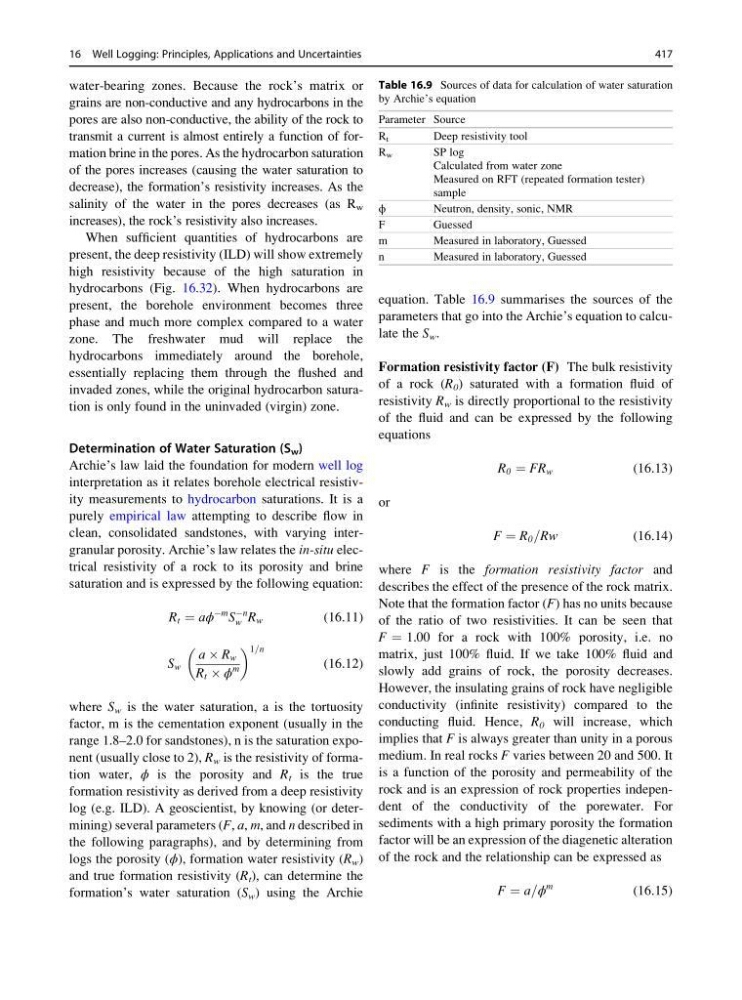
equation. Table 16.9 summarises the sources of the
parameters that go into the Archie’s equation to calculate the S w .
Formation resistivity factor (F) The bulk resistivity
of a rock (R 0 ) saturated with a formation fluid of
resistivity R w is directly proportional to the resistivity
of the fluid and can be expressed by the following
equations
R 0 ¼ FR w
(16.13)
or
F ¼ R 0 =Rw
(16.14)
where F is the formation resistivity factor and
describes the effect of the presence of the rock matrix.
Note that the formation factor (F) has no units because
of the ratio of two resistivities. It can be seen that
F ¼ 1.00 for a rock with 100% porosity, i.e. no
matrix, just 100% fluid. If we take 100% fluid and
slowly add grains of rock, the porosity decreases.
However, the insulating grains of rock have negligible
conductivity (infinite resistivity) compared to the
conducting fluid. Hence, R 0 will increase, which
implies that F is always greater than unity in a porous
medium. In real rocks F varies between 20 and 500. It
is a function of the porosity and permeability of the
rock and is an expression of rock properties independent of the conductivity of the porewater. For
sediments with a high primary porosity the formation
factor will be an expression of the diagenetic alteration
of the rock and the relationship can be expressed as
F ¼ a=ϕ
m
(16.15)
Table 16.9 Sources of data for calculation of water saturation
by Archie’s equation
Parameter Source
R t
Deep resistivity tool
R w
SP log
Calculated from water zone
Measured on RFT (repeated formation tester)
sample
ϕ
Neutron, density, sonic, NMR
F
Guessed
m
Measured in laboratory, Guessed
n
Measured in laboratory, Guessed
16 Well Logging: Principles, Applications and Uncertainties
417
grains are non-conductive and any hydrocarbons in the
pores are also non-conductive, the ability of the rock to
transmit a current is almost entirely a function of formation brine in the pores. As the hydrocarbon saturation
of the pores increases (causing the water saturation to
decrease), the formation’s resistivity increases. As the
salinity of the water in the pores decreases (as R w
increases), the rock’s resistivity also increases.
When sufficient quantities of hydrocarbons are
present, the deep resistivity (ILD) will show extremely
high resistivity because of the high saturation in
hydrocarbons (Fig. 16.32). When hydrocarbons are
present, the borehole environment becomes three
phase and much more complex compared to a water
zone. The freshwater mud will replace the
hydrocarbons immediately around the borehole,
essentially replacing them through the flushed and
invaded zones, while the original hydrocarbon saturation is only found in the uninvaded (virgin) zone.
Determination of Water Saturation (S w )
Archie’s law laid the foundation for modern well log
interpretation as it relates borehole electrical resistivity measurements to hydrocarbon saturations. It is a
purely empirical law attempting to describe flow in
clean, consolidated sandstones, with varying intergranular porosity. Archie’s law relates the in-situ electrical resistivity of a rock to its porosity and brine
saturation and is expressed by the following equation:
R t ¼ aϕ
Àm S
Àn
w R w
(16.11)
S w
a  R w
R t  ϕ
m
1=n
(16.12)
where S w is the water saturation, a is the tortuosity
factor, m is the cementation exponent (usually in the
range 1.8–2.0 for sandstones), n is the saturation exponent (usually close to 2), R w is the resistivity of formation water, ϕ is the porosity and R t is the true
formation resistivity as derived from a deep resistivity
log (e.g. ILD). A geoscientist, by knowing (or determining) several parameters (F, a, m, and n described in
the following paragraphs), and by determining from
logs the porosity (ϕ), formation water resistivity (R w )
and true formation resistivity (R t ), can determine the
formation’s water saturation (S w ) using the Archie
equation. Table 16.9 summarises the sources of the
parameters that go into the Archie’s equation to calculate the S w .
Formation resistivity factor (F) The bulk resistivity
of a rock (R 0 ) saturated with a formation fluid of
resistivity R w is directly proportional to the resistivity
of the fluid and can be expressed by the following
equations
R 0 ¼ FR w
(16.13)
or
F ¼ R 0 =Rw
(16.14)
where F is the formation resistivity factor and
describes the effect of the presence of the rock matrix.
Note that the formation factor (F) has no units because
of the ratio of two resistivities. It can be seen that
F ¼ 1.00 for a rock with 100% porosity, i.e. no
matrix, just 100% fluid. If we take 100% fluid and
slowly add grains of rock, the porosity decreases.
However, the insulating grains of rock have negligible
conductivity (infinite resistivity) compared to the
conducting fluid. Hence, R 0 will increase, which
implies that F is always greater than unity in a porous
medium. In real rocks F varies between 20 and 500. It
is a function of the porosity and permeability of the
rock and is an expression of rock properties independent of the conductivity of the porewater. For
sediments with a high primary porosity the formation
factor will be an expression of the diagenetic alteration
of the rock and the relationship can be expressed as
F ¼ a=ϕ
m
(16.15)
Table 16.9 Sources of data for calculation of water saturation
by Archie’s equation
Parameter Source
R t
Deep resistivity tool
R w
SP log
Calculated from water zone
Measured on RFT (repeated formation tester)
sample
ϕ
Neutron, density, sonic, NMR
F
Guessed
m
Measured in laboratory, Guessed
n
Measured in laboratory, Guessed
16 Well Logging: Principles, Applications and Uncertainties
417