

16.5.7.2 Uses of Resistivity and Conductivity
Logs
Resistivity/conductivity measurements have immense
value for detection and quantitative evaluation of
hydrocarbon productive zones and correlation of geological strata. High resistivity values may indicate a
hydrocarbon-bearing formation. Oil and gas have far
higher resistivity than water, so resistivity logs can be
used to locate the contacts between oil/water (OWC),
gas/water (GWC) and gas/oil (GOC) in the reservoirs.
It also helps to determine hydrocarbon saturation.
Once we know the resistivity of the drilling mud, the
porosity of the rock can be calculated from the resistivity of that part of the rock which has been invaded
by the mud. In addition, resistivity log is also useful to
identify source rocks.
Detection of Hydrocarbon
By far the most important use of resistivity logs
is the determination of hydrocarbon-bearing versus
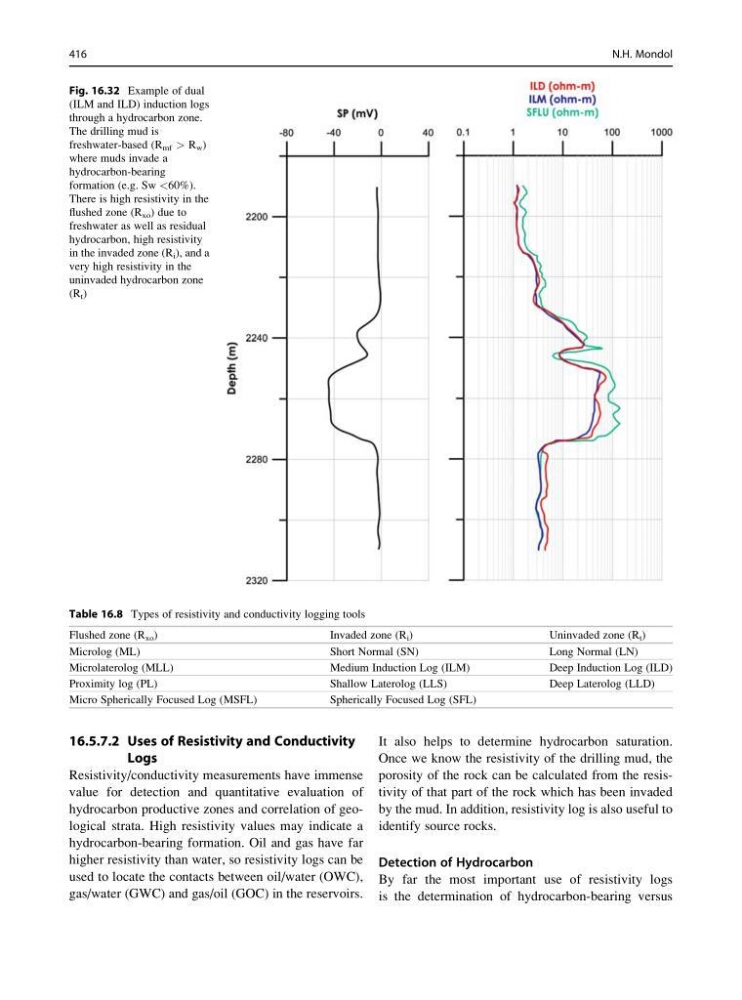
Fig. 16.32 Example of dual
(ILM and ILD) induction logs
through a hydrocarbon zone.
The drilling mud is
freshwater-based (R mf > R w )
where muds invade a
hydrocarbon-bearing
formation (e.g. Sw <60%).
There is high resistivity in the
flushed zone (R xo ) due to
freshwater as well as residual
hydrocarbon, high resistivity
in the invaded zone (R i ), and a
very high resistivity in the
uninvaded hydrocarbon zone
(R t )
Table 16.8 Types of resistivity and conductivity logging tools
Flushed zone (R xo )
Invaded zone (R i )
Uninvaded zone (R t )
Microlog (ML)
Short Normal (SN)
Long Normal (LN)
Microlaterolog (MLL)
Medium Induction Log (ILM)
Deep Induction Log (ILD)
Proximity log (PL)
Shallow Laterolog (LLS)
Deep Laterolog (LLD)
Micro Spherically Focused Log (MSFL)
Spherically Focused Log (SFL)
416
N.H. Mondol
Logs
Resistivity/conductivity measurements have immense
value for detection and quantitative evaluation of
hydrocarbon productive zones and correlation of geological strata. High resistivity values may indicate a
hydrocarbon-bearing formation. Oil and gas have far
higher resistivity than water, so resistivity logs can be
used to locate the contacts between oil/water (OWC),
gas/water (GWC) and gas/oil (GOC) in the reservoirs.
It also helps to determine hydrocarbon saturation.
Once we know the resistivity of the drilling mud, the
porosity of the rock can be calculated from the resistivity of that part of the rock which has been invaded
by the mud. In addition, resistivity log is also useful to
identify source rocks.
Detection of Hydrocarbon
By far the most important use of resistivity logs
is the determination of hydrocarbon-bearing versus
Fig. 16.32 Example of dual
(ILM and ILD) induction logs
through a hydrocarbon zone.
The drilling mud is
freshwater-based (R mf > R w )
where muds invade a
hydrocarbon-bearing
formation (e.g. Sw <60%).
There is high resistivity in the
flushed zone (R xo ) due to
freshwater as well as residual
hydrocarbon, high resistivity
in the invaded zone (R i ), and a
very high resistivity in the
uninvaded hydrocarbon zone
(R t )
Table 16.8 Types of resistivity and conductivity logging tools
Flushed zone (R xo )
Invaded zone (R i )
Uninvaded zone (R t )
Microlog (ML)
Short Normal (SN)
Long Normal (LN)
Microlaterolog (MLL)
Medium Induction Log (ILM)
Deep Induction Log (ILD)
Proximity log (PL)
Shallow Laterolog (LLS)
Deep Laterolog (LLD)
Micro Spherically Focused Log (MSFL)
Spherically Focused Log (SFL)
416
N.H. Mondol