

The quality of reservoir rocks depends on the depositional environments and the primary mineralogical
and textural composition, and on the diagentic processes that change the reservoir properties during
burial.
For sandstone reservoirs the distribution and geometry of sand is critical because much of this is below
the resolution of seismic methods, and even after drilling the information from each well has to be
extrapolated in 3 dimensions.
For this reason I have included a chapter on sedimentary structures and sedimentary facies and also on
carbonates. There are, however, many textbooks
which will give a more detailed presentation of clastic
sedimentology. To be able to predict the reservoir
properties we must understand the principles of sandstone diagenesis and this is discussed in Chapter 4.
This also involves chemical reactions driven by thermodynamics and kinetics. Reservoir quality can to a
certain extent be modelled as a part of basin
modelling, if the primary mineralogical and textural
composition is known.
Exploration and production of conventional oil has
become well established and technologies have been
refined over many years. This book will include an
introduction to geophysical methods and also 4D
seismic methods. Interpretation of geophysical data
requires that the physical properties of sedimentary
rocks are known or can be predicted. We have therefore put some emphasis on rock mechanics and rock
physics.
Unconventional oil such as heavy oil, tar sand,
shale oil and shale gas represents new challenges and
requires also different training and background from
that of the conventional petroleum geologist. The
organic chemistry of petroleum and the detailed mineralogy of the rocks become increasingly important.
Estimates of global petroleum reserves vary greatly
with time and are dependent on the price of oil and gas
and other energy sources and also on exploration and
production technology. There are also very large
reserves of oil shale e.g. the Eocene Green River
shale (in the southern US) which must be heated
before oil and gas can be extracted.
It is however clear that it is becoming more difficult
to find new reserves to compensate for production and
that there are relatively few remaining unexplored
sedimentary basins. Production of oil and gas from
80° C
Seafloor
or land
surface
Biodegraded oil/tar sand
Normal oil - little
biodegradation.
Reservoir rock
pasteurised at
temperatures >80° C
Reservoir
loose sand
Migration
of oil from
deeper
source
rocks
Sand reservoir
with some
quartz cement
Effect of heaƟng (pasteurisaƟon) of reservoir
rock prior to oil migraƟon and filling
Reservoir A may aŌer
upliŌ and erosion contain
oil which is not very much
biodegraded even at
relaƟvely shallow depth .
Reservoir B may be an
exposed tar sand.
A
B
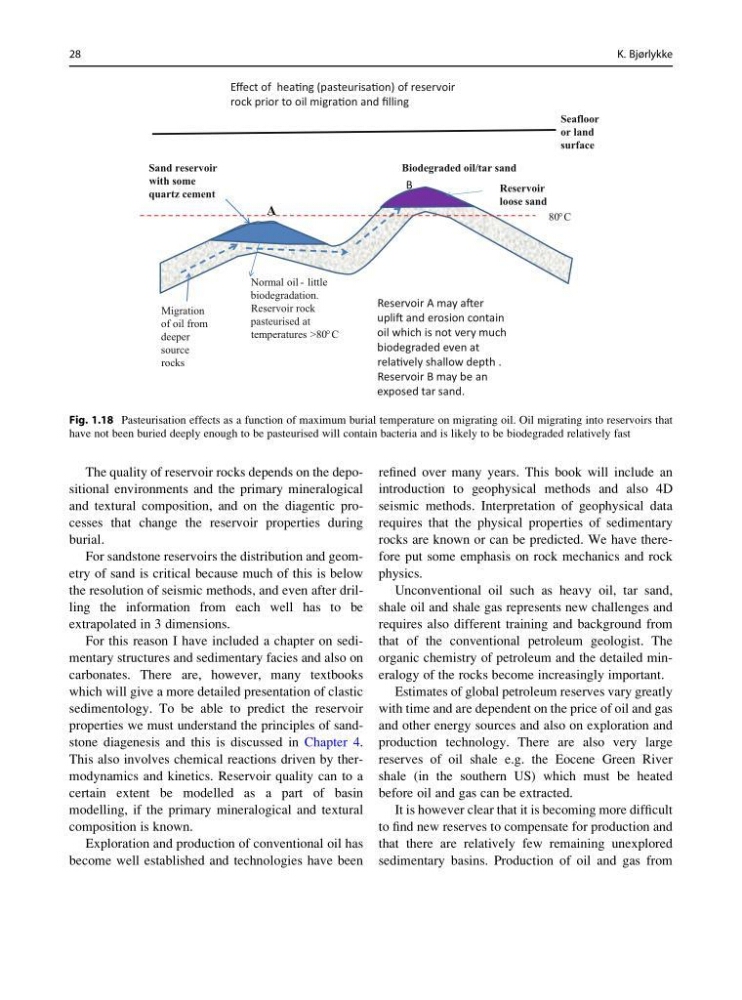
Fig. 1.18 Pasteurisation effects as a function of maximum burial temperature on migrating oil. Oil migrating into reservoirs that
have not been buried deeply enough to be pasteurised will contain bacteria and is likely to be biodegraded relatively fast
28
K. Bjørlykke
and textural composition, and on the diagentic processes that change the reservoir properties during
burial.
For sandstone reservoirs the distribution and geometry of sand is critical because much of this is below
the resolution of seismic methods, and even after drilling the information from each well has to be
extrapolated in 3 dimensions.
For this reason I have included a chapter on sedimentary structures and sedimentary facies and also on
carbonates. There are, however, many textbooks
which will give a more detailed presentation of clastic
sedimentology. To be able to predict the reservoir
properties we must understand the principles of sandstone diagenesis and this is discussed in Chapter 4.
This also involves chemical reactions driven by thermodynamics and kinetics. Reservoir quality can to a
certain extent be modelled as a part of basin
modelling, if the primary mineralogical and textural
composition is known.
Exploration and production of conventional oil has
become well established and technologies have been
refined over many years. This book will include an
introduction to geophysical methods and also 4D
seismic methods. Interpretation of geophysical data
requires that the physical properties of sedimentary
rocks are known or can be predicted. We have therefore put some emphasis on rock mechanics and rock
physics.
Unconventional oil such as heavy oil, tar sand,
shale oil and shale gas represents new challenges and
requires also different training and background from
that of the conventional petroleum geologist. The
organic chemistry of petroleum and the detailed mineralogy of the rocks become increasingly important.
Estimates of global petroleum reserves vary greatly
with time and are dependent on the price of oil and gas
and other energy sources and also on exploration and
production technology. There are also very large
reserves of oil shale e.g. the Eocene Green River
shale (in the southern US) which must be heated
before oil and gas can be extracted.
It is however clear that it is becoming more difficult
to find new reserves to compensate for production and
that there are relatively few remaining unexplored
sedimentary basins. Production of oil and gas from
80° C
Seafloor
or land
surface
Biodegraded oil/tar sand
Normal oil - little
biodegradation.
Reservoir rock
pasteurised at
temperatures >80° C
Reservoir
loose sand
Migration
of oil from
deeper
source
rocks
Sand reservoir
with some
quartz cement
Effect of heaƟng (pasteurisaƟon) of reservoir
rock prior to oil migraƟon and filling
Reservoir A may aŌer
upliŌ and erosion contain
oil which is not very much
biodegraded even at
relaƟvely shallow depth .
Reservoir B may be an
exposed tar sand.
A
B
Fig. 1.18 Pasteurisation effects as a function of maximum burial temperature on migrating oil. Oil migrating into reservoirs that
have not been buried deeply enough to be pasteurised will contain bacteria and is likely to be biodegraded relatively fast
28
K. Bjørlykke