

thermal alteration in a sedimentary basin (vitrinite
reflectivity).
1.18 Summary
In the exploration for oil and gas we need to predict the
occurrence and distribution of source rocks which is a
function of the sedimentary environment and climate
at the time of deposition. The burial history has to be
reconstructed to predict the timing of maturation and
migration. This involves modelling based on the kinetics and temperature history.
Before drilling, the position of a trap and a reservoir
rock has to be determined.
The porosity and permeability of the reservoir rock
is critical. If the porosity is 30% it may at the best
contain about 250 l of oil and 50 l of water for each m
3
of rock, and assuming 50% recovery, 125 l of oil can
be produced. If the porosity is only 15% it may contain
about 100 l of oil and the recovery may then be lower
so that less than 50 l will be produced.
Oil window
Geological time
Gas
Oil
Condensate
Tar sand
Heavy oil
Shale gas
Shallow gas
Oilshale
Organic matter - mostly algae
Surface (0)/25°C
3 km/100°C
4-5 km/150°C
6-8 km/200°C
Shale oil
Depth /Temperature
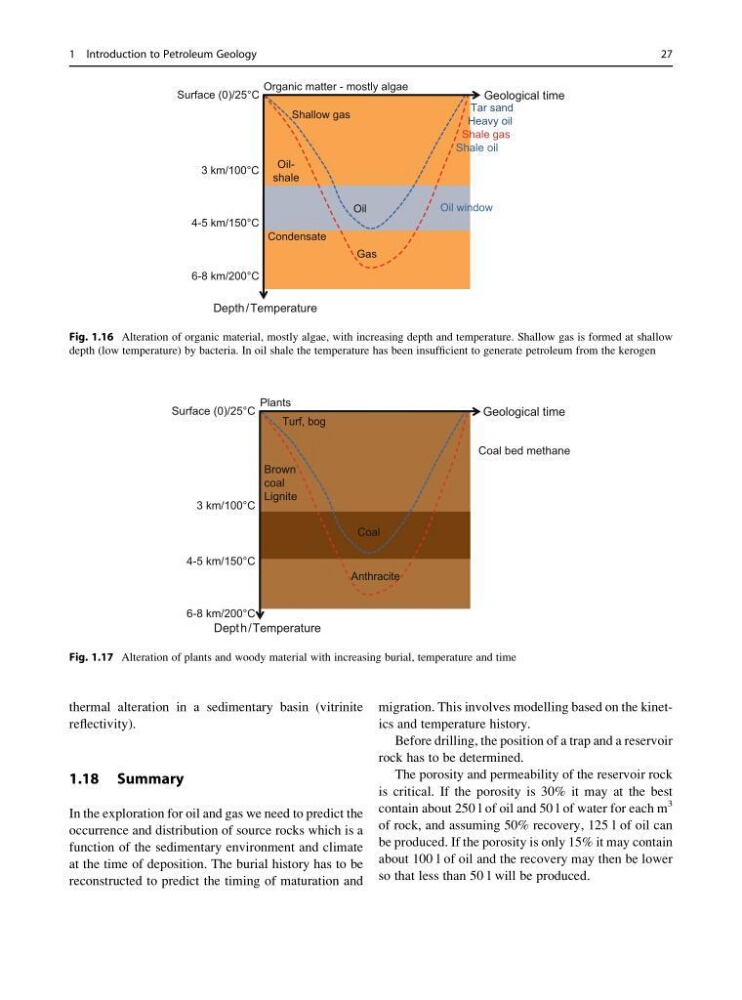
Fig. 1.16 Alteration of organic material, mostly algae, with increasing depth and temperature. Shallow gas is formed at shallow
depth (low temperature) by bacteria. In oil shale the temperature has been insufficient to generate petroleum from the kerogen
Brown
coal
Lignite
Plants
Surface (0)/25°C
3 km/100°C
6-8 km/200°C
Coal
Anthracite
Turf, bog
Coal bed methane
4-5 km/150°C
Geological time
Depth/Temperature
Fig. 1.17 Alteration of plants and woody material with increasing burial, temperature and time
1 Introduction to Petroleum Geology
27
reflectivity).
1.18 Summary
In the exploration for oil and gas we need to predict the
occurrence and distribution of source rocks which is a
function of the sedimentary environment and climate
at the time of deposition. The burial history has to be
reconstructed to predict the timing of maturation and
migration. This involves modelling based on the kinetics and temperature history.
Before drilling, the position of a trap and a reservoir
rock has to be determined.
The porosity and permeability of the reservoir rock
is critical. If the porosity is 30% it may at the best
contain about 250 l of oil and 50 l of water for each m
3
of rock, and assuming 50% recovery, 125 l of oil can
be produced. If the porosity is only 15% it may contain
about 100 l of oil and the recovery may then be lower
so that less than 50 l will be produced.
Oil window
Geological time
Gas
Oil
Condensate
Tar sand
Heavy oil
Shale gas
Shallow gas
Oilshale
Organic matter - mostly algae
Surface (0)/25°C
3 km/100°C
4-5 km/150°C
6-8 km/200°C
Shale oil
Depth /Temperature
Fig. 1.16 Alteration of organic material, mostly algae, with increasing depth and temperature. Shallow gas is formed at shallow
depth (low temperature) by bacteria. In oil shale the temperature has been insufficient to generate petroleum from the kerogen
Brown
coal
Lignite
Plants
Surface (0)/25°C
3 km/100°C
6-8 km/200°C
Coal
Anthracite
Turf, bog
Coal bed methane
4-5 km/150°C
Geological time
Depth/Temperature
Fig. 1.17 Alteration of plants and woody material with increasing burial, temperature and time
1 Introduction to Petroleum Geology
27