

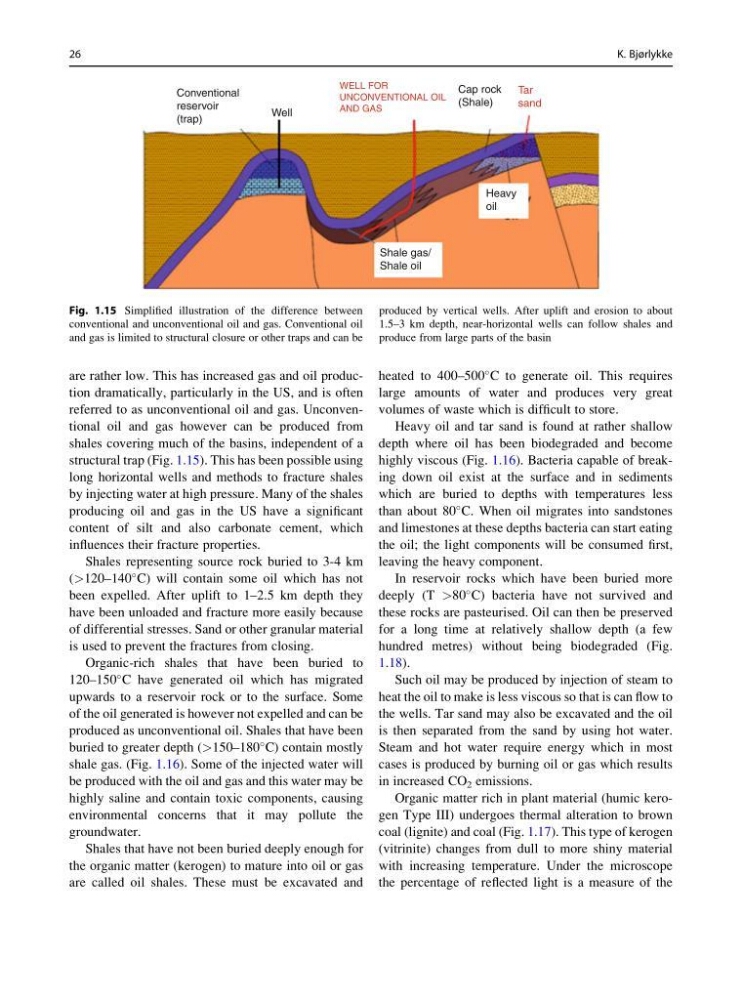
are rather low. This has increased gas and oil production dramatically, particularly in the US, and is often
referred to as unconventional oil and gas. Unconventional oil and gas however can be produced from
shales covering much of the basins, independent of a
structural trap (Fig. 1.15). This has been possible using
long horizontal wells and methods to fracture shales
by injecting water at high pressure. Many of the shales
producing oil and gas in the US have a significant
content of silt and also carbonate cement, which
influences their fracture properties.
Shales representing source rock buried to 3-4 km
(>120–140
C) will contain some oil which has not
been expelled. After uplift to 1–2.5 km depth they
have been unloaded and fracture more easily because
of differential stresses. Sand or other granular material
is used to prevent the fractures from closing.
Organic-rich shales that have been buried to
120–150
C have generated oil which has migrated
upwards to a reservoir rock or to the surface. Some
of the oil generated is however not expelled and can be
produced as unconventional oil. Shales that have been
buried to greater depth (>150–180
C) contain mostly
shale gas. (Fig. 1.16). Some of the injected water will
be produced with the oil and gas and this water may be
highly saline and contain toxic components, causing
environmental concerns that it may pollute the
groundwater.
Shales that have not been buried deeply enough for
the organic matter (kerogen) to mature into oil or gas
are called oil shales. These must be excavated and
heated to 400–500
C to generate oil. This requires
large amounts of water and produces very great
volumes of waste which is difficult to store.
Heavy oil and tar sand is found at rather shallow
depth where oil has been biodegraded and become
highly viscous (Fig. 1.16). Bacteria capable of breaking down oil exist at the surface and in sediments
which are buried to depths with temperatures less
than about 80
C. When oil migrates into sandstones
and limestones at these depths bacteria can start eating
the oil; the light components will be consumed first,
leaving the heavy component.
In reservoir rocks which have been buried more
deeply (T >80
C) bacteria have not survived and
these rocks are pasteurised. Oil can then be preserved
for a long time at relatively shallow depth (a few
hundred metres) without being biodegraded (Fig.
1.18).
Such oil may be produced by injection of steam to
heat the oil to make is less viscous so that is can flow to
the wells. Tar sand may also be excavated and the oil
is then separated from the sand by using hot water.
Steam and hot water require energy which in most
cases is produced by burning oil or gas which results
in increased CO 2 emissions.
Organic matter rich in plant material (humic kerogen Type III) undergoes thermal alteration to brown
coal (lignite) and coal (Fig. 1.17). This type of kerogen
(vitrinite) changes from dull to more shiny material
with increasing temperature. Under the microscope
the percentage of reflected light is a measure of the
Conventional
reservoir
(trap)
Well
Cap rock
(Shale)
Tar
sand
WELL FOR
UNCONVENTIONAL OIL
AND GAS
Heavy
oil
Shale gas/
Shale oil
Fig. 1.15 Simplified illustration of the difference between
conventional and unconventional oil and gas. Conventional oil
and gas is limited to structural closure or other traps and can be
produced by vertical wells. After uplift and erosion to about
1.5–3 km depth, near-horizontal wells can follow shales and
produce from large parts of the basin
26
K. Bjørlykke
referred to as unconventional oil and gas. Unconventional oil and gas however can be produced from
shales covering much of the basins, independent of a
structural trap (Fig. 1.15). This has been possible using
long horizontal wells and methods to fracture shales
by injecting water at high pressure. Many of the shales
producing oil and gas in the US have a significant
content of silt and also carbonate cement, which
influences their fracture properties.
Shales representing source rock buried to 3-4 km
(>120–140
C) will contain some oil which has not
been expelled. After uplift to 1–2.5 km depth they
have been unloaded and fracture more easily because
of differential stresses. Sand or other granular material
is used to prevent the fractures from closing.
Organic-rich shales that have been buried to
120–150
C have generated oil which has migrated
upwards to a reservoir rock or to the surface. Some
of the oil generated is however not expelled and can be
produced as unconventional oil. Shales that have been
buried to greater depth (>150–180
C) contain mostly
shale gas. (Fig. 1.16). Some of the injected water will
be produced with the oil and gas and this water may be
highly saline and contain toxic components, causing
environmental concerns that it may pollute the
groundwater.
Shales that have not been buried deeply enough for
the organic matter (kerogen) to mature into oil or gas
are called oil shales. These must be excavated and
heated to 400–500
C to generate oil. This requires
large amounts of water and produces very great
volumes of waste which is difficult to store.
Heavy oil and tar sand is found at rather shallow
depth where oil has been biodegraded and become
highly viscous (Fig. 1.16). Bacteria capable of breaking down oil exist at the surface and in sediments
which are buried to depths with temperatures less
than about 80
C. When oil migrates into sandstones
and limestones at these depths bacteria can start eating
the oil; the light components will be consumed first,
leaving the heavy component.
In reservoir rocks which have been buried more
deeply (T >80
C) bacteria have not survived and
these rocks are pasteurised. Oil can then be preserved
for a long time at relatively shallow depth (a few
hundred metres) without being biodegraded (Fig.
1.18).
Such oil may be produced by injection of steam to
heat the oil to make is less viscous so that is can flow to
the wells. Tar sand may also be excavated and the oil
is then separated from the sand by using hot water.
Steam and hot water require energy which in most
cases is produced by burning oil or gas which results
in increased CO 2 emissions.
Organic matter rich in plant material (humic kerogen Type III) undergoes thermal alteration to brown
coal (lignite) and coal (Fig. 1.17). This type of kerogen
(vitrinite) changes from dull to more shiny material
with increasing temperature. Under the microscope
the percentage of reflected light is a measure of the
Conventional
reservoir
(trap)
Well
Cap rock
(Shale)
Tar
sand
WELL FOR
UNCONVENTIONAL OIL
AND GAS
Heavy
oil
Shale gas/
Shale oil
Fig. 1.15 Simplified illustration of the difference between
conventional and unconventional oil and gas. Conventional oil
and gas is limited to structural closure or other traps and can be
produced by vertical wells. After uplift and erosion to about
1.5–3 km depth, near-horizontal wells can follow shales and
produce from large parts of the basin
26
K. Bjørlykke