

validation of simple lithology picks and the resolution
of ambiguities in interpretation of “complex” (multimineral) lithologies. The generalised expectations of
log patterns for shales and endmember reservoir
lithologies of limestone, dolomite and sandstone are
shown in Fig. 16.29. In the examination of the
neutron-density log overlay, dolomites and siliceous
rocks (either sandstones or cherts) can be recognised
by the curve separations. However, the close overlay
of the two could be caused either by a limestone or a
cherty dolomite (or a cherty dolomitic limestone!).
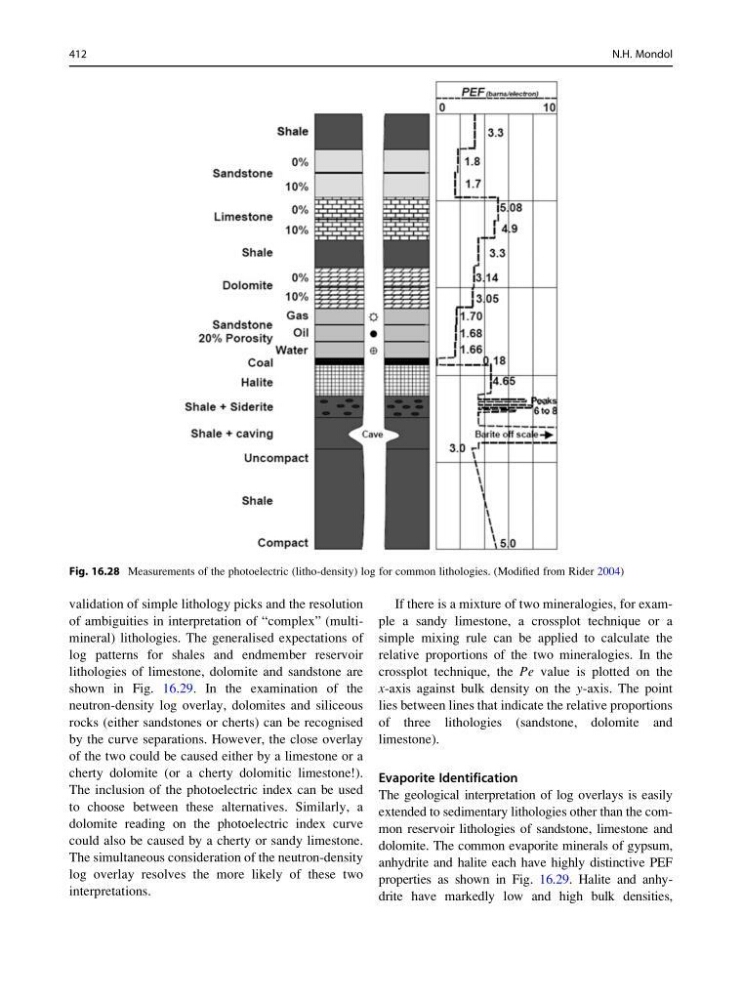
The inclusion of the photoelectric index can be used
to choose between these alternatives. Similarly, a
dolomite reading on the photoelectric index curve
could also be caused by a cherty or sandy limestone.
The simultaneous consideration of the neutron-density
log overlay resolves the more likely of these two
interpretations.
If there is a mixture of two mineralogies, for example a sandy limestone, a crossplot technique or a
simple mixing rule can be applied to calculate the
relative proportions of the two mineralogies. In the
crossplot technique, the Pe value is plotted on the
x-axis against bulk density on the y-axis. The point
lies between lines that indicate the relative proportions
of three lithologies (sandstone, dolomite and
limestone).
Evaporite Identification
The geological interpretation of log overlays is easily
extended to sedimentary lithologies other than the common reservoir lithologies of sandstone, limestone and
dolomite. The common evaporite minerals of gypsum,
anhydrite and halite each have highly distinctive PEF
properties as shown in Fig. 16.29. Halite and anhydrite have markedly low and high bulk densities,
Fig. 16.28 Measurements of the photoelectric (litho-density) log for common lithologies. (Modified from Rider 2004)
412
N.H. Mondol
of ambiguities in interpretation of “complex” (multimineral) lithologies. The generalised expectations of
log patterns for shales and endmember reservoir
lithologies of limestone, dolomite and sandstone are
shown in Fig. 16.29. In the examination of the
neutron-density log overlay, dolomites and siliceous
rocks (either sandstones or cherts) can be recognised
by the curve separations. However, the close overlay
of the two could be caused either by a limestone or a
cherty dolomite (or a cherty dolomitic limestone!).
The inclusion of the photoelectric index can be used
to choose between these alternatives. Similarly, a
dolomite reading on the photoelectric index curve
could also be caused by a cherty or sandy limestone.
The simultaneous consideration of the neutron-density
log overlay resolves the more likely of these two
interpretations.
If there is a mixture of two mineralogies, for example a sandy limestone, a crossplot technique or a
simple mixing rule can be applied to calculate the
relative proportions of the two mineralogies. In the
crossplot technique, the Pe value is plotted on the
x-axis against bulk density on the y-axis. The point
lies between lines that indicate the relative proportions
of three lithologies (sandstone, dolomite and
limestone).
Evaporite Identification
The geological interpretation of log overlays is easily
extended to sedimentary lithologies other than the common reservoir lithologies of sandstone, limestone and
dolomite. The common evaporite minerals of gypsum,
anhydrite and halite each have highly distinctive PEF
properties as shown in Fig. 16.29. Halite and anhydrite have markedly low and high bulk densities,
Fig. 16.28 Measurements of the photoelectric (litho-density) log for common lithologies. (Modified from Rider 2004)
412
N.H. Mondol