

16.5.6 Photoelectric Factor/Litho-density
Log
16.5.6.1 Generalities and Basic Principles
The photoelectric factor (PEF) or litho-density log is a
new form of the density log with added features. The
tool is physically very similar to the density tool but it
has enhanced detectors, and the distance between the
long spacing and the short spacing detectors has been
decreased. This decrease has increased the vertical
resolution of the tool and improved its overall
counting accuracy. The photoelectric tool has a
caesium-137 source emitting gamma rays at
0.662 MeV. The more efficient detectors in the lithodensity tool have the ability to recognise and count
separately gamma rays which have high
(0.25–0.662 MeV) and low (0.04–0.0 MeV) energies.
The high energy gamma rays are those that are
undergoing Compton scattering. The low energy
gamma rays are those that are undergoing photoelectric absorption. The probability that a gamma ray is
adsorbed by the process of photoelectric absorption
depends upon the characteristic photoelectric crosssection of the process (σ e ). Characteristic photoelectric cross-sections are measured in barns, where 1 barn
¼ 10
À24 cm
2 . A specific photoelectric absorption
index P e is defined with the relationship
Pe
1
K
σ e
Z
(16.9)
where Pe is the photoelectric absorption index (barns/
electron), σe is the photoelectric cross-section (barns),
Z is the atomic number (number of electrons) and K is
a coefficient dependent upon the energy at which the
photoelectric absorption is observed (no units). A log
scale running from 0 to 10 barns/electron is most often
used (Fig. 16.28). The photoelectric log values of
common minerals and fluids are given in Table 16.7.
16.5.6.2 Uses of Photoelectric/Litho-density
Log
The PEF/litho-density log is one of the most useful logs
for lithology discrimination. This is simply because the
tool is sensitive only to the mean atomic number of the
formation, and at the same time is insensitive to changes
in porosity and fluid saturation in the rock. Hence, the
absolute P e value may often be used to indicate directly
the presence of a given lithology, which may then be
checked against the other tool readings for consistency.
Uses of PEF to discriminate lithologies are shown below:
Identification of Reservoir Rocks
The addition of the photoelectric log to the gamma ray
and neutron-density logs provides both additional
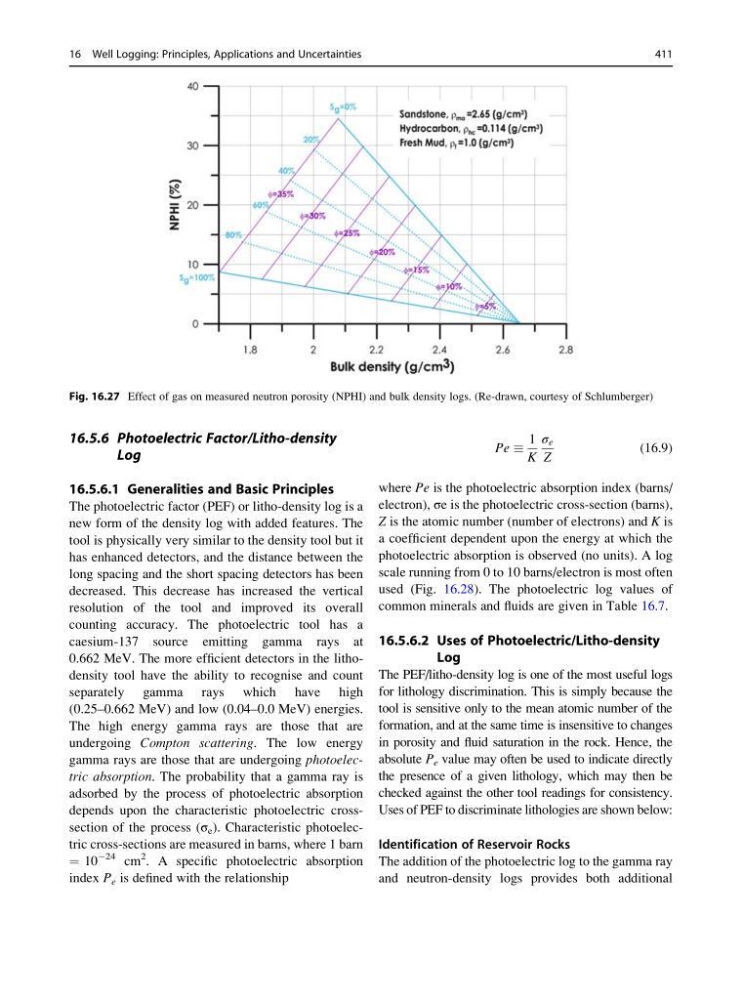
Fig. 16.27 Effect of gas on measured neutron porosity (NPHI) and bulk density logs. (Re-drawn, courtesy of Schlumberger)
16 Well Logging: Principles, Applications and Uncertainties
411
Log
16.5.6.1 Generalities and Basic Principles
The photoelectric factor (PEF) or litho-density log is a
new form of the density log with added features. The
tool is physically very similar to the density tool but it
has enhanced detectors, and the distance between the
long spacing and the short spacing detectors has been
decreased. This decrease has increased the vertical
resolution of the tool and improved its overall
counting accuracy. The photoelectric tool has a
caesium-137 source emitting gamma rays at
0.662 MeV. The more efficient detectors in the lithodensity tool have the ability to recognise and count
separately gamma rays which have high
(0.25–0.662 MeV) and low (0.04–0.0 MeV) energies.
The high energy gamma rays are those that are
undergoing Compton scattering. The low energy
gamma rays are those that are undergoing photoelectric absorption. The probability that a gamma ray is
adsorbed by the process of photoelectric absorption
depends upon the characteristic photoelectric crosssection of the process (σ e ). Characteristic photoelectric cross-sections are measured in barns, where 1 barn
¼ 10
À24 cm
2 . A specific photoelectric absorption
index P e is defined with the relationship
Pe
1
K
σ e
Z
(16.9)
where Pe is the photoelectric absorption index (barns/
electron), σe is the photoelectric cross-section (barns),
Z is the atomic number (number of electrons) and K is
a coefficient dependent upon the energy at which the
photoelectric absorption is observed (no units). A log
scale running from 0 to 10 barns/electron is most often
used (Fig. 16.28). The photoelectric log values of
common minerals and fluids are given in Table 16.7.
16.5.6.2 Uses of Photoelectric/Litho-density
Log
The PEF/litho-density log is one of the most useful logs
for lithology discrimination. This is simply because the
tool is sensitive only to the mean atomic number of the
formation, and at the same time is insensitive to changes
in porosity and fluid saturation in the rock. Hence, the
absolute P e value may often be used to indicate directly
the presence of a given lithology, which may then be
checked against the other tool readings for consistency.
Uses of PEF to discriminate lithologies are shown below:
Identification of Reservoir Rocks
The addition of the photoelectric log to the gamma ray
and neutron-density logs provides both additional
Fig. 16.27 Effect of gas on measured neutron porosity (NPHI) and bulk density logs. (Re-drawn, courtesy of Schlumberger)
16 Well Logging: Principles, Applications and Uncertainties
411