

16.5.5.3 Uncertainties of Porosity Logs
Enlarged and rough boreholes, formation fracture,
gas in the borehole and formation, or improper
centralisation can produce signal attenuation in porosity log measurements resulting in higher porosity
values. In rough holes or in heavy drilling muds, the
density data might be invalid. Porosity calculated from
density and sonic depends on the choice of matrix
density and matrix transit time, which varies with
lithology. Porosity calculations for unconsolidated
formations may yield porosity values higher than the
actual values when using the Wyllie equation (Wyllie
et al. 1956). Porosity calculated from density depends
on the choice of fluid density, which varies with fluid
type and salinity. Porosity calculated in gas-bearing
zones will be higher than the actual values because the
traveltime in gas is higher than in water. Presence of
gas (light HC) in the pore space causes density-derived
porosity to be more than the actual porosity. If the
actual lithology is sandstone, the measured neutron
porosity is less than the actual porosity. If the actual
lithology is dolomite, the log porosity is greater than
the actual porosity. If gas is present in the formation,
porosities can be overestimated (Fig. 16.27).
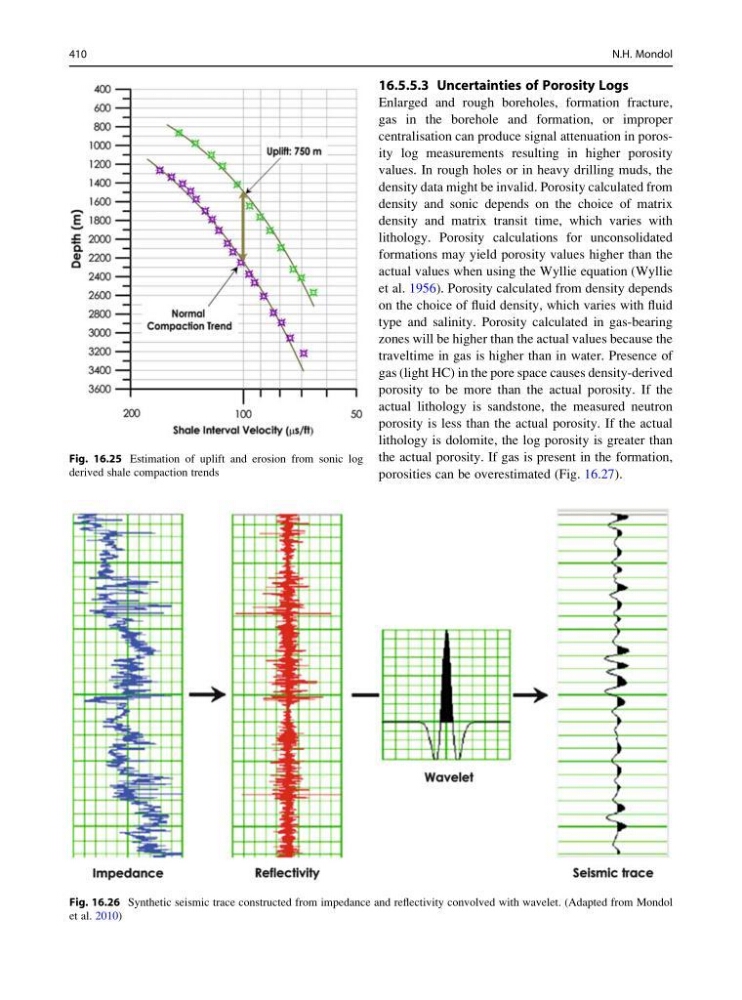
Fig. 16.26 Synthetic seismic trace constructed from impedance and reflectivity convolved with wavelet. (Adapted from Mondol
et al. 2010)
Fig. 16.25 Estimation of uplift and erosion from sonic log
derived shale compaction trends
410
N.H. Mondol
Enlarged and rough boreholes, formation fracture,
gas in the borehole and formation, or improper
centralisation can produce signal attenuation in porosity log measurements resulting in higher porosity
values. In rough holes or in heavy drilling muds, the
density data might be invalid. Porosity calculated from
density and sonic depends on the choice of matrix
density and matrix transit time, which varies with
lithology. Porosity calculations for unconsolidated
formations may yield porosity values higher than the
actual values when using the Wyllie equation (Wyllie
et al. 1956). Porosity calculated from density depends
on the choice of fluid density, which varies with fluid
type and salinity. Porosity calculated in gas-bearing
zones will be higher than the actual values because the
traveltime in gas is higher than in water. Presence of
gas (light HC) in the pore space causes density-derived
porosity to be more than the actual porosity. If the
actual lithology is sandstone, the measured neutron
porosity is less than the actual porosity. If the actual
lithology is dolomite, the log porosity is greater than
the actual porosity. If gas is present in the formation,
porosities can be overestimated (Fig. 16.27).
Fig. 16.26 Synthetic seismic trace constructed from impedance and reflectivity convolved with wavelet. (Adapted from Mondol
et al. 2010)
Fig. 16.25 Estimation of uplift and erosion from sonic log
derived shale compaction trends
410
N.H. Mondol