

is misjudged. If oil or gas is present in the formation,
porosities can be overestimated by the density
log. Remember that the tool measures the invaded
zone, so the relevant fluid is the mud filtrate in
most circumstances. If available, the fluid densities
should be corrected to borehole temperature conditions.
The most accurate porosity determinations are
obtained from laboratory measurements on cores and
so core data is used to provide accurate matrix
densities for particular intervals. If there is a database
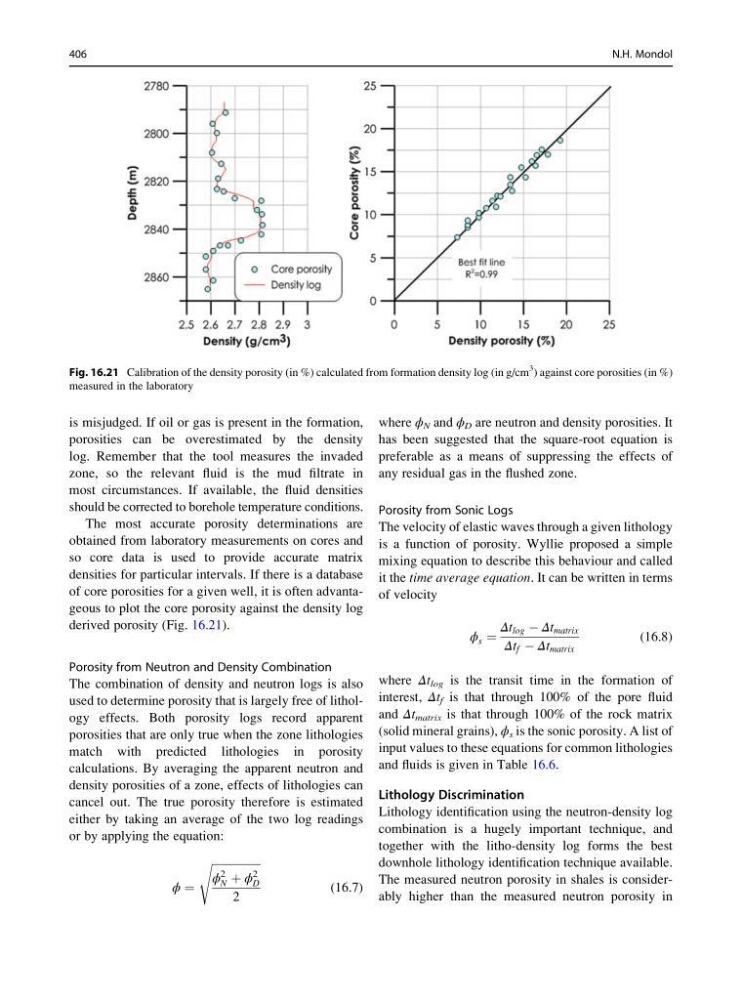
of core porosities for a given well, it is often advantageous to plot the core porosity against the density log
derived porosity (Fig. 16.21).
Porosity from Neutron and Density Combination
The combination of density and neutron logs is also
used to determine porosity that is largely free of lithology effects. Both porosity logs record apparent
porosities that are only true when the zone lithologies
match with predicted lithologies in porosity
calculations. By averaging the apparent neutron and
density porosities of a zone, effects of lithologies can
cancel out. The true porosity therefore is estimated
either by taking an average of the two log readings
or by applying the equation:
ϕ ¼
ffiffiffiffiffiffiffiffiffiffiffiffiffiffiffiffiffi ffi
ϕ
2
N þ ϕ
2
D
2
s
(16.7)
where ϕ N and ϕ D are neutron and density porosities. It
has been suggested that the square-root equation is
preferable as a means of suppressing the effects of
any residual gas in the flushed zone.
Porosity from Sonic Logs
The velocity of elastic waves through a given lithology
is a function of porosity. Wyllie proposed a simple
mixing equation to describe this behaviour and called
it the time average equation. It can be written in terms
of velocity
ϕ s ¼
Δt log À Δt matrix
Δt f À Δt matrix
(16.8)
where Δt log is the transit time in the formation of
interest, Δt f is that through 100% of the pore fluid
and Δt matrix is that through 100% of the rock matrix
(solid mineral grains), ϕ s is the sonic porosity. A list of
input values to these equations for common lithologies
and fluids is given in Table 16.6.
Lithology Discrimination
Lithology identification using the neutron-density log
combination is a hugely important technique, and
together with the litho-density log forms the best
downhole lithology identification technique available.
The measured neutron porosity in shales is considerably higher than the measured neutron porosity in
Fig. 16.21 Calibration of the density porosity (in %) calculated from formation density log (in g/cm
3
) against core porosities (in %)
measured in the laboratory
406
N.H. Mondol
porosities can be overestimated by the density
log. Remember that the tool measures the invaded
zone, so the relevant fluid is the mud filtrate in
most circumstances. If available, the fluid densities
should be corrected to borehole temperature conditions.
The most accurate porosity determinations are
obtained from laboratory measurements on cores and
so core data is used to provide accurate matrix
densities for particular intervals. If there is a database
of core porosities for a given well, it is often advantageous to plot the core porosity against the density log
derived porosity (Fig. 16.21).
Porosity from Neutron and Density Combination
The combination of density and neutron logs is also
used to determine porosity that is largely free of lithology effects. Both porosity logs record apparent
porosities that are only true when the zone lithologies
match with predicted lithologies in porosity
calculations. By averaging the apparent neutron and
density porosities of a zone, effects of lithologies can
cancel out. The true porosity therefore is estimated
either by taking an average of the two log readings
or by applying the equation:
ϕ ¼
ffiffiffiffiffiffiffiffiffiffiffiffiffiffiffiffiffi ffi
ϕ
2
N þ ϕ
2
D
2
s
(16.7)
where ϕ N and ϕ D are neutron and density porosities. It
has been suggested that the square-root equation is
preferable as a means of suppressing the effects of
any residual gas in the flushed zone.
Porosity from Sonic Logs
The velocity of elastic waves through a given lithology
is a function of porosity. Wyllie proposed a simple
mixing equation to describe this behaviour and called
it the time average equation. It can be written in terms
of velocity
ϕ s ¼
Δt log À Δt matrix
Δt f À Δt matrix
(16.8)
where Δt log is the transit time in the formation of
interest, Δt f is that through 100% of the pore fluid
and Δt matrix is that through 100% of the rock matrix
(solid mineral grains), ϕ s is the sonic porosity. A list of
input values to these equations for common lithologies
and fluids is given in Table 16.6.
Lithology Discrimination
Lithology identification using the neutron-density log
combination is a hugely important technique, and
together with the litho-density log forms the best
downhole lithology identification technique available.
The measured neutron porosity in shales is considerably higher than the measured neutron porosity in
Fig. 16.21 Calibration of the density porosity (in %) calculated from formation density log (in g/cm
3
) against core porosities (in %)
measured in the laboratory
406
N.H. Mondol