

index. Neutron logs can therefore be used to detect gas
and distinguish it from oil.
Density Log
The density tools are induced radiation tools. They
bombard the formation with gamma radiation and measure how much radiation returns to the sensors. The tool
consists of a radioactive source (usually caesium-137 or
cobalt-60) that emits gamma rays of medium energy (in
the range 0.2–2 MeV). The tool has short- and longspaced detectors (Fig. 16.17). The common density
tools are FDC (formation density compensated), LDT
(litho-density tool), CDS (compensated density) and
PDS (photoelectric density). Returning gamma rays
are measured at two different energy levels: (1) higher
energy gamma rays (Compton scattering) determine
bulk density and therefore porosity (e.g. FDC, CDS
tools) and (2) low energy gamma rays (due to photoelectric effect) are used to determine formation lithology (e.g. LDT and PDS). The low energy gamma rays
show little dependence on porosity and fluid and so are
very useful for lithology identification. The density log
unit is g/cm
3 or kg/m
3
. The unit of the photoelectric log
is b/e (barns per electron, equal to 10
À28 m
2
).
A formation with a high bulk density has a high
number of electrons. It attenuates the gamma rays
significantly, and hence a low gamma ray count rate
is recorded at the sensors. A formation with a low bulk
density has a low number of electrons. It attenuates the
gamma rays less than a high density formation, and
hence a higher gamma ray count rate is recorded at the
sensors.
Sonic Log
Sonic logs measure how sound travels through rocks,
and in particular provide information about porosity.
With this method a probe sends out acoustic pulses
which travel through the rock surrounding the well to
the other end of the logging tool, and the velocity of
sound in the rock is recorded (Fig. 16.18). This also
indicates whether a liquid or gas phase occupies the
pore spaces. The velocity is also dependent on how the
rock is compacted, i.e. the pore distribution and the
nature of the cements. The common sonic tools are
BHC (borehole compensated sonic), LSS (long spaced
sonic), array sonic/full waveform sonic and DSI
(dipole shear imager). The velocity measured by the
sonic log is however not a direct function of the
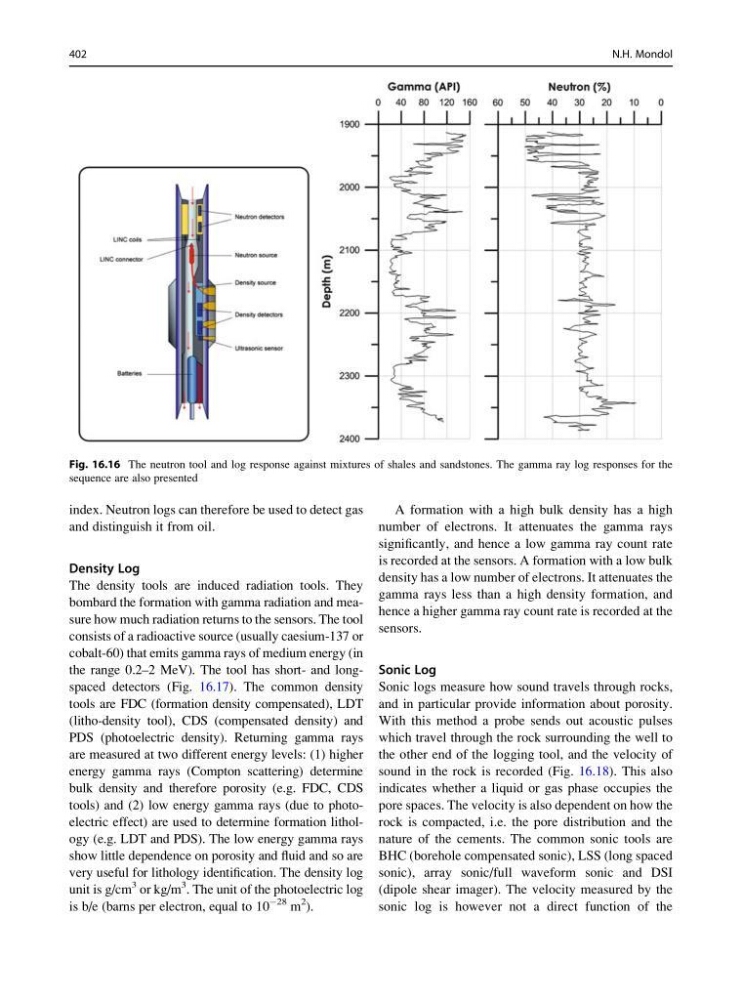
Fig. 16.16 The neutron tool and log response against mixtures of shales and sandstones. The gamma ray log responses for the
sequence are also presented
402
N.H. Mondol
and distinguish it from oil.
Density Log
The density tools are induced radiation tools. They
bombard the formation with gamma radiation and measure how much radiation returns to the sensors. The tool
consists of a radioactive source (usually caesium-137 or
cobalt-60) that emits gamma rays of medium energy (in
the range 0.2–2 MeV). The tool has short- and longspaced detectors (Fig. 16.17). The common density
tools are FDC (formation density compensated), LDT
(litho-density tool), CDS (compensated density) and
PDS (photoelectric density). Returning gamma rays
are measured at two different energy levels: (1) higher
energy gamma rays (Compton scattering) determine
bulk density and therefore porosity (e.g. FDC, CDS
tools) and (2) low energy gamma rays (due to photoelectric effect) are used to determine formation lithology (e.g. LDT and PDS). The low energy gamma rays
show little dependence on porosity and fluid and so are
very useful for lithology identification. The density log
unit is g/cm
3 or kg/m
3
. The unit of the photoelectric log
is b/e (barns per electron, equal to 10
À28 m
2
).
A formation with a high bulk density has a high
number of electrons. It attenuates the gamma rays
significantly, and hence a low gamma ray count rate
is recorded at the sensors. A formation with a low bulk
density has a low number of electrons. It attenuates the
gamma rays less than a high density formation, and
hence a higher gamma ray count rate is recorded at the
sensors.
Sonic Log
Sonic logs measure how sound travels through rocks,
and in particular provide information about porosity.
With this method a probe sends out acoustic pulses
which travel through the rock surrounding the well to
the other end of the logging tool, and the velocity of
sound in the rock is recorded (Fig. 16.18). This also
indicates whether a liquid or gas phase occupies the
pore spaces. The velocity is also dependent on how the
rock is compacted, i.e. the pore distribution and the
nature of the cements. The common sonic tools are
BHC (borehole compensated sonic), LSS (long spaced
sonic), array sonic/full waveform sonic and DSI
(dipole shear imager). The velocity measured by the
sonic log is however not a direct function of the
Fig. 16.16 The neutron tool and log response against mixtures of shales and sandstones. The gamma ray log responses for the
sequence are also presented
402
N.H. Mondol