

gamma readings. Coal and dolomite may contain
absorbed uranium. Evaporite deposits may include
potassium minerals such as carnallite. When this is
the case, spectral gamma ray logging can be done to
identify these anomalies.
16.5.5 Porosity Logs
16.5.5.1 Generalities and Basic Principles
Evaluating porosity is an important petrophysical task
in formation evaluation. The porosity of a formation
can be estimated either from neutron, density, sonic or
NMR logging. None of these logs measure porosity
directly. The density, neutron and NMR logs are
nuclear measurements whereas the sonic log uses
acoustic measurements. When using a single porosity
log, the true porosity is calculated from interpolation
between the values for the matrix mineral and the pore
fluid. A combination of porosity logs gives more accurate estimates of porosity and valuable indications for
lithology. The basic principles of four porosity logs
are given below:
Neutron Log
A neutron log is obtained using a neutron source, which
sends radiation into the rocks (Fig. 16.16). The neutron
rays are absorbed by rock, and particularly by the water
in the formation. This is due to collisions with atomic
nuclei, and the absorption of the neutron radiation is
primarily a function of hydrogen atom concentrations
(hydrogen index). Since most of the hydrogen in rocks
is present as water, neutron logs provide an expression
of the water content and thereby the porosity of a rock.
The common density tools are GNT (gamma-ray neutron tool), SNT (sidewall neutron tool), CNL (compensated neutron log) and DNL (dual neutron log). Neutron
logs are displayed as neutron porosity and common
units are p.u. (porosity unit), decimal or %.
In shales and sandstones with high clay content the
neutron logs record higher porosity because hydrogen
is also present in the clay minerals which are part of
the solid phase. This is called the shale effect and is
most pronounced in shales with high content of smectite and kaolinite compared to those with mostly illite
and chlorite. Limestones however give very reliable
porosity values because carbonate minerals contain
little hydrogen. Calculation of porosity based on neutron logs (neutron porosity) results in too low porosity
values when the pores are filled with gas because they
contain less hydrogen per volume compared to water
and oil. This is called the gas effect. Gas is less dense
and has fewer hydrogen atoms per unit volume than
water and oil, and therefore has a lower hydrogen
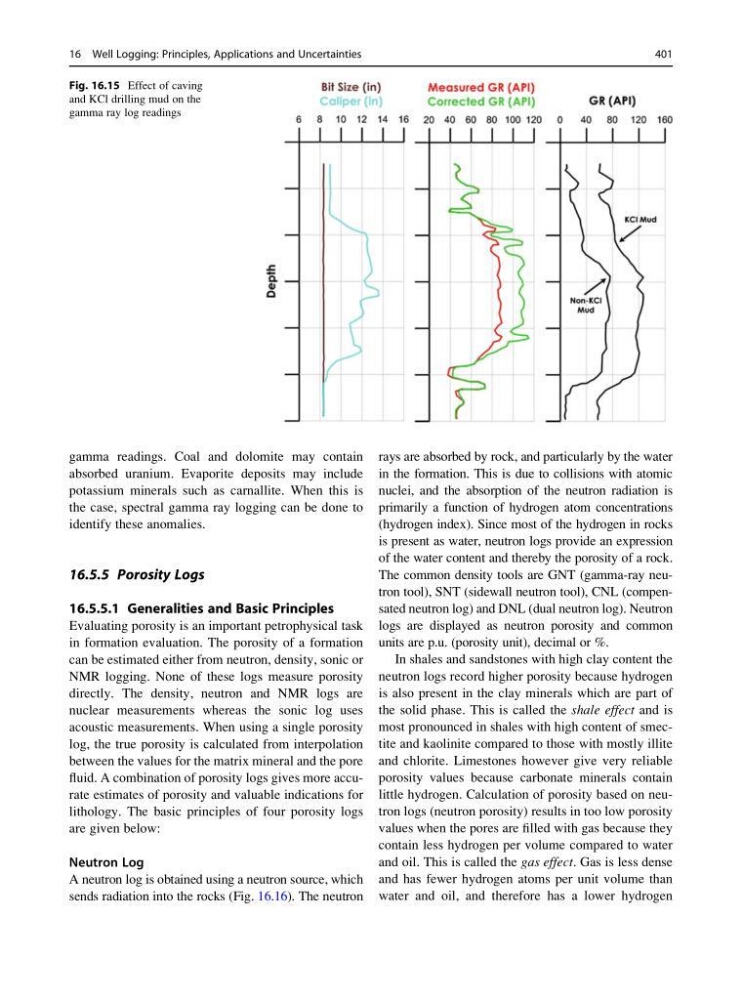
Fig. 16.15 Effect of caving
and KCl drilling mud on the
gamma ray log readings
16 Well Logging: Principles, Applications and Uncertainties
401
absorbed uranium. Evaporite deposits may include
potassium minerals such as carnallite. When this is
the case, spectral gamma ray logging can be done to
identify these anomalies.
16.5.5 Porosity Logs
16.5.5.1 Generalities and Basic Principles
Evaluating porosity is an important petrophysical task
in formation evaluation. The porosity of a formation
can be estimated either from neutron, density, sonic or
NMR logging. None of these logs measure porosity
directly. The density, neutron and NMR logs are
nuclear measurements whereas the sonic log uses
acoustic measurements. When using a single porosity
log, the true porosity is calculated from interpolation
between the values for the matrix mineral and the pore
fluid. A combination of porosity logs gives more accurate estimates of porosity and valuable indications for
lithology. The basic principles of four porosity logs
are given below:
Neutron Log
A neutron log is obtained using a neutron source, which
sends radiation into the rocks (Fig. 16.16). The neutron
rays are absorbed by rock, and particularly by the water
in the formation. This is due to collisions with atomic
nuclei, and the absorption of the neutron radiation is
primarily a function of hydrogen atom concentrations
(hydrogen index). Since most of the hydrogen in rocks
is present as water, neutron logs provide an expression
of the water content and thereby the porosity of a rock.
The common density tools are GNT (gamma-ray neutron tool), SNT (sidewall neutron tool), CNL (compensated neutron log) and DNL (dual neutron log). Neutron
logs are displayed as neutron porosity and common
units are p.u. (porosity unit), decimal or %.
In shales and sandstones with high clay content the
neutron logs record higher porosity because hydrogen
is also present in the clay minerals which are part of
the solid phase. This is called the shale effect and is
most pronounced in shales with high content of smectite and kaolinite compared to those with mostly illite
and chlorite. Limestones however give very reliable
porosity values because carbonate minerals contain
little hydrogen. Calculation of porosity based on neutron logs (neutron porosity) results in too low porosity
values when the pores are filled with gas because they
contain less hydrogen per volume compared to water
and oil. This is called the gas effect. Gas is less dense
and has fewer hydrogen atoms per unit volume than
water and oil, and therefore has a lower hydrogen
Fig. 16.15 Effect of caving
and KCl drilling mud on the
gamma ray log readings
16 Well Logging: Principles, Applications and Uncertainties
401