

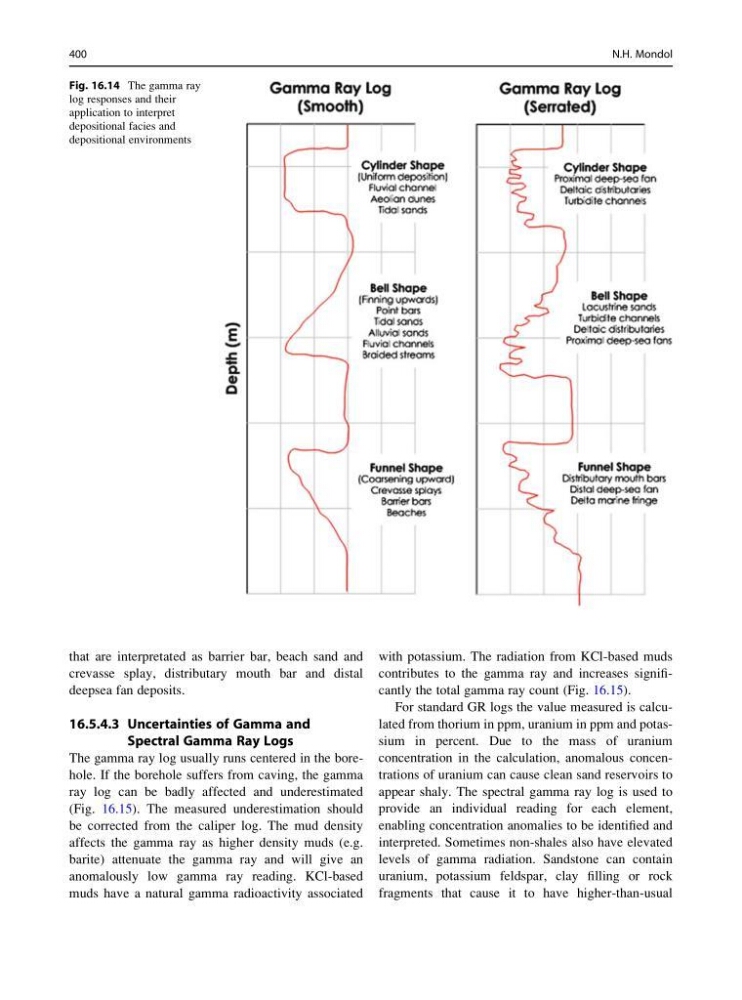
that are interpretated as barrier bar, beach sand and
crevasse splay, distributary mouth bar and distal
deepsea fan deposits.
16.5.4.3 Uncertainties of Gamma and
Spectral Gamma Ray Logs
The gamma ray log usually runs centered in the borehole. If the borehole suffers from caving, the gamma
ray log can be badly affected and underestimated
(Fig. 16.15). The measured underestimation should
be corrected from the caliper log. The mud density
affects the gamma ray as higher density muds (e.g.
barite) attenuate the gamma ray and will give an
anomalously low gamma ray reading. KCl-based
muds have a natural gamma radioactivity associated
with potassium. The radiation from KCl-based muds
contributes to the gamma ray and increases significantly the total gamma ray count (Fig. 16.15).
For standard GR logs the value measured is calculated from thorium in ppm, uranium in ppm and potassium in percent. Due to the mass of uranium
concentration in the calculation, anomalous concentrations of uranium can cause clean sand reservoirs to
appear shaly. The spectral gamma ray log is used to
provide an individual reading for each element,
enabling concentration anomalies to be identified and
interpreted. Sometimes non-shales also have elevated
levels of gamma radiation. Sandstone can contain
uranium, potassium feldspar, clay filling or rock
fragments that cause it to have higher-than-usual
Fig. 16.14 The gamma ray
log responses and their
application to interpret
depositional facies and
depositional environments
400
N.H. Mondol
crevasse splay, distributary mouth bar and distal
deepsea fan deposits.
16.5.4.3 Uncertainties of Gamma and
Spectral Gamma Ray Logs
The gamma ray log usually runs centered in the borehole. If the borehole suffers from caving, the gamma
ray log can be badly affected and underestimated
(Fig. 16.15). The measured underestimation should
be corrected from the caliper log. The mud density
affects the gamma ray as higher density muds (e.g.
barite) attenuate the gamma ray and will give an
anomalously low gamma ray reading. KCl-based
muds have a natural gamma radioactivity associated
with potassium. The radiation from KCl-based muds
contributes to the gamma ray and increases significantly the total gamma ray count (Fig. 16.15).
For standard GR logs the value measured is calculated from thorium in ppm, uranium in ppm and potassium in percent. Due to the mass of uranium
concentration in the calculation, anomalous concentrations of uranium can cause clean sand reservoirs to
appear shaly. The spectral gamma ray log is used to
provide an individual reading for each element,
enabling concentration anomalies to be identified and
interpreted. Sometimes non-shales also have elevated
levels of gamma radiation. Sandstone can contain
uranium, potassium feldspar, clay filling or rock
fragments that cause it to have higher-than-usual
Fig. 16.14 The gamma ray
log responses and their
application to interpret
depositional facies and
depositional environments
400
N.H. Mondol