

produce more negative (to the left) (Fig. 16.8) or
positive values based on salinity variations between
drilling mud and formation water.
SP measures the naturally occurring electrical potential (voltage) produced by the interaction of formation
water, conductive drilling fluid and shale. There are
three sources of the currents; two are electrochemical
potential (liquid junction potential and membrane
potential), and one electrokinetic potential. The liquid
junction potential and the membrane potential are the
main components of SP deflection. The Na
+ and Cl
À
ions have different nobilities at the junction of the
invaded and virgin zones. The ion movement across
this boundary generates a current flow and hence a
potential. The greater the difference between the salinity of the solutions (mud and formation water), the
greater the potential. In low porosity, low permeability
formations, the mudcake builds slowly and the electrokinetic potential becomes predominant. Electrokinetic
potential is generated by the flow of mud filtrate
through a porous permeable bed. It depends upon the
resistivity of the mud filtrate and will only become
important if there are high differential pressures across
the formation. The effects are normally negligible in
permeable formations because the mudcake builds
quickly and halts any further invasion.
16.5.3.2 Uses of SP Log
The SP log has several applications: (1) indication of
the shaliness of a formation, (2) correlation of stratigraphic sequences, (3) detection of permeable beds,
(4) determination of formation water resistivity (R w ),
and (5) detection of hydrocarbons by the suppression
of the SP curve. The two most common applications
are described below:
Shale Volume Estimation
The volume of shale is used in the evaluation of shaly
sand reservoirs and as a mapping parameter for both
sandstone and carbonate facies analysis. The following relationships are used to estimate shale volume
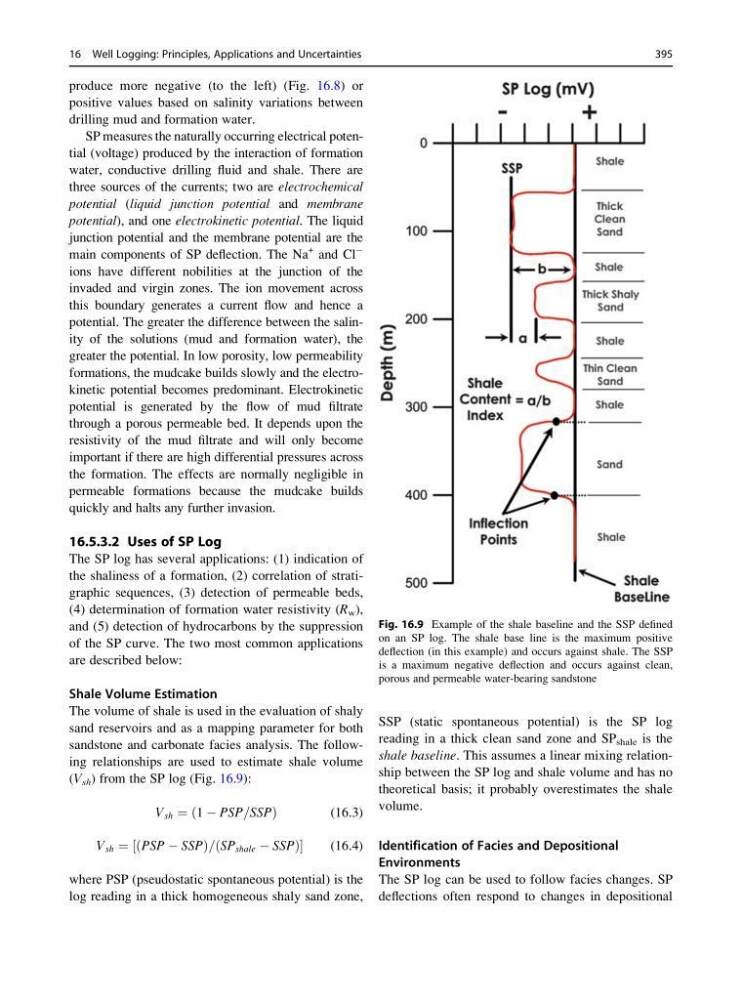
(V sh ) from the SP log (Fig. 16.9):
V sh ¼ 1 À PSP=SSP
ð
Þ
(16.3)
V sh ¼ PSP À SSP
ð
Þ = SP shale À SSP
ð
Þ
½
(16.4)
where PSP (pseudostatic spontaneous potential) is the
log reading in a thick homogeneous shaly sand zone,
SSP (static spontaneous potential) is the SP log
reading in a thick clean sand zone and SP shale is the
shale baseline. This assumes a linear mixing relationship between the SP log and shale volume and has no
theoretical basis; it probably overestimates the shale
volume.
Identification of Facies and Depositional
Environments
The SP log can be used to follow facies changes. SP
deflections often respond to changes in depositional
Fig. 16.9 Example of the shale baseline and the SSP defined
on an SP log. The shale base line is the maximum positive
deflection (in this example) and occurs against shale. The SSP
is a maximum negative deflection and occurs against clean,
porous and permeable water-bearing sandstone
16 Well Logging: Principles, Applications and Uncertainties
395
positive values based on salinity variations between
drilling mud and formation water.
SP measures the naturally occurring electrical potential (voltage) produced by the interaction of formation
water, conductive drilling fluid and shale. There are
three sources of the currents; two are electrochemical
potential (liquid junction potential and membrane
potential), and one electrokinetic potential. The liquid
junction potential and the membrane potential are the
main components of SP deflection. The Na
+ and Cl
À
ions have different nobilities at the junction of the
invaded and virgin zones. The ion movement across
this boundary generates a current flow and hence a
potential. The greater the difference between the salinity of the solutions (mud and formation water), the
greater the potential. In low porosity, low permeability
formations, the mudcake builds slowly and the electrokinetic potential becomes predominant. Electrokinetic
potential is generated by the flow of mud filtrate
through a porous permeable bed. It depends upon the
resistivity of the mud filtrate and will only become
important if there are high differential pressures across
the formation. The effects are normally negligible in
permeable formations because the mudcake builds
quickly and halts any further invasion.
16.5.3.2 Uses of SP Log
The SP log has several applications: (1) indication of
the shaliness of a formation, (2) correlation of stratigraphic sequences, (3) detection of permeable beds,
(4) determination of formation water resistivity (R w ),
and (5) detection of hydrocarbons by the suppression
of the SP curve. The two most common applications
are described below:
Shale Volume Estimation
The volume of shale is used in the evaluation of shaly
sand reservoirs and as a mapping parameter for both
sandstone and carbonate facies analysis. The following relationships are used to estimate shale volume
(V sh ) from the SP log (Fig. 16.9):
V sh ¼ 1 À PSP=SSP
ð
Þ
(16.3)
V sh ¼ PSP À SSP
ð
Þ = SP shale À SSP
ð
Þ
½
(16.4)
where PSP (pseudostatic spontaneous potential) is the
log reading in a thick homogeneous shaly sand zone,
SSP (static spontaneous potential) is the SP log
reading in a thick clean sand zone and SP shale is the
shale baseline. This assumes a linear mixing relationship between the SP log and shale volume and has no
theoretical basis; it probably overestimates the shale
volume.
Identification of Facies and Depositional
Environments
The SP log can be used to follow facies changes. SP
deflections often respond to changes in depositional
Fig. 16.9 Example of the shale baseline and the SSP defined
on an SP log. The shale base line is the maximum positive
deflection (in this example) and occurs against shale. The SSP
is a maximum negative deflection and occurs against clean,
porous and permeable water-bearing sandstone
16 Well Logging: Principles, Applications and Uncertainties
395