

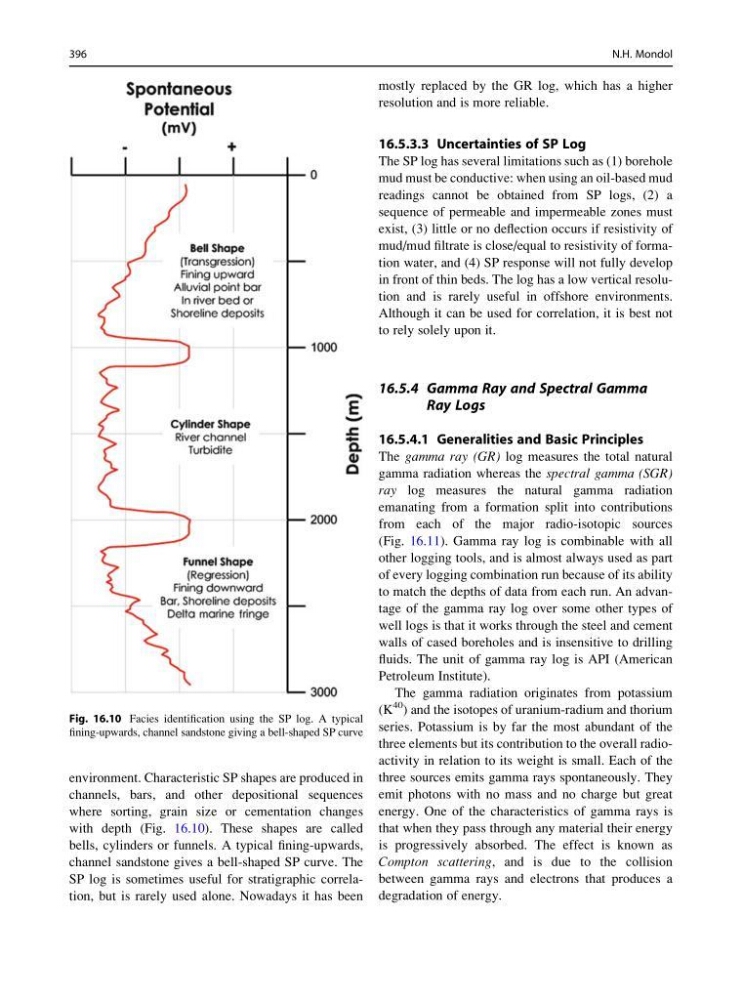
environment. Characteristic SP shapes are produced in
channels, bars, and other depositional sequences
where sorting, grain size or cementation changes
with depth (Fig. 16.10). These shapes are called
bells, cylinders or funnels. A typical fining-upwards,
channel sandstone gives a bell-shaped SP curve. The
SP log is sometimes useful for stratigraphic correlation, but is rarely used alone. Nowadays it has been
mostly replaced by the GR log, which has a higher
resolution and is more reliable.
16.5.3.3 Uncertainties of SP Log
The SP log has several limitations such as (1) borehole
mud must be conductive: when using an oil-based mud
readings cannot be obtained from SP logs, (2) a
sequence of permeable and impermeable zones must
exist, (3) little or no deflection occurs if resistivity of
mud/mud filtrate is close/equal to resistivity of formation water, and (4) SP response will not fully develop
in front of thin beds. The log has a low vertical resolution and is rarely useful in offshore environments.
Although it can be used for correlation, it is best not
to rely solely upon it.
16.5.4 Gamma Ray and Spectral Gamma
Ray Logs
16.5.4.1 Generalities and Basic Principles
The gamma ray (GR) log measures the total natural
gamma radiation whereas the spectral gamma (SGR)
ray log measures the natural gamma radiation
emanating from a formation split into contributions
from each of the major radio-isotopic sources
(Fig. 16.11). Gamma ray log is combinable with all
other logging tools, and is almost always used as part
of every logging combination run because of its ability
to match the depths of data from each run. An advantage of the gamma ray log over some other types of
well logs is that it works through the steel and cement
walls of cased boreholes and is insensitive to drilling
fluids. The unit of gamma ray log is API (American
Petroleum Institute).
The gamma radiation originates from potassium
(K
40 ) and the isotopes of uranium-radium and thorium
series. Potassium is by far the most abundant of the
three elements but its contribution to the overall radioactivity in relation to its weight is small. Each of the
three sources emits gamma rays spontaneously. They
emit photons with no mass and no charge but great
energy. One of the characteristics of gamma rays is
that when they pass through any material their energy
is progressively absorbed. The effect is known as
Compton scattering, and is due to the collision
between gamma rays and electrons that produces a
degradation of energy.
Fig. 16.10 Facies identification using the SP log. A typical
fining-upwards, channel sandstone giving a bell-shaped SP curve
396
N.H. Mondol
channels, bars, and other depositional sequences
where sorting, grain size or cementation changes
with depth (Fig. 16.10). These shapes are called
bells, cylinders or funnels. A typical fining-upwards,
channel sandstone gives a bell-shaped SP curve. The
SP log is sometimes useful for stratigraphic correlation, but is rarely used alone. Nowadays it has been
mostly replaced by the GR log, which has a higher
resolution and is more reliable.
16.5.3.3 Uncertainties of SP Log
The SP log has several limitations such as (1) borehole
mud must be conductive: when using an oil-based mud
readings cannot be obtained from SP logs, (2) a
sequence of permeable and impermeable zones must
exist, (3) little or no deflection occurs if resistivity of
mud/mud filtrate is close/equal to resistivity of formation water, and (4) SP response will not fully develop
in front of thin beds. The log has a low vertical resolution and is rarely useful in offshore environments.
Although it can be used for correlation, it is best not
to rely solely upon it.
16.5.4 Gamma Ray and Spectral Gamma
Ray Logs
16.5.4.1 Generalities and Basic Principles
The gamma ray (GR) log measures the total natural
gamma radiation whereas the spectral gamma (SGR)
ray log measures the natural gamma radiation
emanating from a formation split into contributions
from each of the major radio-isotopic sources
(Fig. 16.11). Gamma ray log is combinable with all
other logging tools, and is almost always used as part
of every logging combination run because of its ability
to match the depths of data from each run. An advantage of the gamma ray log over some other types of
well logs is that it works through the steel and cement
walls of cased boreholes and is insensitive to drilling
fluids. The unit of gamma ray log is API (American
Petroleum Institute).
The gamma radiation originates from potassium
(K
40 ) and the isotopes of uranium-radium and thorium
series. Potassium is by far the most abundant of the
three elements but its contribution to the overall radioactivity in relation to its weight is small. Each of the
three sources emits gamma rays spontaneously. They
emit photons with no mass and no charge but great
energy. One of the characteristics of gamma rays is
that when they pass through any material their energy
is progressively absorbed. The effect is known as
Compton scattering, and is due to the collision
between gamma rays and electrons that produces a
degradation of energy.
Fig. 16.10 Facies identification using the SP log. A typical
fining-upwards, channel sandstone giving a bell-shaped SP curve
396
N.H. Mondol