

temperature, but less so than MWD and LWD as the
formation is now in the process of reheating the
borehole. Drilling mud takes several days or even
weeks before its temperature approaches that of
the formation water, and there is therefore considerable
uncertainty involved in such temperature calculations.
16.5.2 Caliper Log
16.5.2.1 Generalities and Basic Principles
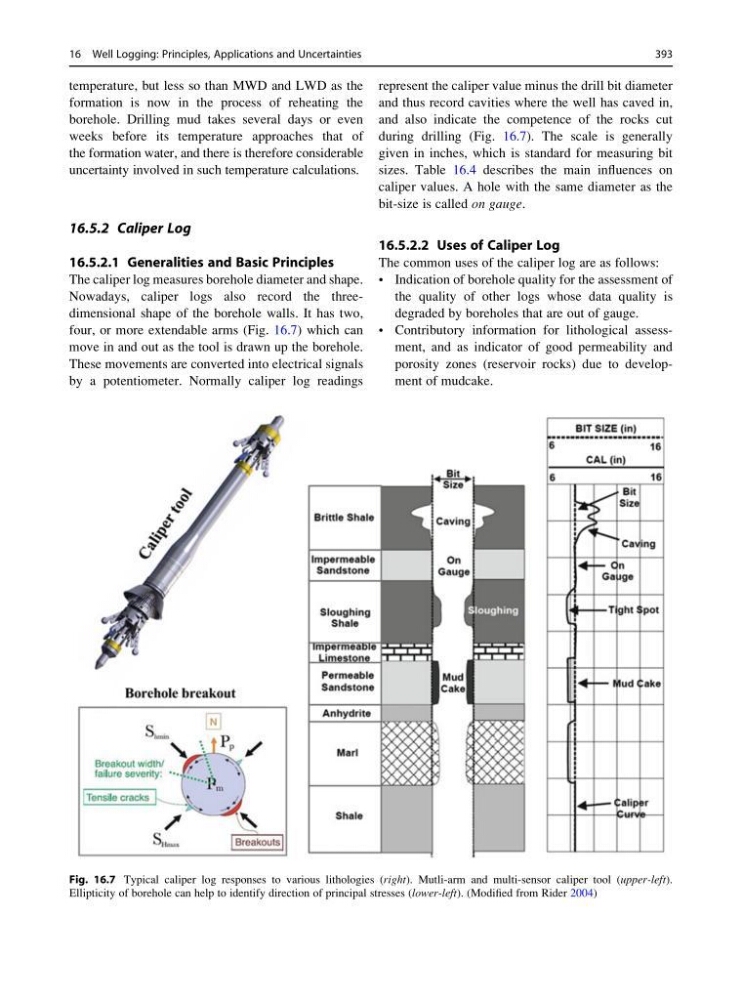
The caliper log measures borehole diameter and shape.
Nowadays, caliper logs also record the threedimensional shape of the borehole walls. It has two,
four, or more extendable arms (Fig. 16.7) which can
move in and out as the tool is drawn up the borehole.
These movements are converted into electrical signals
by a potentiometer. Normally caliper log readings
represent the caliper value minus the drill bit diameter
and thus record cavities where the well has caved in,
and also indicate the competence of the rocks cut
during drilling (Fig. 16.7). The scale is generally
given in inches, which is standard for measuring bit
sizes. Table 16.4 describes the main influences on
caliper values. A hole with the same diameter as the
bit-size is called on gauge.
16.5.2.2 Uses of Caliper Log
The common uses of the caliper log are as follows:
• Indication of borehole quality for the assessment of
the quality of other logs whose data quality is
degraded by boreholes that are out of gauge.
• Contributory information for lithological assessment, and as indicator of good permeability and
porosity zones (reservoir rocks) due to development of mudcake.
Fig. 16.7 Typical caliper log responses to various lithologies (right). Mutli-arm and multi-sensor caliper tool (upper-left).
Ellipticity of borehole can help to identify direction of principal stresses (lower-left). (Modified from Rider 2004)
16 Well Logging: Principles, Applications and Uncertainties
393
formation is now in the process of reheating the
borehole. Drilling mud takes several days or even
weeks before its temperature approaches that of
the formation water, and there is therefore considerable
uncertainty involved in such temperature calculations.
16.5.2 Caliper Log
16.5.2.1 Generalities and Basic Principles
The caliper log measures borehole diameter and shape.
Nowadays, caliper logs also record the threedimensional shape of the borehole walls. It has two,
four, or more extendable arms (Fig. 16.7) which can
move in and out as the tool is drawn up the borehole.
These movements are converted into electrical signals
by a potentiometer. Normally caliper log readings
represent the caliper value minus the drill bit diameter
and thus record cavities where the well has caved in,
and also indicate the competence of the rocks cut
during drilling (Fig. 16.7). The scale is generally
given in inches, which is standard for measuring bit
sizes. Table 16.4 describes the main influences on
caliper values. A hole with the same diameter as the
bit-size is called on gauge.
16.5.2.2 Uses of Caliper Log
The common uses of the caliper log are as follows:
• Indication of borehole quality for the assessment of
the quality of other logs whose data quality is
degraded by boreholes that are out of gauge.
• Contributory information for lithological assessment, and as indicator of good permeability and
porosity zones (reservoir rocks) due to development of mudcake.
Fig. 16.7 Typical caliper log responses to various lithologies (right). Mutli-arm and multi-sensor caliper tool (upper-left).
Ellipticity of borehole can help to identify direction of principal stresses (lower-left). (Modified from Rider 2004)
16 Well Logging: Principles, Applications and Uncertainties
393