

magnetometers and accelerometers to determine borehole inclination and azimuth during the actual drilling.
Some information is logged on the rig, such as a
mud log which may record up to five or ten properties
of the drilling fluid, or a drilling log which records the
rate of penetration and other functions of the drilling
process. The stratigraphic log or sample description
log, records the site geologists’ identification of the
rock samples retrieved from the drilling mud, together
with qualitative or interpretive data concerning evidence of the fluid content of the rock, and thus is one
of the primary sources of rock and fluid descriptions
for the well.
16.5 Logging Tools
Logging tools have been developed over the years to
measure radioactivity (e.g. Gamma Ray, Neutron and
Density logs), electrical properties (e.g. SP, Induction
and Resistivity logs), acoustic properties (Sonic log),
nuclear magnetic resonance (NMR log), pressure, and
many other properties of the rocks and their contained
fluids. Other logs, which measure properties of the
wellbore itself, are Caliper, Temperature, Image and
Dipmeter logs. Despite the availability of this rather
large number of devices, each providing complementary information, the final answers derived are mainly
(1) the location of hydrocarbon-bearing formations,
(2) an estimate of their producibility, and (3) an assessment of the quantity of hydrocarbon in place in the
reservoir. Note that the greatest variety of logging
tools is run in the area that is expected to be of greatest
interest, i.e. the reservoir.
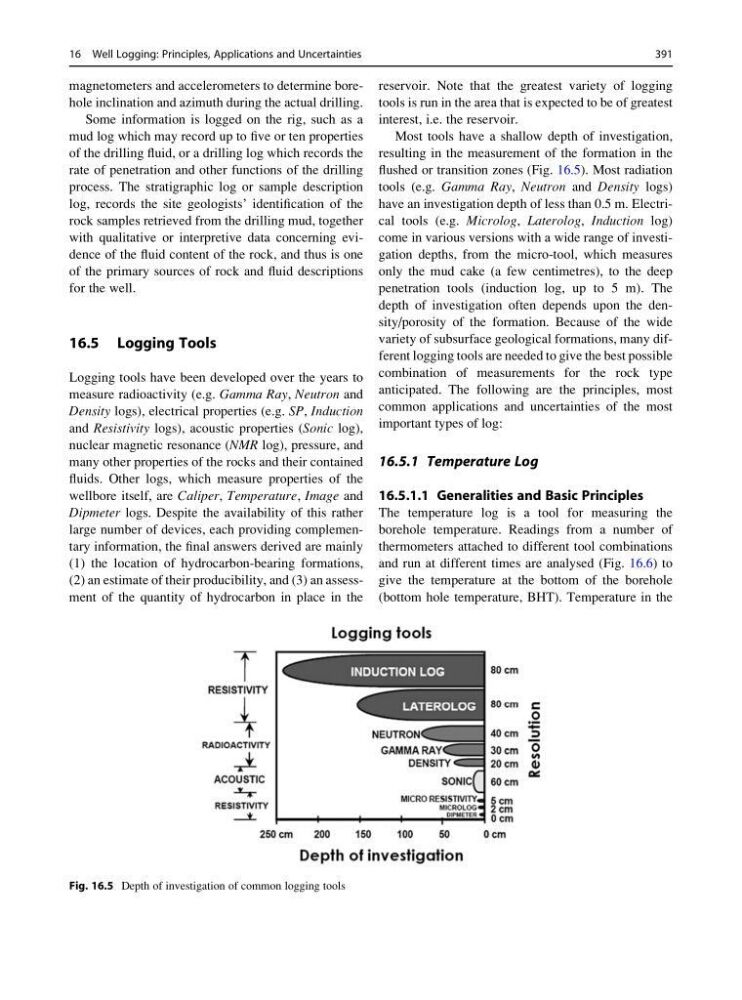
Most tools have a shallow depth of investigation,
resulting in the measurement of the formation in the
flushed or transition zones (Fig. 16.5). Most radiation
tools (e.g. Gamma Ray, Neutron and Density logs)
have an investigation depth of less than 0.5 m. Electrical tools (e.g. Microlog, Laterolog, Induction log)
come in various versions with a wide range of investigation depths, from the micro-tool, which measures
only the mud cake (a few centimetres), to the deep
penetration tools (induction log, up to 5 m). The
depth of investigation often depends upon the density/porosity of the formation. Because of the wide
variety of subsurface geological formations, many different logging tools are needed to give the best possible
combination of measurements for the rock type
anticipated. The following are the principles, most
common applications and uncertainties of the most
important types of log:
16.5.1 Temperature Log
16.5.1.1 Generalities and Basic Principles
The temperature log is a tool for measuring the
borehole temperature. Readings from a number of
thermometers attached to different tool combinations
and run at different times are analysed (Fig. 16.6) to
give the temperature at the bottom of the borehole
(bottom hole temperature, BHT). Temperature in the
Fig. 16.5 Depth of investigation of common logging tools
16 Well Logging: Principles, Applications and Uncertainties
391
Some information is logged on the rig, such as a
mud log which may record up to five or ten properties
of the drilling fluid, or a drilling log which records the
rate of penetration and other functions of the drilling
process. The stratigraphic log or sample description
log, records the site geologists’ identification of the
rock samples retrieved from the drilling mud, together
with qualitative or interpretive data concerning evidence of the fluid content of the rock, and thus is one
of the primary sources of rock and fluid descriptions
for the well.
16.5 Logging Tools
Logging tools have been developed over the years to
measure radioactivity (e.g. Gamma Ray, Neutron and
Density logs), electrical properties (e.g. SP, Induction
and Resistivity logs), acoustic properties (Sonic log),
nuclear magnetic resonance (NMR log), pressure, and
many other properties of the rocks and their contained
fluids. Other logs, which measure properties of the
wellbore itself, are Caliper, Temperature, Image and
Dipmeter logs. Despite the availability of this rather
large number of devices, each providing complementary information, the final answers derived are mainly
(1) the location of hydrocarbon-bearing formations,
(2) an estimate of their producibility, and (3) an assessment of the quantity of hydrocarbon in place in the
reservoir. Note that the greatest variety of logging
tools is run in the area that is expected to be of greatest
interest, i.e. the reservoir.
Most tools have a shallow depth of investigation,
resulting in the measurement of the formation in the
flushed or transition zones (Fig. 16.5). Most radiation
tools (e.g. Gamma Ray, Neutron and Density logs)
have an investigation depth of less than 0.5 m. Electrical tools (e.g. Microlog, Laterolog, Induction log)
come in various versions with a wide range of investigation depths, from the micro-tool, which measures
only the mud cake (a few centimetres), to the deep
penetration tools (induction log, up to 5 m). The
depth of investigation often depends upon the density/porosity of the formation. Because of the wide
variety of subsurface geological formations, many different logging tools are needed to give the best possible
combination of measurements for the rock type
anticipated. The following are the principles, most
common applications and uncertainties of the most
important types of log:
16.5.1 Temperature Log
16.5.1.1 Generalities and Basic Principles
The temperature log is a tool for measuring the
borehole temperature. Readings from a number of
thermometers attached to different tool combinations
and run at different times are analysed (Fig. 16.6) to
give the temperature at the bottom of the borehole
(bottom hole temperature, BHT). Temperature in the
Fig. 16.5 Depth of investigation of common logging tools
16 Well Logging: Principles, Applications and Uncertainties
391