

16.4 Measuring Techniques
Well logs measure in open hole, cased hole and parallel with drilling (Fig. 16.4). The conventional wireline
logs that are run in a hole which has just been drilled,
and before it is cased, are called open-hole logs. Openhole logs require that the drill-string must be removed
from the well before the logging tools can be lowered
into the hole. Open hole logs are used to determine
most petrophysical properties of the rocks. Logs run
after the well is cased are called cased-hole logs. Most
cased-hole logs are used to assess the integrity of the
well completion and fluid flow into the well though
some cased-hole logs can also be used to determine
petrophysical properties. Most logs can now be
recorded while drilling (i.e. do not need the drill-string
be removed) and so measurements are available continuously as drilling proceeds. These logs are called
MWD (Measurements While Drilling) and LWD (Logging While Drilling).
MWD and LWD are types of well logging where
the measurement tools are incorporated into the drillstring and provide real-time information to help with
steering the drill. These technologies were originally
developed to partially or completely replace the openand cased-hole logging. MWD and LWD offer the
same measurements as wireline logging but in poor
quality, lower resolution and less coverage. Information
may be continuously transmitted to the surface by mud
pulses, a common method of data transmission where a
valve is operated to restrict the flow of the drilling mud
according to the digital information to be transmitted.
This creates pressure fluctuations representing the
information. The pressure fluctuations propagate within
the drilling fluid towards the surface where they are
received from pressure sensors. At the surface, the
received pressure signals are processed by computers
to reconstruct the information. Alternatively, the data is
recorded downhole and retrieved later when the instrument is brought back to the surface.
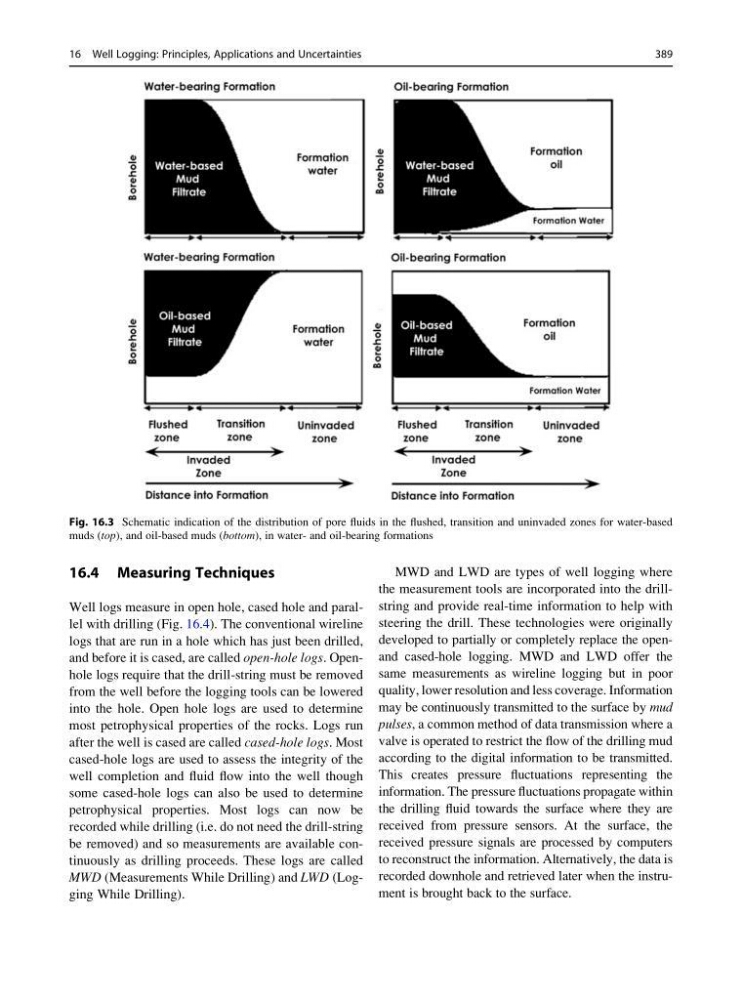
Fig. 16.3 Schematic indication of the distribution of pore fluids in the flushed, transition and uninvaded zones for water-based
muds (top), and oil-based muds (bottom), in water- and oil-bearing formations
16 Well Logging: Principles, Applications and Uncertainties
389
Well logs measure in open hole, cased hole and parallel with drilling (Fig. 16.4). The conventional wireline
logs that are run in a hole which has just been drilled,
and before it is cased, are called open-hole logs. Openhole logs require that the drill-string must be removed
from the well before the logging tools can be lowered
into the hole. Open hole logs are used to determine
most petrophysical properties of the rocks. Logs run
after the well is cased are called cased-hole logs. Most
cased-hole logs are used to assess the integrity of the
well completion and fluid flow into the well though
some cased-hole logs can also be used to determine
petrophysical properties. Most logs can now be
recorded while drilling (i.e. do not need the drill-string
be removed) and so measurements are available continuously as drilling proceeds. These logs are called
MWD (Measurements While Drilling) and LWD (Logging While Drilling).
MWD and LWD are types of well logging where
the measurement tools are incorporated into the drillstring and provide real-time information to help with
steering the drill. These technologies were originally
developed to partially or completely replace the openand cased-hole logging. MWD and LWD offer the
same measurements as wireline logging but in poor
quality, lower resolution and less coverage. Information
may be continuously transmitted to the surface by mud
pulses, a common method of data transmission where a
valve is operated to restrict the flow of the drilling mud
according to the digital information to be transmitted.
This creates pressure fluctuations representing the
information. The pressure fluctuations propagate within
the drilling fluid towards the surface where they are
received from pressure sensors. At the surface, the
received pressure signals are processed by computers
to reconstruct the information. Alternatively, the data is
recorded downhole and retrieved later when the instrument is brought back to the surface.
Fig. 16.3 Schematic indication of the distribution of pore fluids in the flushed, transition and uninvaded zones for water-based
muds (top), and oil-based muds (bottom), in water- and oil-bearing formations
16 Well Logging: Principles, Applications and Uncertainties
389