

concerns subsurface mapping or correlation. Estimation is the more quantitative aspect of well logging, in
which physical parameters such as water saturation or
pressure are needed with some precision. The final
category consists of well logging measurements
which are used to monitor changes in a reservoir
during its production phase.
16.3 Drilling Muds and Borehole
Environments
During drilling a water-based, or sometimes oil-based,
slurry containing clays and other natural materials,
called drilling mud (drilling fluid), is pumped down
the drill-string. Drilling muds are added to the
wellbore to facilitate the drilling process by
suspending cuttings, controlling pressure, stabilising
exposed rock, providing buoyancy, and cooling and
lubricating the drilling bit. Nowadays, drilling deeper,
longer and more challenging wells is made possible
due to more efficient and effective drilling fluids. High
density materials (e.g. barite, hematite) are added to
the drilling mud to increase its density and thereby its
pressure on the walls of the well. The drilling fluid
pumped down the borehole must ensure that the
hydrostatic pressure in the wellbore exceeds the fluid
pressure in the formation pore space to prevent
disasters such as blowouts. The drilling mud helps to
transport the rock fragments (cuttings) from the drill
bit up to the surface (Fig. 16.2), where the cuttings are
analysed for indications of hydrocarbon. Another
important function of drilling fluids is rock
stabilisation. Special additives ensure that the drilling
fluid is not absorbed by the rock formation in the well
and that the pores of the rock formation are not
clogged.
Because the pressure in the drilling mud must
exceed the formation pore pressure, the mud begins
to enter permeable zones in the formation but is normally rapidly stopped by the build-up of a mudcake
which lines the borehole wall (Fig. 16.2). The solid
particles are concentrated there while the fluid
penetrates the formation, first creating a flushed zone
where nearly all the primary pore fluids are replaced
by the fluids from the drilling mud. This part of the
drilling mud is called the mud filtrate. Beyond this,
there will be a zone where the primary pore fluids are
partially replaced by drilling fluids, called the transition zone. The virgin formation fluids occupy the
uninvaded/undisturbed zone further into the formation
(Fig. 16.2). The depth of invasion is related to the
permeability of the rock. Drilling mud extends furthest
into porous sandstones but flushing and invasion will
be rather limited in low permeability formations such
as shales and tight sandstones. As the well is drilled
deeper, further invasion occurs slowly through the
mudcake, either dynamically, while mud is being
circulated, or statically when the mud is stationary.
In addition, the movement of the drill-string can dislodge some of the mudcake, allowing renewed
invasion.
The replacement of oil by the water-based mud
filtrate is by pressure-driven displacement. In waterbearing formations the mud filtrate replaces all of the
formation water close to the borehole (Fig. 16.3a) but
this decreases with depth of invasion. In oil-bearing
formations the mud filtrate replaces all the formation
water and most of the oil close to the borehole wall,
again decreasing with distance into the formation
(Fig 16.3b). Oil-based mud filtrates replace the fluids
in the invaded zone by pressure-driven displacement
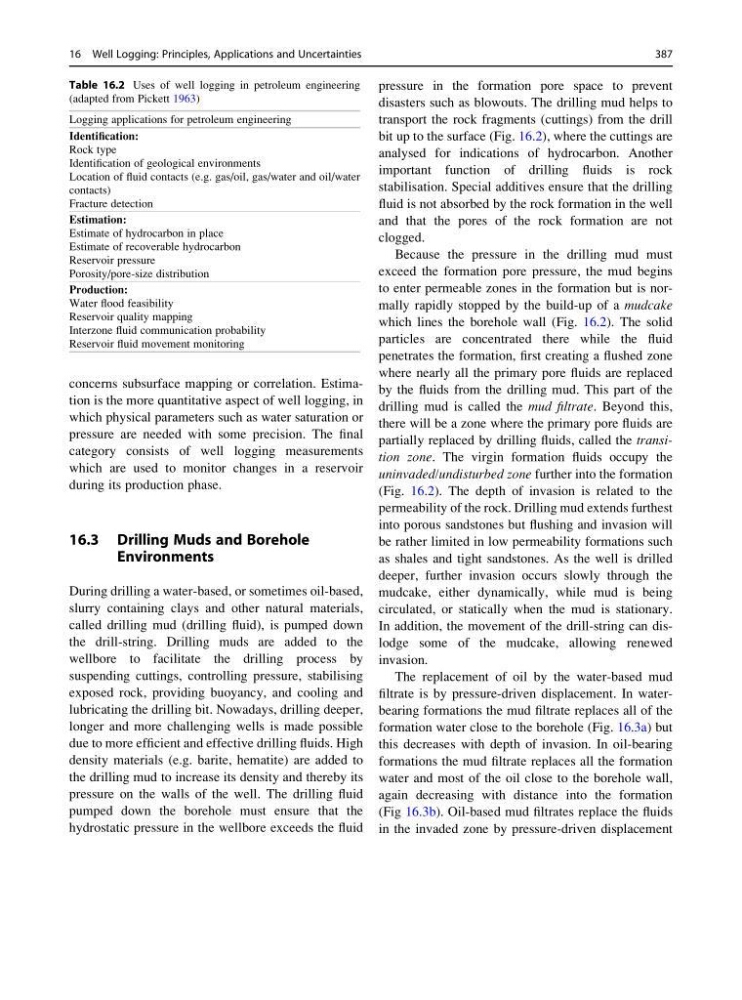
Table 16.2 Uses of well logging in petroleum engineering
(adapted from Pickett 1963)
Logging applications for petroleum engineering
Identification:
Rock type
Identification of geological environments
Location of fluid contacts (e.g. gas/oil, gas/water and oil/water
contacts)
Fracture detection
Estimation:
Estimate of hydrocarbon in place
Estimate of recoverable hydrocarbon
Reservoir pressure
Porosity/pore-size distribution
Production:
Water flood feasibility
Reservoir quality mapping
Interzone fluid communication probability
Reservoir fluid movement monitoring
16 Well Logging: Principles, Applications and Uncertainties
387
which physical parameters such as water saturation or
pressure are needed with some precision. The final
category consists of well logging measurements
which are used to monitor changes in a reservoir
during its production phase.
16.3 Drilling Muds and Borehole
Environments
During drilling a water-based, or sometimes oil-based,
slurry containing clays and other natural materials,
called drilling mud (drilling fluid), is pumped down
the drill-string. Drilling muds are added to the
wellbore to facilitate the drilling process by
suspending cuttings, controlling pressure, stabilising
exposed rock, providing buoyancy, and cooling and
lubricating the drilling bit. Nowadays, drilling deeper,
longer and more challenging wells is made possible
due to more efficient and effective drilling fluids. High
density materials (e.g. barite, hematite) are added to
the drilling mud to increase its density and thereby its
pressure on the walls of the well. The drilling fluid
pumped down the borehole must ensure that the
hydrostatic pressure in the wellbore exceeds the fluid
pressure in the formation pore space to prevent
disasters such as blowouts. The drilling mud helps to
transport the rock fragments (cuttings) from the drill
bit up to the surface (Fig. 16.2), where the cuttings are
analysed for indications of hydrocarbon. Another
important function of drilling fluids is rock
stabilisation. Special additives ensure that the drilling
fluid is not absorbed by the rock formation in the well
and that the pores of the rock formation are not
clogged.
Because the pressure in the drilling mud must
exceed the formation pore pressure, the mud begins
to enter permeable zones in the formation but is normally rapidly stopped by the build-up of a mudcake
which lines the borehole wall (Fig. 16.2). The solid
particles are concentrated there while the fluid
penetrates the formation, first creating a flushed zone
where nearly all the primary pore fluids are replaced
by the fluids from the drilling mud. This part of the
drilling mud is called the mud filtrate. Beyond this,
there will be a zone where the primary pore fluids are
partially replaced by drilling fluids, called the transition zone. The virgin formation fluids occupy the
uninvaded/undisturbed zone further into the formation
(Fig. 16.2). The depth of invasion is related to the
permeability of the rock. Drilling mud extends furthest
into porous sandstones but flushing and invasion will
be rather limited in low permeability formations such
as shales and tight sandstones. As the well is drilled
deeper, further invasion occurs slowly through the
mudcake, either dynamically, while mud is being
circulated, or statically when the mud is stationary.
In addition, the movement of the drill-string can dislodge some of the mudcake, allowing renewed
invasion.
The replacement of oil by the water-based mud
filtrate is by pressure-driven displacement. In waterbearing formations the mud filtrate replaces all of the
formation water close to the borehole (Fig. 16.3a) but
this decreases with depth of invasion. In oil-bearing
formations the mud filtrate replaces all the formation
water and most of the oil close to the borehole wall,
again decreasing with distance into the formation
(Fig 16.3b). Oil-based mud filtrates replace the fluids
in the invaded zone by pressure-driven displacement
Table 16.2 Uses of well logging in petroleum engineering
(adapted from Pickett 1963)
Logging applications for petroleum engineering
Identification:
Rock type
Identification of geological environments
Location of fluid contacts (e.g. gas/oil, gas/water and oil/water
contacts)
Fracture detection
Estimation:
Estimate of hydrocarbon in place
Estimate of recoverable hydrocarbon
Reservoir pressure
Porosity/pore-size distribution
Production:
Water flood feasibility
Reservoir quality mapping
Interzone fluid communication probability
Reservoir fluid movement monitoring
16 Well Logging: Principles, Applications and Uncertainties
387