

permeability, and the oil saturation and relative permeability will therefore also be high.
In fining-upward units such as fluvial sandstones
and turbidites the permeability and capillary entry
pressure decrease upward. Due to its buoyancy, oil
will flow along the top of sandstone or siltstone beds
against the overlying mudstones or shales. Here the
permeability as well as the oil saturation will be lower
in siltstones and poorly sorted sandstones and the flow
rate and oil saturation is reduced compared to cleaner
sands. Sedimentary structures such as cross-bedding
may contain laminae that are barriers for oil because
they have very high capillary entry pressure. This may
produce micro-traps for the migrating oil and gas,
increasing the loss during migration.
The direction of migration is up the maximum
slope of sandstone beds in regular planar sand sheets
which may be folded, and this may be modelled based
on 3D seismic. In elongate sandstone bodies like fluvial channels and certain submarine bars, however, the
direction of migration is also controlled by the
sandstone geometry. Abandoned channels may
become separate traps and synsedimentary faults (i.e.
growth faults) may trap migrating oil and gas. On a
smaller scale there may be micro-traps defined by
sedimentary structures or small-scale faulting, and
faulting will increase the volume of oil and gas lost
during migration. Foresets in cross-bedded sandstones
may contain laminae and even stylolites which may be
barriers for fluid flow, particularly oil because of the
capillary resistance.
15.4 Migration of Oil Through Shales
There are rarely continuous connecting sandstone bodies from the source rock to the reservoir, and petroleum must therefore migrate through shales.
Fluid flow through shales may occur in different
ways:
1. Matrix-controlled (intergranular flow)
Primary migration
Petroleum migration
Source rock
S e c o n d a ry m ig ra ti o n
L a t e r a l c a r r i e r
Trap
Trap
Trap
Reservoir rock
Vertical carrier
Seal
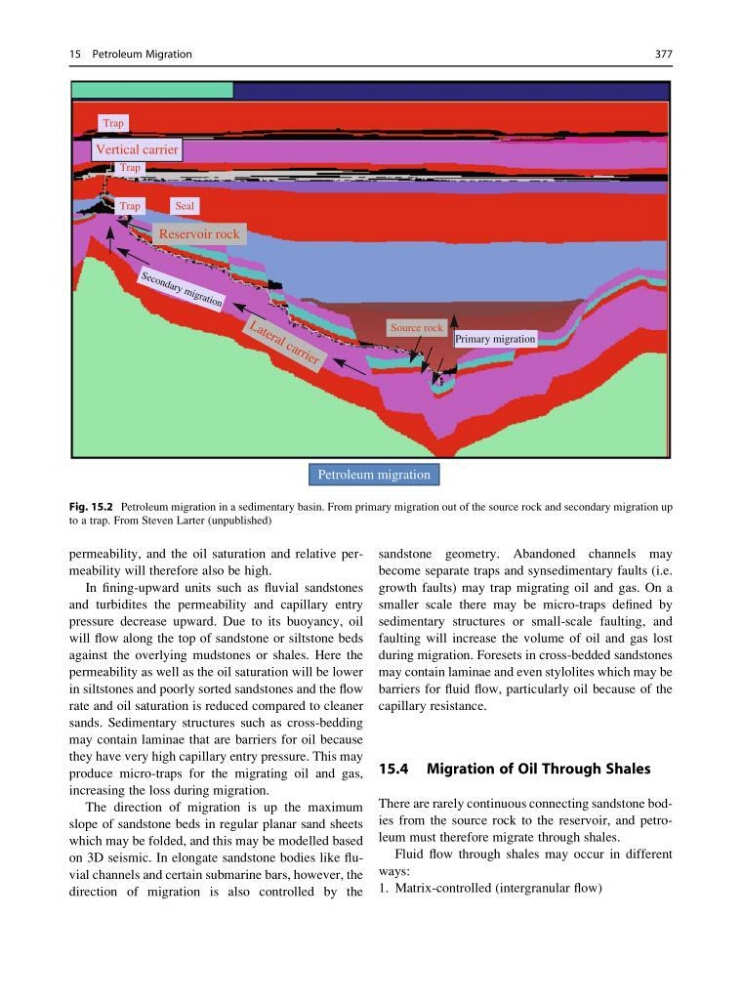
Fig. 15.2 Petroleum migration in a sedimentary basin. From primary migration out of the source rock and secondary migration up
to a trap. From Steven Larter (unpublished)
15 Petroleum Migration
377
In fining-upward units such as fluvial sandstones
and turbidites the permeability and capillary entry
pressure decrease upward. Due to its buoyancy, oil
will flow along the top of sandstone or siltstone beds
against the overlying mudstones or shales. Here the
permeability as well as the oil saturation will be lower
in siltstones and poorly sorted sandstones and the flow
rate and oil saturation is reduced compared to cleaner
sands. Sedimentary structures such as cross-bedding
may contain laminae that are barriers for oil because
they have very high capillary entry pressure. This may
produce micro-traps for the migrating oil and gas,
increasing the loss during migration.
The direction of migration is up the maximum
slope of sandstone beds in regular planar sand sheets
which may be folded, and this may be modelled based
on 3D seismic. In elongate sandstone bodies like fluvial channels and certain submarine bars, however, the
direction of migration is also controlled by the
sandstone geometry. Abandoned channels may
become separate traps and synsedimentary faults (i.e.
growth faults) may trap migrating oil and gas. On a
smaller scale there may be micro-traps defined by
sedimentary structures or small-scale faulting, and
faulting will increase the volume of oil and gas lost
during migration. Foresets in cross-bedded sandstones
may contain laminae and even stylolites which may be
barriers for fluid flow, particularly oil because of the
capillary resistance.
15.4 Migration of Oil Through Shales
There are rarely continuous connecting sandstone bodies from the source rock to the reservoir, and petroleum must therefore migrate through shales.
Fluid flow through shales may occur in different
ways:
1. Matrix-controlled (intergranular flow)
Primary migration
Petroleum migration
Source rock
S e c o n d a ry m ig ra ti o n
L a t e r a l c a r r i e r
Trap
Trap
Trap
Reservoir rock
Vertical carrier
Seal
Fig. 15.2 Petroleum migration in a sedimentary basin. From primary migration out of the source rock and secondary migration up
to a trap. From Steven Larter (unpublished)
15 Petroleum Migration
377