

The smallest pore throats are therefore critical for the
migration, not the radius of the pores themselves.
The capillary forces can be tested experimentally
by measuring the pressure required to displace water
and force oil into sandstone. The pressure measured
corresponds to oil columns from 0.3 to 3 m
(Schowalter 1997). In siltstones the displacement pressure is much higher and in mudstones and shales the
displacement pressure corresponds to hundreds of
metres or even kilometres of oil column.
It is difficult to control the surface properties of oils
in the laboratory. Experimentally it is easier to use
mercury as the displacing fluid and mercury
capillary-pressure curves (mercury injection curves)
are the standard way to analyse the effective pore
size distribution in reservoir rocks. Since the surface
tension is known the critical pore throat radius (R) can
be calculated.
In sandstones the displacement pressure increases
with increasing cementation and the resultant reduction in porosity and permeability. Even relatively well
cemented sandstones are not normally barriers to oil
migration, though. Well-cemented carbonate layers
and also thin clay layers and stylolites may serve
effectively as seals for further migration. The main
problem is usually not the migration through
sandstones, but from one sandstone body to the next
through shales. Faults in sandstones may have a clay
smear, reducing the permeability and increasing the
capillary entry pressure.
During progressive burial, faults and fractures do
not tend to be open conduits for fluid flow, but during
uplift rocks are more brittle (overconsolidated) and
fractures and faults may be more open.
Shales and mudstones buried to more than about
3 km have relatively low porosity and permeability
and high capillary entry pressure. The vertical extension of oil columns is limited by the depth at which oil
is generated (3–5 km) and the reservoir depth.
Extractions of fluids from shales in near contact with
oil and condensate in reservoirs do not show evidence
of oil saturation (Olstad et al. 1997), suggesting that
oil has not displaced water in the shales. Gas
molecules, and particularly methane, are very much
smaller than those composing oils and can probably
diffuse through shales, though at relatively slow rates.
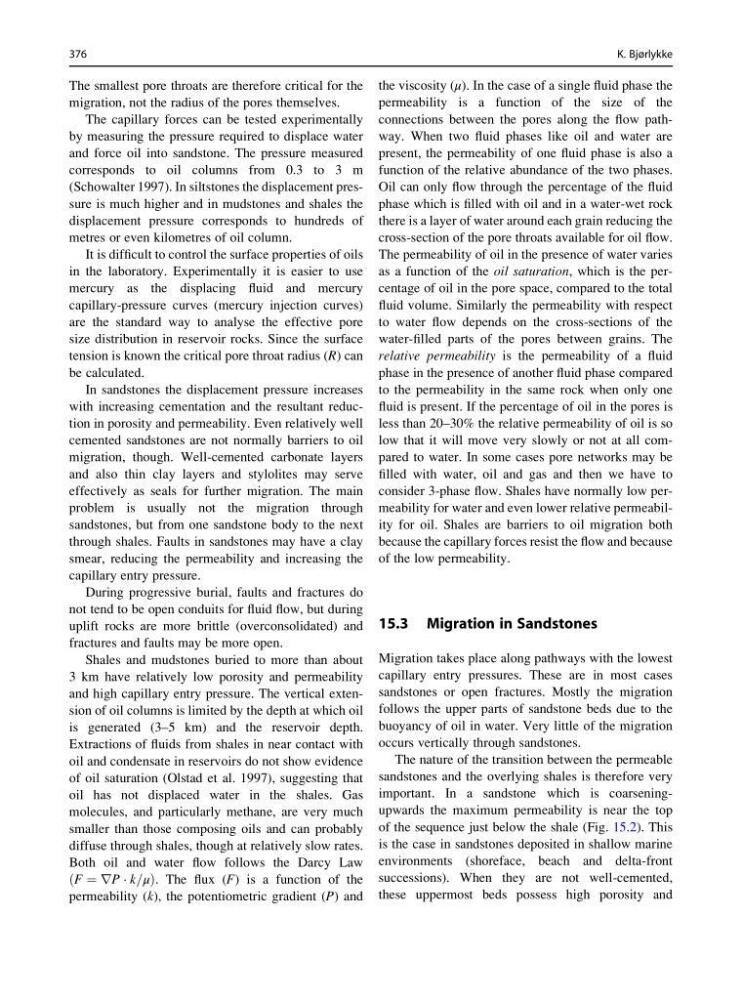
Both oil and water flow follows the Darcy Law
F ¼ rP Á k=μ
ð
Þ . The flux (F) is a function of the
permeability (k), the potentiometric gradient (P) and
the viscosity (μ). In the case of a single fluid phase the
permeability is a function of the size of the
connections between the pores along the flow pathway. When two fluid phases like oil and water are
present, the permeability of one fluid phase is also a
function of the relative abundance of the two phases.
Oil can only flow through the percentage of the fluid
phase which is filled with oil and in a water-wet rock
there is a layer of water around each grain reducing the
cross-section of the pore throats available for oil flow.
The permeability of oil in the presence of water varies
as a function of the oil saturation, which is the percentage of oil in the pore space, compared to the total
fluid volume. Similarly the permeability with respect
to water flow depends on the cross-sections of the
water-filled parts of the pores between grains. The
relative permeability is the permeability of a fluid
phase in the presence of another fluid phase compared
to the permeability in the same rock when only one
fluid is present. If the percentage of oil in the pores is
less than 20–30% the relative permeability of oil is so
low that it will move very slowly or not at all compared to water. In some cases pore networks may be
filled with water, oil and gas and then we have to
consider 3-phase flow. Shales have normally low permeability for water and even lower relative permeability for oil. Shales are barriers to oil migration both
because the capillary forces resist the flow and because
of the low permeability.
15.3 Migration in Sandstones
Migration takes place along pathways with the lowest
capillary entry pressures. These are in most cases
sandstones or open fractures. Mostly the migration
follows the upper parts of sandstone beds due to the
buoyancy of oil in water. Very little of the migration
occurs vertically through sandstones.
The nature of the transition between the permeable
sandstones and the overlying shales is therefore very
important. In a sandstone which is coarseningupwards the maximum permeability is near the top
of the sequence just below the shale (Fig. 15.2). This
is the case in sandstones deposited in shallow marine
environments (shoreface, beach and delta-front
successions). When they are not well-cemented,
these uppermost beds possess high porosity and
376
K. Bjørlykke
migration, not the radius of the pores themselves.
The capillary forces can be tested experimentally
by measuring the pressure required to displace water
and force oil into sandstone. The pressure measured
corresponds to oil columns from 0.3 to 3 m
(Schowalter 1997). In siltstones the displacement pressure is much higher and in mudstones and shales the
displacement pressure corresponds to hundreds of
metres or even kilometres of oil column.
It is difficult to control the surface properties of oils
in the laboratory. Experimentally it is easier to use
mercury as the displacing fluid and mercury
capillary-pressure curves (mercury injection curves)
are the standard way to analyse the effective pore
size distribution in reservoir rocks. Since the surface
tension is known the critical pore throat radius (R) can
be calculated.
In sandstones the displacement pressure increases
with increasing cementation and the resultant reduction in porosity and permeability. Even relatively well
cemented sandstones are not normally barriers to oil
migration, though. Well-cemented carbonate layers
and also thin clay layers and stylolites may serve
effectively as seals for further migration. The main
problem is usually not the migration through
sandstones, but from one sandstone body to the next
through shales. Faults in sandstones may have a clay
smear, reducing the permeability and increasing the
capillary entry pressure.
During progressive burial, faults and fractures do
not tend to be open conduits for fluid flow, but during
uplift rocks are more brittle (overconsolidated) and
fractures and faults may be more open.
Shales and mudstones buried to more than about
3 km have relatively low porosity and permeability
and high capillary entry pressure. The vertical extension of oil columns is limited by the depth at which oil
is generated (3–5 km) and the reservoir depth.
Extractions of fluids from shales in near contact with
oil and condensate in reservoirs do not show evidence
of oil saturation (Olstad et al. 1997), suggesting that
oil has not displaced water in the shales. Gas
molecules, and particularly methane, are very much
smaller than those composing oils and can probably
diffuse through shales, though at relatively slow rates.
Both oil and water flow follows the Darcy Law
F ¼ rP Á k=μ
ð
Þ . The flux (F) is a function of the
permeability (k), the potentiometric gradient (P) and
the viscosity (μ). In the case of a single fluid phase the
permeability is a function of the size of the
connections between the pores along the flow pathway. When two fluid phases like oil and water are
present, the permeability of one fluid phase is also a
function of the relative abundance of the two phases.
Oil can only flow through the percentage of the fluid
phase which is filled with oil and in a water-wet rock
there is a layer of water around each grain reducing the
cross-section of the pore throats available for oil flow.
The permeability of oil in the presence of water varies
as a function of the oil saturation, which is the percentage of oil in the pore space, compared to the total
fluid volume. Similarly the permeability with respect
to water flow depends on the cross-sections of the
water-filled parts of the pores between grains. The
relative permeability is the permeability of a fluid
phase in the presence of another fluid phase compared
to the permeability in the same rock when only one
fluid is present. If the percentage of oil in the pores is
less than 20–30% the relative permeability of oil is so
low that it will move very slowly or not at all compared to water. In some cases pore networks may be
filled with water, oil and gas and then we have to
consider 3-phase flow. Shales have normally low permeability for water and even lower relative permeability for oil. Shales are barriers to oil migration both
because the capillary forces resist the flow and because
of the low permeability.
15.3 Migration in Sandstones
Migration takes place along pathways with the lowest
capillary entry pressures. These are in most cases
sandstones or open fractures. Mostly the migration
follows the upper parts of sandstone beds due to the
buoyancy of oil in water. Very little of the migration
occurs vertically through sandstones.
The nature of the transition between the permeable
sandstones and the overlying shales is therefore very
important. In a sandstone which is coarseningupwards the maximum permeability is near the top
of the sequence just below the shale (Fig. 15.2). This
is the case in sandstones deposited in shallow marine
environments (shoreface, beach and delta-front
successions). When they are not well-cemented,
these uppermost beds possess high porosity and
376
K. Bjørlykke