

2. Flow in fractures produced by hydro-fracturing due
to overpressure (mostly microfractures)
3. Flow in tectonically induced macrofractures
In the case of matrix-controlled flow the capillary
entry pressure and the permeability are a function of
the pore size distribution and diagenetic alterations. In
shales the typical pore sizes may be a few 100 A ˚ or
less. In the Gulf Coast the pore diameter may be less
than 25 A ˚ at 3–4 km depth and less than 10 A ˚ at
4–5 km burial (Leonard 1993). The size of the largest
pores and their connections will however determine
the permeability. If the largest connecting pore size is
below 50 A ˚ this is approaching the size of the
asphaltenes in crude oil (Tissot and Welte 1978, p.
170). A sieving effect should therefore be observed
relative to the size of the organic molecules if the pore
throats are below this value. Migration of oil through
low permeability shales probably only happens along
fractures and not through the shale matrix. Fractures in
shales may be formed tectonically during uplift and
extension when the shales are brittle. Relatively large
fractures may occur because the horizontal stresses
trying to close the fractures are generally small. This
is a common cause of oil and gas leakage from
reservoirs. However, nearly all onshore reservoirs
and many offshore reservoirs have experienced some
uplift from their maximum burial depth and in a rock
mechanical sense are therefore overconsolidated and
will tend to be brittle. During basin subsidence, tectonic shear produces fractures during ductile deformation and these fractures are then no more permeable
than the matrix.
Oil fields are often highly overpressured, with
many of them leaking petroleum at the top of the
structure which is often close to the fracture pressure.
This means that it is the horizontal stress and the
tensional strength of the rocks that control the pressure. When the pressure is close to fracture pressure it
implies that faults are no longer the conduits for fluid
flow because the rock matrix would then fracture and
let the oil through. If faults were a zone of weakness
the fluid pressure should have remained below fracture
pressure.
In the case of traps formed by rotated fault blocks
the top of the structure will usually coincide with a
fault. Even if seismic evidence indicates gas leakage
from the top of the reservoir, this does not necessarily
mean that the leakage is along the fault, because
fracturing of the cap rock will occur in approximately
the same position (Fig. 15.3).
We must distinguish clearly between migration of
oil along a fault plane and across it. If there is sand on
both sides of the fault plane it is difficult to predict if
the fault will be a barrier for oil migration. Sealing
faults are often critical for the formation of traps in
rotated fault blocks. Clay smears from adjacent shales
can serve as a barrier at shallow depth, while at greater
depth intensive quartz cementation may reduce the
permeability and the capillary entry pressure for oil.
See further discussion on rock mechanics in sedimentary basins (Chap. 11).
In subsiding basins, fault planes are at shallow to
moderate burial depth and are subjected to shear deformation which produces clay smearing, so that the
permeability along the fault is normally lower than
through the rock matrix. After tectonic displacement,
faults may also be subject to cementation. During
tectonic uplift, however, faults may be extensional
and much more permeable.
Migration due to hydrofracturing of shales. If the
fluid pressure exceeds the fracture pressure the rock
will hydrofracture. The pressure required to fracture
the rock can be measured in a well by using a leak-off
test (LOT test, see Chap. 11). However, the LOT
Perm
Cap. press
A
B
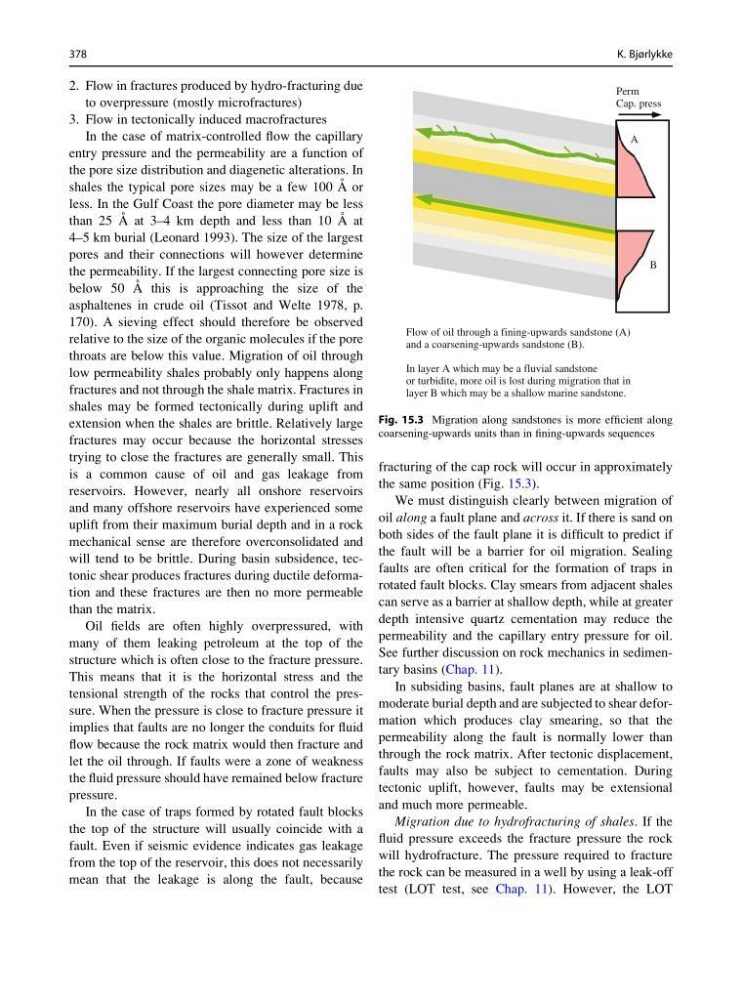
Flow of oil through a fining-upwards sandstone (A)
and a coarsening-upwards sandstone (B).
In layer A which may be a fluvial sandstone
or turbidite, more oil is lost during migration that in
layer B which may be a shallow marine sandstone.
Fig. 15.3 Migration along sandstones is more efficient along
coarsening-upwards units than in fining-upwards sequences
378
K. Bjørlykke
to overpressure (mostly microfractures)
3. Flow in tectonically induced macrofractures
In the case of matrix-controlled flow the capillary
entry pressure and the permeability are a function of
the pore size distribution and diagenetic alterations. In
shales the typical pore sizes may be a few 100 A ˚ or
less. In the Gulf Coast the pore diameter may be less
than 25 A ˚ at 3–4 km depth and less than 10 A ˚ at
4–5 km burial (Leonard 1993). The size of the largest
pores and their connections will however determine
the permeability. If the largest connecting pore size is
below 50 A ˚ this is approaching the size of the
asphaltenes in crude oil (Tissot and Welte 1978, p.
170). A sieving effect should therefore be observed
relative to the size of the organic molecules if the pore
throats are below this value. Migration of oil through
low permeability shales probably only happens along
fractures and not through the shale matrix. Fractures in
shales may be formed tectonically during uplift and
extension when the shales are brittle. Relatively large
fractures may occur because the horizontal stresses
trying to close the fractures are generally small. This
is a common cause of oil and gas leakage from
reservoirs. However, nearly all onshore reservoirs
and many offshore reservoirs have experienced some
uplift from their maximum burial depth and in a rock
mechanical sense are therefore overconsolidated and
will tend to be brittle. During basin subsidence, tectonic shear produces fractures during ductile deformation and these fractures are then no more permeable
than the matrix.
Oil fields are often highly overpressured, with
many of them leaking petroleum at the top of the
structure which is often close to the fracture pressure.
This means that it is the horizontal stress and the
tensional strength of the rocks that control the pressure. When the pressure is close to fracture pressure it
implies that faults are no longer the conduits for fluid
flow because the rock matrix would then fracture and
let the oil through. If faults were a zone of weakness
the fluid pressure should have remained below fracture
pressure.
In the case of traps formed by rotated fault blocks
the top of the structure will usually coincide with a
fault. Even if seismic evidence indicates gas leakage
from the top of the reservoir, this does not necessarily
mean that the leakage is along the fault, because
fracturing of the cap rock will occur in approximately
the same position (Fig. 15.3).
We must distinguish clearly between migration of
oil along a fault plane and across it. If there is sand on
both sides of the fault plane it is difficult to predict if
the fault will be a barrier for oil migration. Sealing
faults are often critical for the formation of traps in
rotated fault blocks. Clay smears from adjacent shales
can serve as a barrier at shallow depth, while at greater
depth intensive quartz cementation may reduce the
permeability and the capillary entry pressure for oil.
See further discussion on rock mechanics in sedimentary basins (Chap. 11).
In subsiding basins, fault planes are at shallow to
moderate burial depth and are subjected to shear deformation which produces clay smearing, so that the
permeability along the fault is normally lower than
through the rock matrix. After tectonic displacement,
faults may also be subject to cementation. During
tectonic uplift, however, faults may be extensional
and much more permeable.
Migration due to hydrofracturing of shales. If the
fluid pressure exceeds the fracture pressure the rock
will hydrofracture. The pressure required to fracture
the rock can be measured in a well by using a leak-off
test (LOT test, see Chap. 11). However, the LOT
Perm
Cap. press
A
B
Flow of oil through a fining-upwards sandstone (A)
and a coarsening-upwards sandstone (B).
In layer A which may be a fluvial sandstone
or turbidite, more oil is lost during migration that in
layer B which may be a shallow marine sandstone.
Fig. 15.3 Migration along sandstones is more efficient along
coarsening-upwards units than in fining-upwards sequences
378
K. Bjørlykke