

by chemical compaction, and open fractures will gradually be healed by quartz cement.
13.3 Carbonate Compaction
Compaction of carbonates is controlled by principally
very different processes than in siliceous sediments.
Because the kinetics of carbonate dissolution and precipitation are so much faster than for siliceous rocks
(mudstones and shales), temperature is not the main
control on carbonate compaction. Cementation of
carbonate sediments into hard solid rocks may occur
right near the surface. In addition the presence of
aragonite which is thermodynamically less stable
than calcite provides a strong drive for cementation.
The sediments then become mechanically overconsolidated and may be unable to undergo further
mechanical compaction even when subjected to
40–50 MPa (4–5 km depth). Carbonate sediments
like the Chalk, composed almost entirely of low-Mg
calcite, undergo little dissolution and cementation also
along stylolites at 2-3 km depth. Overpressure is very
important in reducing both mechanical compaction
and pressure dissolution. In the Ekofisk Field, Chalk
may have porosities exceeding 30% at nearly 3 km
burial depth due to high overpressure, because the
effective stress only corresponds to about 1 km without overpressure.
The processes controlling porosity loss in carbonate
sediments are still poorly understood.
The dissolution rate may be more important compared to sandstones. At the contact between two calcite grains there is probably only a very thin layer of
water, while clay minerals have a double layer due to
the negative surface charges. The transport of calcium
along the calcite grain contacts may also be ratelimiting. Carbonate grains, particularly of fossils,
may have an organic coating which may influence
precipitation.
Early porosity reduction in carbonate at shallow
depth may help to preserve the resultant porosity during deeper burial. Carbonates have generally lower
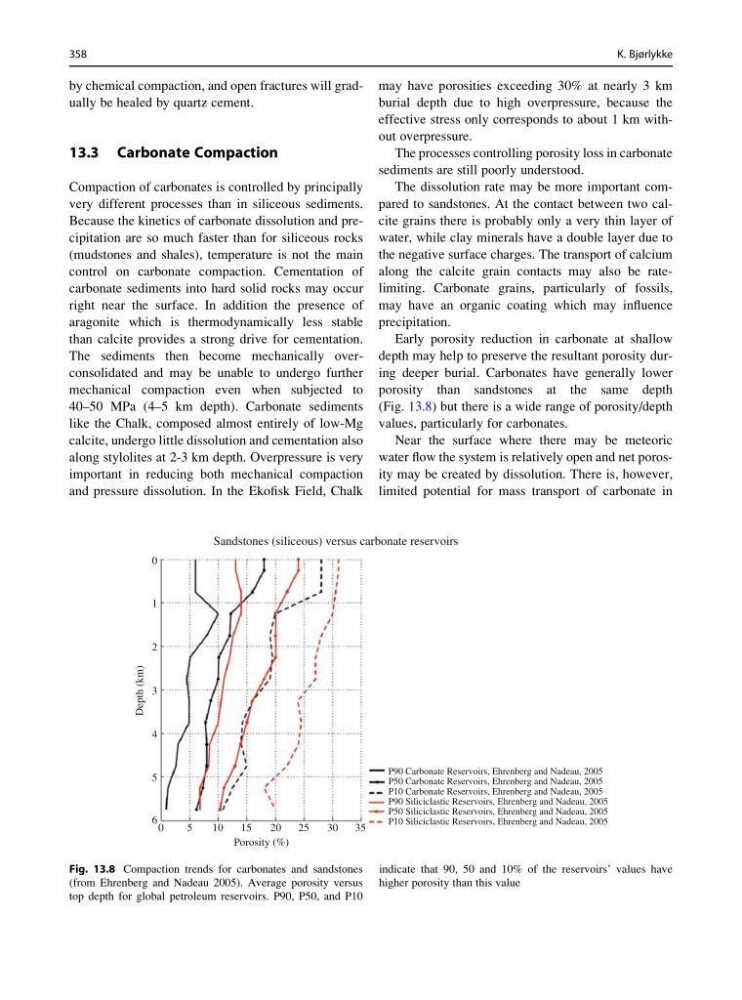
porosity than sandstones at the same depth
(Fig. 13.8) but there is a wide range of porosity/depth
values, particularly for carbonates.
Near the surface where there may be meteoric
water flow the system is relatively open and net porosity may be created by dissolution. There is, however,
limited potential for mass transport of carbonate in
0
Sandstones (siliceous) versus carbonate reservoirs
1
2
Depth (km)
3
4
5
6
0
5
10
15
20
25
30
35
P90 Carbonate Reservoirs, Ehrenberg and Nadeau, 2005
P50 Carbonate Reservoirs, Ehrenberg and Nadeau, 2005
P10 Carbonate Reservoirs, Ehrenberg and Nadeau, 2005
P90 Siliciclastic Reservoirs, Ehrenberg and Nadeau, 2005
P50 Siliciclastic Reservoirs, Ehrenberg and Nadeau, 2005
P10 Siliciclastic Reservoirs, Ehrenberg and Nadeau, 2005
Porosity (%)
Fig. 13.8 Compaction trends for carbonates and sandstones
(from Ehrenberg and Nadeau 2005). Average porosity versus
top depth for global petroleum reservoirs. P90, P50, and P10
indicate that 90, 50 and 10% of the reservoirs’ values have
higher porosity than this value
358
K. Bjørlykke
13.3 Carbonate Compaction
Compaction of carbonates is controlled by principally
very different processes than in siliceous sediments.
Because the kinetics of carbonate dissolution and precipitation are so much faster than for siliceous rocks
(mudstones and shales), temperature is not the main
control on carbonate compaction. Cementation of
carbonate sediments into hard solid rocks may occur
right near the surface. In addition the presence of
aragonite which is thermodynamically less stable
than calcite provides a strong drive for cementation.
The sediments then become mechanically overconsolidated and may be unable to undergo further
mechanical compaction even when subjected to
40–50 MPa (4–5 km depth). Carbonate sediments
like the Chalk, composed almost entirely of low-Mg
calcite, undergo little dissolution and cementation also
along stylolites at 2-3 km depth. Overpressure is very
important in reducing both mechanical compaction
and pressure dissolution. In the Ekofisk Field, Chalk
may have porosities exceeding 30% at nearly 3 km
burial depth due to high overpressure, because the
effective stress only corresponds to about 1 km without overpressure.
The processes controlling porosity loss in carbonate
sediments are still poorly understood.
The dissolution rate may be more important compared to sandstones. At the contact between two calcite grains there is probably only a very thin layer of
water, while clay minerals have a double layer due to
the negative surface charges. The transport of calcium
along the calcite grain contacts may also be ratelimiting. Carbonate grains, particularly of fossils,
may have an organic coating which may influence
precipitation.
Early porosity reduction in carbonate at shallow
depth may help to preserve the resultant porosity during deeper burial. Carbonates have generally lower
porosity than sandstones at the same depth
(Fig. 13.8) but there is a wide range of porosity/depth
values, particularly for carbonates.
Near the surface where there may be meteoric
water flow the system is relatively open and net porosity may be created by dissolution. There is, however,
limited potential for mass transport of carbonate in
0
Sandstones (siliceous) versus carbonate reservoirs
1
2
Depth (km)
3
4
5
6
0
5
10
15
20
25
30
35
P90 Carbonate Reservoirs, Ehrenberg and Nadeau, 2005
P50 Carbonate Reservoirs, Ehrenberg and Nadeau, 2005
P10 Carbonate Reservoirs, Ehrenberg and Nadeau, 2005
P90 Siliciclastic Reservoirs, Ehrenberg and Nadeau, 2005
P50 Siliciclastic Reservoirs, Ehrenberg and Nadeau, 2005
P10 Siliciclastic Reservoirs, Ehrenberg and Nadeau, 2005
Porosity (%)
Fig. 13.8 Compaction trends for carbonates and sandstones
(from Ehrenberg and Nadeau 2005). Average porosity versus
top depth for global petroleum reservoirs. P90, P50, and P10
indicate that 90, 50 and 10% of the reservoirs’ values have
higher porosity than this value
358
K. Bjørlykke