

Mud containing mostly quartz, illite and chlorite
will be chemically stable up to high temperatures
because these are metamorphic minerals. With
increasing overburden and temperature, massive
mudstones develop a more pronounced cleavage typical of shales.
This is due to a higher degree of parallel orientation
of the sheet silicate minerals, particularly mica, illite
and chlorite.
During folding, high horizontal stresses may produce an axial plane cleavage. This is controlled by a
reorientation of clay minerals (sheet silicates) and also
a flattening (elongation) of quartz grains by stressdriven dissolution and precipitation.
Mudstones and shales which have a high organic
content contain kerogen which often occurs as thin
lamina. Before the source rock becomes mature the
kerogen is a part of the solid phase and can carry some
of the overburden stress. When most of the kerogen is
altered to oil and gas it becomes part of the fluid phase,
thus changing the fluid/solid ratio so that the pore
pressure reaches fracture pressure which makes expulsion more efficient. Shales with a lower organic content also will generate petroleum and gas which may
migrate into the most porous and permeable layers.
Some of the oil and gas, though, will be retained in the
small pores as shale gas. There is now considerable
interest in shale gas, particularly in onshore basins
where drilling costs are moderate.
13.2 Sandstones
Compaction of sand and sandstones has been
discussed in Chap. 4. Mechanical compaction of
sand is very sensitive to primary grain size and sorting.
This is a function of the depositional environment.
Mechanical compaction is dominant at shallow burial
down to about 2 km (70-80
C) and at greater depth
compaction is mainly chemical, involving mineral
dissolution and precipitation. Dissolution at grain
contacts (pressure dissolution) is driven by the
increased solubility due to stress causing a slight
supersaturation of silica with respect to quartz and a
precipitation of new authigenic quartz (overgrowth). It
is now generally assumed that the precipitation, which
is a function of temperature, is the rate-limiting step
and that this chemical compaction is therefore rather
insensitive to the stress. Dissolution at grain contacts
occurs preferentially in contacts with mica and clay
minerals which favour the development of stylolites.
Transport distance between the dissolution and precipitation sites is very short and is driven by diffusion,
and will be limited by the distance between the
stylolites.
Compaction-driven porewater can not explain significant transport of silica. At normal geothermal
gradients 3·10
9 volumes of water are required to precipitate one volume of quartz. In addition, porewater is
generally not moving upwards in relation to the seafloor so there is little cooling of the porewater (see
Chap. 4).
As in mudstones, chemical compaction in
sandstones is mostly controlled by temperature and
both sandstones and mudstones compact chemically
during burial. Overpressure reduces the effective
stress but has then little effect on compaction.
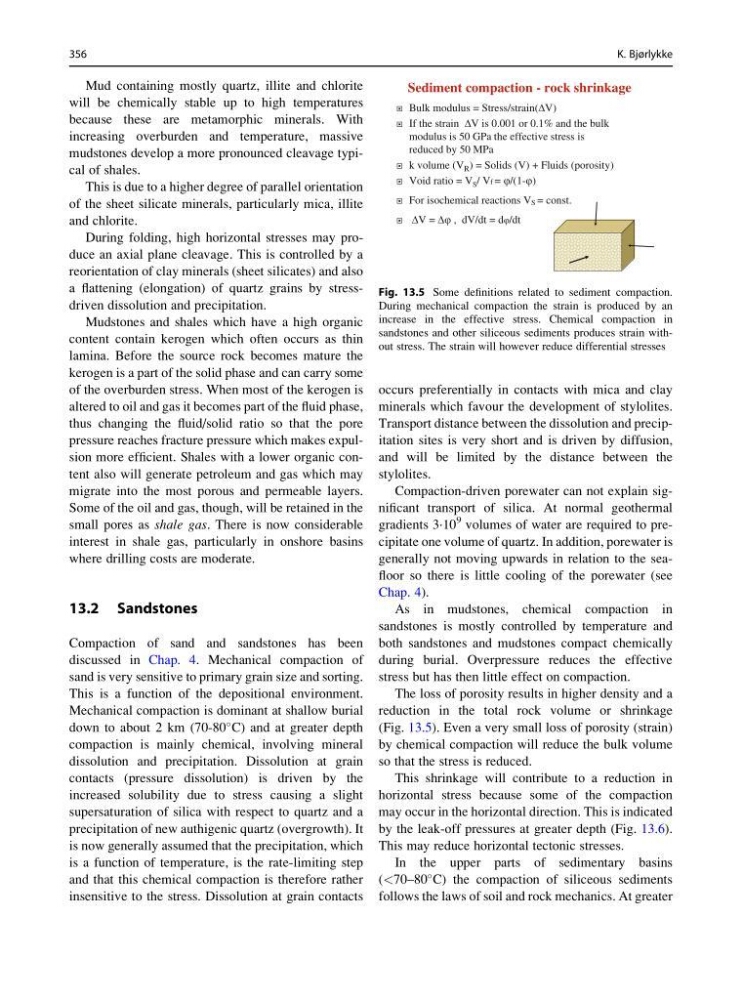
The loss of porosity results in higher density and a
reduction in the total rock volume or shrinkage
(Fig. 13.5). Even a very small loss of porosity (strain)
by chemical compaction will reduce the bulk volume
so that the stress is reduced.
This shrinkage will contribute to a reduction in
horizontal stress because some of the compaction
may occur in the horizontal direction. This is indicated
by the leak-off pressures at greater depth (Fig. 13.6).
This may reduce horizontal tectonic stresses.
In the upper parts of sedimentary basins
(<70–80
C) the compaction of siliceous sediments
follows the laws of soil and rock mechanics. At greater
Bulk modulus = Stress/strain(ΔV)
If the strain ΔV is 0.001 or 0.1% and the bulk
modulus is 50 GPa the effective stress is
reduced by 50 MPa
k volume (V R ) = Solids (V) + Fluids (porosity)
Void ratio = V S / Vf = ϕ/(1-ϕ)
For isochemical reactions VS = const.
ΔV = Δϕ , dV/dt = dϕ/dt
Sediment compaction - rock shrinkage
Fig. 13.5 Some definitions related to sediment compaction.
During mechanical compaction the strain is produced by an
increase in the effective stress. Chemical compaction in
sandstones and other siliceous sediments produces strain without stress. The strain will however reduce differential stresses
356
K. Bjørlykke
will be chemically stable up to high temperatures
because these are metamorphic minerals. With
increasing overburden and temperature, massive
mudstones develop a more pronounced cleavage typical of shales.
This is due to a higher degree of parallel orientation
of the sheet silicate minerals, particularly mica, illite
and chlorite.
During folding, high horizontal stresses may produce an axial plane cleavage. This is controlled by a
reorientation of clay minerals (sheet silicates) and also
a flattening (elongation) of quartz grains by stressdriven dissolution and precipitation.
Mudstones and shales which have a high organic
content contain kerogen which often occurs as thin
lamina. Before the source rock becomes mature the
kerogen is a part of the solid phase and can carry some
of the overburden stress. When most of the kerogen is
altered to oil and gas it becomes part of the fluid phase,
thus changing the fluid/solid ratio so that the pore
pressure reaches fracture pressure which makes expulsion more efficient. Shales with a lower organic content also will generate petroleum and gas which may
migrate into the most porous and permeable layers.
Some of the oil and gas, though, will be retained in the
small pores as shale gas. There is now considerable
interest in shale gas, particularly in onshore basins
where drilling costs are moderate.
13.2 Sandstones
Compaction of sand and sandstones has been
discussed in Chap. 4. Mechanical compaction of
sand is very sensitive to primary grain size and sorting.
This is a function of the depositional environment.
Mechanical compaction is dominant at shallow burial
down to about 2 km (70-80
C) and at greater depth
compaction is mainly chemical, involving mineral
dissolution and precipitation. Dissolution at grain
contacts (pressure dissolution) is driven by the
increased solubility due to stress causing a slight
supersaturation of silica with respect to quartz and a
precipitation of new authigenic quartz (overgrowth). It
is now generally assumed that the precipitation, which
is a function of temperature, is the rate-limiting step
and that this chemical compaction is therefore rather
insensitive to the stress. Dissolution at grain contacts
occurs preferentially in contacts with mica and clay
minerals which favour the development of stylolites.
Transport distance between the dissolution and precipitation sites is very short and is driven by diffusion,
and will be limited by the distance between the
stylolites.
Compaction-driven porewater can not explain significant transport of silica. At normal geothermal
gradients 3·10
9 volumes of water are required to precipitate one volume of quartz. In addition, porewater is
generally not moving upwards in relation to the seafloor so there is little cooling of the porewater (see
Chap. 4).
As in mudstones, chemical compaction in
sandstones is mostly controlled by temperature and
both sandstones and mudstones compact chemically
during burial. Overpressure reduces the effective
stress but has then little effect on compaction.
The loss of porosity results in higher density and a
reduction in the total rock volume or shrinkage
(Fig. 13.5). Even a very small loss of porosity (strain)
by chemical compaction will reduce the bulk volume
so that the stress is reduced.
This shrinkage will contribute to a reduction in
horizontal stress because some of the compaction
may occur in the horizontal direction. This is indicated
by the leak-off pressures at greater depth (Fig. 13.6).
This may reduce horizontal tectonic stresses.
In the upper parts of sedimentary basins
(<70–80
C) the compaction of siliceous sediments
follows the laws of soil and rock mechanics. At greater
Bulk modulus = Stress/strain(ΔV)
If the strain ΔV is 0.001 or 0.1% and the bulk
modulus is 50 GPa the effective stress is
reduced by 50 MPa
k volume (V R ) = Solids (V) + Fluids (porosity)
Void ratio = V S / Vf = ϕ/(1-ϕ)
For isochemical reactions VS = const.
ΔV = Δϕ , dV/dt = dϕ/dt
Sediment compaction - rock shrinkage
Fig. 13.5 Some definitions related to sediment compaction.
During mechanical compaction the strain is produced by an
increase in the effective stress. Chemical compaction in
sandstones and other siliceous sediments produces strain without stress. The strain will however reduce differential stresses
356
K. Bjørlykke