

of silica to be precipitated as early quartz cement. At
greater depth most of the quartz cement is probably
derived from pressure solution of detrital quartz.
In sandstones the quartz cement is sourced by solution of quartz grains at grain contacts or along
stylolites, but it is not clear to what extent silt and
sand grains floating in a matrix of clay will dissolve
and cause precipitation of quartz as cement or as
overgrowth on the grains. While quartz grains dispersed in a clay matrix may dissolve in contact with
clay minerals, the surrounding clay may prevent or
retard overgrowth.
At greater burial and temperatures (>130
C) kaolinite becomes unstable in the presence of K-feldspar
and releases silica which is precipitated as quartz
(Bjørlykke 1981, Bjørlykke et al. 1986):
Al 2 Si 2 0 5 ðOHÞ 4 þ KAlSi 3 O 8 ¼ KAl 3 Si 3 O 10 ðOHÞ 2
þ 2SiO 2 þ H 2 O
Kaolinite þ K-feldspar ¼ illite þ quartz þ water
This reaction is driven towards increased density
(lower water content).
Kaolinite is however stable up to more that 200
C
if there is no K-feldspar or other source of potassium
available locally in the rock. It may then be replaced
by pyrophyllite (AlSi 2 0 5 (OH)) which contains less
water.
a
b
c
d
e
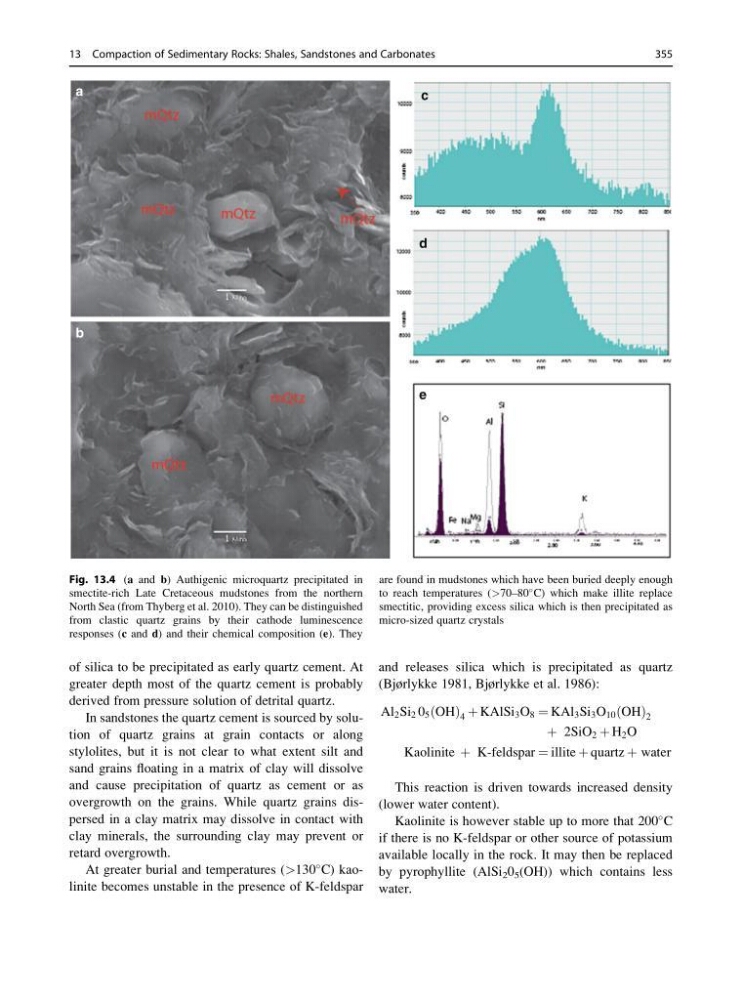
Fig. 13.4 (a and b) Authigenic microquartz precipitated in
smectite-rich Late Cretaceous mudstones from the northern
North Sea (from Thyberg et al. 2010). They can be distinguished
from clastic quartz grains by their cathode luminescence
responses (c and d) and their chemical composition (e). They
are found in mudstones which have been buried deeply enough
to reach temperatures (>70–80
C) which make illite replace
smectitic, providing excess silica which is then precipitated as
micro-sized quartz crystals
13 Compaction of Sedimentary Rocks: Shales, Sandstones and Carbonates
355
greater depth most of the quartz cement is probably
derived from pressure solution of detrital quartz.
In sandstones the quartz cement is sourced by solution of quartz grains at grain contacts or along
stylolites, but it is not clear to what extent silt and
sand grains floating in a matrix of clay will dissolve
and cause precipitation of quartz as cement or as
overgrowth on the grains. While quartz grains dispersed in a clay matrix may dissolve in contact with
clay minerals, the surrounding clay may prevent or
retard overgrowth.
At greater burial and temperatures (>130
C) kaolinite becomes unstable in the presence of K-feldspar
and releases silica which is precipitated as quartz
(Bjørlykke 1981, Bjørlykke et al. 1986):
Al 2 Si 2 0 5 ðOHÞ 4 þ KAlSi 3 O 8 ¼ KAl 3 Si 3 O 10 ðOHÞ 2
þ 2SiO 2 þ H 2 O
Kaolinite þ K-feldspar ¼ illite þ quartz þ water
This reaction is driven towards increased density
(lower water content).
Kaolinite is however stable up to more that 200
C
if there is no K-feldspar or other source of potassium
available locally in the rock. It may then be replaced
by pyrophyllite (AlSi 2 0 5 (OH)) which contains less
water.
a
b
c
d
e
Fig. 13.4 (a and b) Authigenic microquartz precipitated in
smectite-rich Late Cretaceous mudstones from the northern
North Sea (from Thyberg et al. 2010). They can be distinguished
from clastic quartz grains by their cathode luminescence
responses (c and d) and their chemical composition (e). They
are found in mudstones which have been buried deeply enough
to reach temperatures (>70–80
C) which make illite replace
smectitic, providing excess silica which is then precipitated as
micro-sized quartz crystals
13 Compaction of Sedimentary Rocks: Shales, Sandstones and Carbonates
355