

very sensitive to the chemical composition of the
porewater. Additions of salt (NaCl or KCl) are used
to stabilise soft clays for engineering purposes (construction), increasing their compressive and shear
strengths. Addition of KCl in the drilling mud is also
used to stabilise clays when drilling.
Sediments are often highly anisotropic and
parameters like seismic velocity and resistivity can
vary greatly with the orientation of the measurement
relative to the bedding. Mudstones may also become
increasingly anisotropic with burial depth, giving
higher velocity parallel to the bedding than in the
vertical direction. Experimental compaction shows,
however, that the degree of grain reorientation varies
markedly with the clay mineralogy and the content of
sand and silt (Voltolini et al. 2009).
The composition of mudstones and shales with
respect to their clay mineralogy and their content of
silt and sand can provide not only important information about the environment both in and around the
basin, but also about the rock properties controlling
bulk compressibility, density, seismic velocity and
resistivity. These parameters are important in the
interpretation of seismic data and also electromagnetic
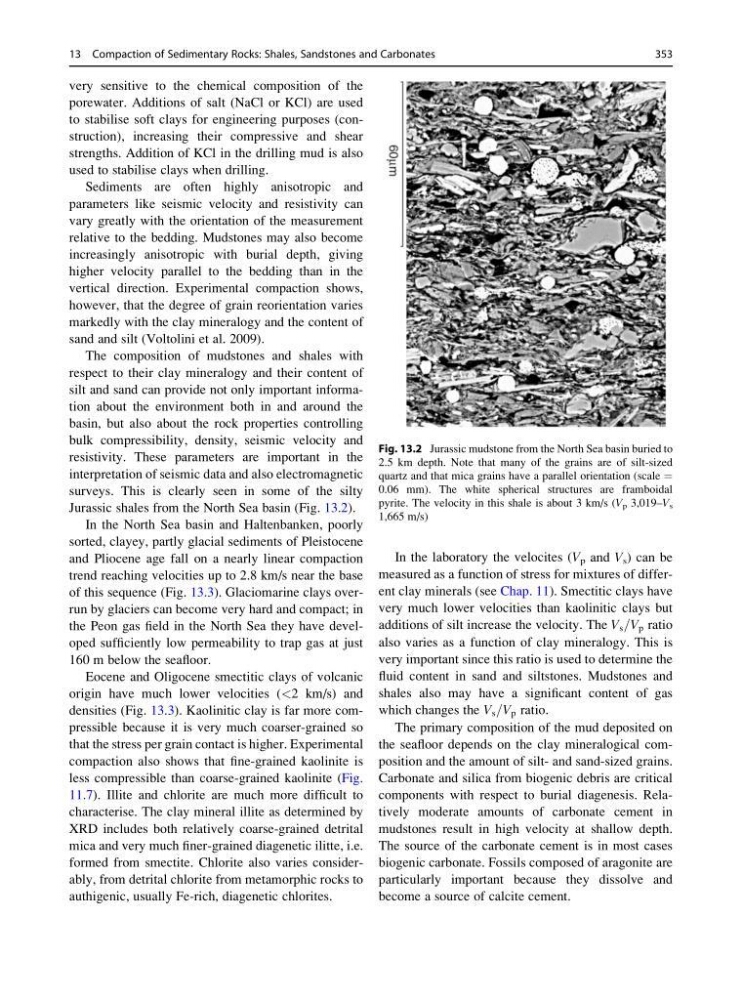
surveys. This is clearly seen in some of the silty
Jurassic shales from the North Sea basin (Fig. 13.2).
In the North Sea basin and Haltenbanken, poorly
sorted, clayey, partly glacial sediments of Pleistocene
and Pliocene age fall on a nearly linear compaction
trend reaching velocities up to 2.8 km/s near the base
of this sequence (Fig. 13.3). Glaciomarine clays overrun by glaciers can become very hard and compact; in
the Peon gas field in the North Sea they have developed sufficiently low permeability to trap gas at just
160 m below the seafloor.
Eocene and Oligocene smectitic clays of volcanic
origin have much lower velocities (<2 km/s) and
densities (Fig. 13.3). Kaolinitic clay is far more compressible because it is very much coarser-grained so
that the stress per grain contact is higher. Experimental
compaction also shows that fine-grained kaolinite is
less compressible than coarse-grained kaolinite (Fig.
11.7). Illite and chlorite are much more difficult to
characterise. The clay mineral illite as determined by
XRD includes both relatively coarse-grained detrital
mica and very much finer-grained diagenetic ilitte, i.e.
formed from smectite. Chlorite also varies considerably, from detrital chlorite from metamorphic rocks to
authigenic, usually Fe-rich, diagenetic chlorites.
In the laboratory the velocites (V p and V s ) can be
measured as a function of stress for mixtures of different clay minerals (see Chap. 11). Smectitic clays have
very much lower velocities than kaolinitic clays but
additions of silt increase the velocity. The V s =V p ratio
also varies as a function of clay mineralogy. This is
very important since this ratio is used to determine the
fluid content in sand and siltstones. Mudstones and
shales also may have a significant content of gas
which changes the V s =V p ratio.
The primary composition of the mud deposited on
the seafloor depends on the clay mineralogical composition and the amount of silt- and sand-sized grains.
Carbonate and silica from biogenic debris are critical
components with respect to burial diagenesis. Relatively moderate amounts of carbonate cement in
mudstones result in high velocity at shallow depth.
The source of the carbonate cement is in most cases
biogenic carbonate. Fossils composed of aragonite are
particularly important because they dissolve and
become a source of calcite cement.
Fig. 13.2 Jurassic mudstone from the North Sea basin buried to
2.5 km depth. Note that many of the grains are of silt-sized
quartz and that mica grains have a parallel orientation (scale ¼
0.06 mm). The white spherical structures are framboidal
pyrite. The velocity in this shale is about 3 km/s (V p 3,019–V s
1,665 m/s)
13 Compaction of Sedimentary Rocks: Shales, Sandstones and Carbonates
353
porewater. Additions of salt (NaCl or KCl) are used
to stabilise soft clays for engineering purposes (construction), increasing their compressive and shear
strengths. Addition of KCl in the drilling mud is also
used to stabilise clays when drilling.
Sediments are often highly anisotropic and
parameters like seismic velocity and resistivity can
vary greatly with the orientation of the measurement
relative to the bedding. Mudstones may also become
increasingly anisotropic with burial depth, giving
higher velocity parallel to the bedding than in the
vertical direction. Experimental compaction shows,
however, that the degree of grain reorientation varies
markedly with the clay mineralogy and the content of
sand and silt (Voltolini et al. 2009).
The composition of mudstones and shales with
respect to their clay mineralogy and their content of
silt and sand can provide not only important information about the environment both in and around the
basin, but also about the rock properties controlling
bulk compressibility, density, seismic velocity and
resistivity. These parameters are important in the
interpretation of seismic data and also electromagnetic
surveys. This is clearly seen in some of the silty
Jurassic shales from the North Sea basin (Fig. 13.2).
In the North Sea basin and Haltenbanken, poorly
sorted, clayey, partly glacial sediments of Pleistocene
and Pliocene age fall on a nearly linear compaction
trend reaching velocities up to 2.8 km/s near the base
of this sequence (Fig. 13.3). Glaciomarine clays overrun by glaciers can become very hard and compact; in
the Peon gas field in the North Sea they have developed sufficiently low permeability to trap gas at just
160 m below the seafloor.
Eocene and Oligocene smectitic clays of volcanic
origin have much lower velocities (<2 km/s) and
densities (Fig. 13.3). Kaolinitic clay is far more compressible because it is very much coarser-grained so
that the stress per grain contact is higher. Experimental
compaction also shows that fine-grained kaolinite is
less compressible than coarse-grained kaolinite (Fig.
11.7). Illite and chlorite are much more difficult to
characterise. The clay mineral illite as determined by
XRD includes both relatively coarse-grained detrital
mica and very much finer-grained diagenetic ilitte, i.e.
formed from smectite. Chlorite also varies considerably, from detrital chlorite from metamorphic rocks to
authigenic, usually Fe-rich, diagenetic chlorites.
In the laboratory the velocites (V p and V s ) can be
measured as a function of stress for mixtures of different clay minerals (see Chap. 11). Smectitic clays have
very much lower velocities than kaolinitic clays but
additions of silt increase the velocity. The V s =V p ratio
also varies as a function of clay mineralogy. This is
very important since this ratio is used to determine the
fluid content in sand and siltstones. Mudstones and
shales also may have a significant content of gas
which changes the V s =V p ratio.
The primary composition of the mud deposited on
the seafloor depends on the clay mineralogical composition and the amount of silt- and sand-sized grains.
Carbonate and silica from biogenic debris are critical
components with respect to burial diagenesis. Relatively moderate amounts of carbonate cement in
mudstones result in high velocity at shallow depth.
The source of the carbonate cement is in most cases
biogenic carbonate. Fossils composed of aragonite are
particularly important because they dissolve and
become a source of calcite cement.
Fig. 13.2 Jurassic mudstone from the North Sea basin buried to
2.5 km depth. Note that many of the grains are of silt-sized
quartz and that mica grains have a parallel orientation (scale ¼
0.06 mm). The white spherical structures are framboidal
pyrite. The velocity in this shale is about 3 km/s (V p 3,019–V s
1,665 m/s)
13 Compaction of Sedimentary Rocks: Shales, Sandstones and Carbonates
353