

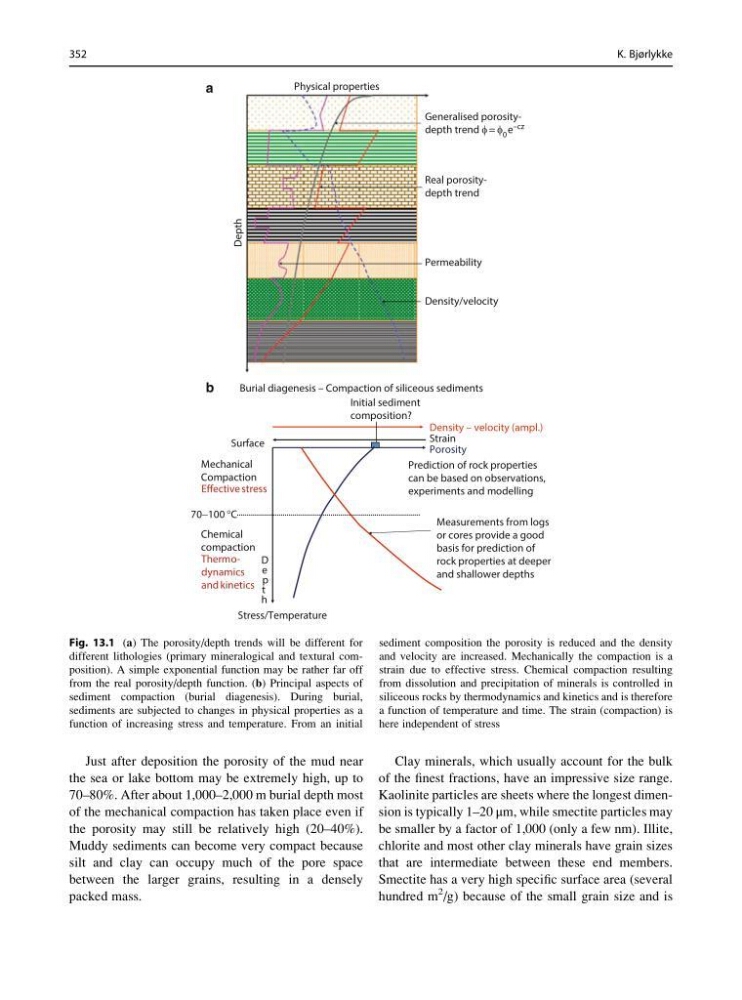
Just after deposition the porosity of the mud near
the sea or lake bottom may be extremely high, up to
70–80%. After about 1,000–2,000 m burial depth most
of the mechanical compaction has taken place even if
the porosity may still be relatively high (20–40%).
Muddy sediments can become very compact because
silt and clay can occupy much of the pore space
between the larger grains, resulting in a densely
packed mass.
Clay minerals, which usually account for the bulk
of the finest fractions, have an impressive size range.
Kaolinite particles are sheets where the longest dimension is typically 1–20 μm, while smectite particles may
be smaller by a factor of 1,000 (only a few nm). Illite,
chlorite and most other clay minerals have grain sizes
that are intermediate between these end members.
Smectite has a very high specific surface area (several
hundred m
2 /g) because of the small grain size and is
Physical properties
Generalised porositydepth trend φ = φ 0 e
–cz
Real porositydepth trend
Permeability
Density/velocity
Depth
Porosity
Stress/Temperature
Density – velocity (ampl.)
D
e
p
t
h
Initial sediment
composition?
Surface
Prediction of rock properties
can be based on observations,
experiments and modelling
Measurements from logs
or cores provide a good
basis for prediction of
rock properties at deeper
and shallower depths
70−100 °C
Mechanical
Compaction
b
a
Effective stress
Chemical
compaction
Thermodynamics
and kinetics
Burial diagenesis – Compaction of siliceous sediments
Strain
Fig. 13.1 (a) The porosity/depth trends will be different for
different lithologies (primary mineralogical and textural composition). A simple exponential function may be rather far off
from the real porosity/depth function. (b) Principal aspects of
sediment compaction (burial diagenesis). During burial,
sediments are subjected to changes in physical properties as a
function of increasing stress and temperature. From an initial
sediment composition the porosity is reduced and the density
and velocity are increased. Mechanically the compaction is a
strain due to effective stress. Chemical compaction resulting
from dissolution and precipitation of minerals is controlled in
siliceous rocks by thermodynamics and kinetics and is therefore
a function of temperature and time. The strain (compaction) is
here independent of stress
352
K. Bjørlykke
the sea or lake bottom may be extremely high, up to
70–80%. After about 1,000–2,000 m burial depth most
of the mechanical compaction has taken place even if
the porosity may still be relatively high (20–40%).
Muddy sediments can become very compact because
silt and clay can occupy much of the pore space
between the larger grains, resulting in a densely
packed mass.
Clay minerals, which usually account for the bulk
of the finest fractions, have an impressive size range.
Kaolinite particles are sheets where the longest dimension is typically 1–20 μm, while smectite particles may
be smaller by a factor of 1,000 (only a few nm). Illite,
chlorite and most other clay minerals have grain sizes
that are intermediate between these end members.
Smectite has a very high specific surface area (several
hundred m
2 /g) because of the small grain size and is
Physical properties
Generalised porositydepth trend φ = φ 0 e
–cz
Real porositydepth trend
Permeability
Density/velocity
Depth
Porosity
Stress/Temperature
Density – velocity (ampl.)
D
e
p
t
h
Initial sediment
composition?
Surface
Prediction of rock properties
can be based on observations,
experiments and modelling
Measurements from logs
or cores provide a good
basis for prediction of
rock properties at deeper
and shallower depths
70−100 °C
Mechanical
Compaction
b
a
Effective stress
Chemical
compaction
Thermodynamics
and kinetics
Burial diagenesis – Compaction of siliceous sediments
Strain
Fig. 13.1 (a) The porosity/depth trends will be different for
different lithologies (primary mineralogical and textural composition). A simple exponential function may be rather far off
from the real porosity/depth function. (b) Principal aspects of
sediment compaction (burial diagenesis). During burial,
sediments are subjected to changes in physical properties as a
function of increasing stress and temperature. From an initial
sediment composition the porosity is reduced and the density
and velocity are increased. Mechanically the compaction is a
strain due to effective stress. Chemical compaction resulting
from dissolution and precipitation of minerals is controlled in
siliceous rocks by thermodynamics and kinetics and is therefore
a function of temperature and time. The strain (compaction) is
here independent of stress
352
K. Bjørlykke