

The strain rates are important for the laboratory determination of K 0 because deformation by creep is a function of time. Some rocks behave very differently at low
strain rates and at high strain rates. For further discussion
on brittle and ductile behaviour see Sect. 11.4.4.
When the effective stress in the reservoir is increased
due to reduced fluid pressure during petroleum production, the strain rates are fairly high. Therefore, the ratio
between the horizontal and vertical stress will be controlled by mechanical compaction, and the K 0 values
determined in laboratory tests may be applied.
11.3.2 Field Measurements of Horizontal
Stress
As it is difficult to predict the horizontal in situ stress
condition in the basin, and as the horizontal stresses
may be very different in two orthogonal directions, it
is common to resort to field measurements. The maximum horizontal stress is termed σ H while the minimum horizontal stress is called σ h . If the vertical stress
is the major principal stress σ 1 , the two horizontal
principal stresses are σ 2 and σ 3 , respectively.
To measure these two horizontal stresses and their
orientation one may use so-called hydrofracturing
tests in a borehole (e.g. Goodman 1989, Fjaer et al.
2008). For a typical situation where the major principal stress in the sediment is vertical, a vertical radial
fracture will open in the wall of a vertical borehole
when the fluid pressure in the borehole is increased.
This is because the fracture will be oriented perpendicular to the direction of lowest effective stress which
is in the horizontal direction. If the maximum and
minimum horizontal stresses are different, the
tangential stresses around the borehole vary. When
the fluid pressure is equal to the minimum effective
stress plus the rock tensile strength (τ) at the most
critical location around the borehole, i.e. the location
with the smallest initial tangential compression stress,
a fracture opens in the wall of the borehole. This fluid
pressure level is called the fracture pressure. By lowering the fluid pressure after the crack has opened, and
then increasing the fluid pressure again, one may
determine the tensile strength of the rock as the difference between the fracture pressure during the first and
second load cycles. The tensile strength of a sedimentary rock is only a small fraction of the compressive
strength, and tensile strength can often be neglected.
Thus the fracture from the first load cycle may be used
to determine the horizontal stresses.
The best way to measure the fracture pressure during the drilling phase of exploration is to perform a
series of “minifrac” tests. However, this is not normally done, and it has become common practice in the
petroleum industry to perform a simpler measurement
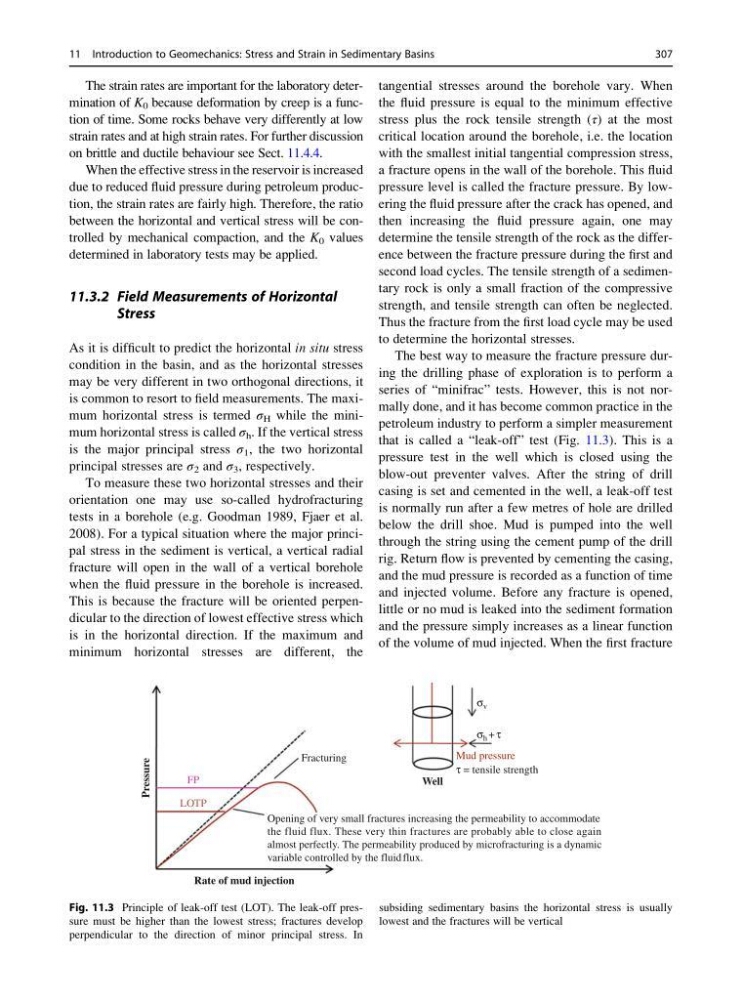
that is called a “leak-off” test (Fig. 11.3). This is a
pressure test in the well which is closed using the
blow-out preventer valves. After the string of drill
casing is set and cemented in the well, a leak-off test
is normally run after a few metres of hole are drilled
below the drill shoe. Mud is pumped into the well
through the string using the cement pump of the drill
rig. Return flow is prevented by cementing the casing,
and the mud pressure is recorded as a function of time
and injected volume. Before any fracture is opened,
little or no mud is leaked into the sediment formation
and the pressure simply increases as a linear function
of the volume of mud injected. When the first fracture
Opening of very small fractures increasing the permeability to accommodate
the fluid flux. These very thin fractures are probably able to close again
almost perfectly. The permeability produced by microfracturing is a dynamic
variable controlled by the fluid flux.
τ = tensile strength
σ v
σ h + τ
Fracturing
Rate of mud injection
Pressure
FP
LOTP
Mud pressure
Well
Fig. 11.3 Principle of leak-off test (LOT). The leak-off pressure must be higher than the lowest stress; fractures develop
perpendicular to the direction of minor principal stress. In
subsiding sedimentary basins the horizontal stress is usually
lowest and the fractures will be vertical
11 Introduction to Geomechanics: Stress and Strain in Sedimentary Basins
307
strain rates and at high strain rates. For further discussion
on brittle and ductile behaviour see Sect. 11.4.4.
When the effective stress in the reservoir is increased
due to reduced fluid pressure during petroleum production, the strain rates are fairly high. Therefore, the ratio
between the horizontal and vertical stress will be controlled by mechanical compaction, and the K 0 values
determined in laboratory tests may be applied.
11.3.2 Field Measurements of Horizontal
Stress
As it is difficult to predict the horizontal in situ stress
condition in the basin, and as the horizontal stresses
may be very different in two orthogonal directions, it
is common to resort to field measurements. The maximum horizontal stress is termed σ H while the minimum horizontal stress is called σ h . If the vertical stress
is the major principal stress σ 1 , the two horizontal
principal stresses are σ 2 and σ 3 , respectively.
To measure these two horizontal stresses and their
orientation one may use so-called hydrofracturing
tests in a borehole (e.g. Goodman 1989, Fjaer et al.
2008). For a typical situation where the major principal stress in the sediment is vertical, a vertical radial
fracture will open in the wall of a vertical borehole
when the fluid pressure in the borehole is increased.
This is because the fracture will be oriented perpendicular to the direction of lowest effective stress which
is in the horizontal direction. If the maximum and
minimum horizontal stresses are different, the
tangential stresses around the borehole vary. When
the fluid pressure is equal to the minimum effective
stress plus the rock tensile strength (τ) at the most
critical location around the borehole, i.e. the location
with the smallest initial tangential compression stress,
a fracture opens in the wall of the borehole. This fluid
pressure level is called the fracture pressure. By lowering the fluid pressure after the crack has opened, and
then increasing the fluid pressure again, one may
determine the tensile strength of the rock as the difference between the fracture pressure during the first and
second load cycles. The tensile strength of a sedimentary rock is only a small fraction of the compressive
strength, and tensile strength can often be neglected.
Thus the fracture from the first load cycle may be used
to determine the horizontal stresses.
The best way to measure the fracture pressure during the drilling phase of exploration is to perform a
series of “minifrac” tests. However, this is not normally done, and it has become common practice in the
petroleum industry to perform a simpler measurement
that is called a “leak-off” test (Fig. 11.3). This is a
pressure test in the well which is closed using the
blow-out preventer valves. After the string of drill
casing is set and cemented in the well, a leak-off test
is normally run after a few metres of hole are drilled
below the drill shoe. Mud is pumped into the well
through the string using the cement pump of the drill
rig. Return flow is prevented by cementing the casing,
and the mud pressure is recorded as a function of time
and injected volume. Before any fracture is opened,
little or no mud is leaked into the sediment formation
and the pressure simply increases as a linear function
of the volume of mud injected. When the first fracture
Opening of very small fractures increasing the permeability to accommodate
the fluid flux. These very thin fractures are probably able to close again
almost perfectly. The permeability produced by microfracturing is a dynamic
variable controlled by the fluid flux.
τ = tensile strength
σ v
σ h + τ
Fracturing
Rate of mud injection
Pressure
FP
LOTP
Mud pressure
Well
Fig. 11.3 Principle of leak-off test (LOT). The leak-off pressure must be higher than the lowest stress; fractures develop
perpendicular to the direction of minor principal stress. In
subsiding sedimentary basins the horizontal stress is usually
lowest and the fractures will be vertical
11 Introduction to Geomechanics: Stress and Strain in Sedimentary Basins
307