

expressed in terms of effective stresses, and it is
assumed that there is no cementation (cohesion c ¼
0). The K 0 value defined this way refers to the ratio of
effective horizontal and vertical stresses (not total
stresses). For φ
0
¼ 30; K 0nc becomes 1/2.
When such a sediment is unloaded (erosion) and
thus becomes overconsolidated (OC), the horizontal
stress does not decrease proportionally with the reduction in vertical effective stress because the sediment
skeleton does not exhibit elastic behaviour. Horizontal
stresses are “locked in” in the sediment, and the K 0 -
value increases. The following semi-empirical relationship is used, based on laboratory experiments and
field measurements:
K 0oc ¼ K 0nc ðOCRÞ
n
(11.7)
where OCR is the overconsolidation ratio and n is a
coefficient experimentally determined to usually be
between 0.6 and 0.8, depending on the sediment
properties. K 0 may well reach values above 1 (2–3
have been measured), which means that the horizontal
stress is significantly larger than the vertical stress.
During burial and compaction and erosion (uplift),
the horizontal stresses may change due to tectonic
movements, and with time due to combinations of
mechanical loading and unloading and also chemical
compaction which may be independent of stress.
If extension occurs in a sediment with friction angle
(φ
0 ) but no cohesion intercept (c), the effective horizontal stress coefficient would decrease from K 0 to a
lower limiting value of:
K ext ¼ 1 À sin φ
0
=1 þ sin φ
0
(11.8)
At this low lateral effective stress, shear failure
would occur and a shear plane (normal fault) would
form. Such extension may occur due to general basin
extension, or more locally over a salt dome, over an
elevated fault block of sedimentary rock with softer
sediments on either side, or at the top of a slope.
If on the other hand, lateral compression occurs in
the same sediment, the lateral effective stress coefficient would increase to a limiting value (reverse
faulting):
K com ¼ 1 þ sin φ
0
=1 À sin φ
0
(11.9)
Assuming φ
0
¼ 30, K ext and K com would be 1/3 and
3, respectively. If a cohesion intercept (c) is included,
the value for K ext would be smaller and K com higher
than given by Eqs. (11.8) and (11.9), respectively. For
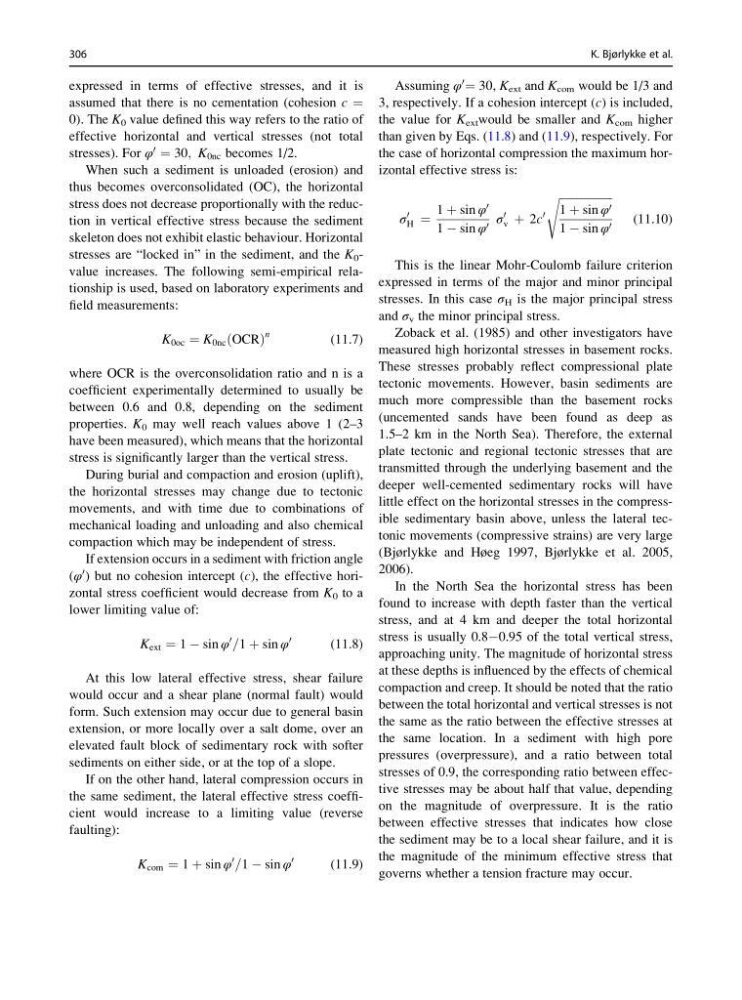
the case of horizontal compression the maximum horizontal effective stress is:
σ
0
H ¼
1 þ sin φ
0
1 À sin φ 0 σ
0
v þ 2c
0
ffiffiffiffiffiffiffiffiffiffiffiffiffiffiffiffiffiffiffi
1 þ sin φ 0
1 À sin φ 0
s
(11.10)
This is the linear Mohr-Coulomb failure criterion
expressed in terms of the major and minor principal
stresses. In this case σ H is the major principal stress
and σ v the minor principal stress.
Zoback et al. (1985) and other investigators have
measured high horizontal stresses in basement rocks.
These stresses probably reflect compressional plate
tectonic movements. However, basin sediments are
much more compressible than the basement rocks
(uncemented sands have been found as deep as
1.5–2 km in the North Sea). Therefore, the external
plate tectonic and regional tectonic stresses that are
transmitted through the underlying basement and the
deeper well-cemented sedimentary rocks will have
little effect on the horizontal stresses in the compressible sedimentary basin above, unless the lateral tectonic movements (compressive strains) are very large
(Bjørlykke and Høeg 1997, Bjørlykke et al. 2005,
2006).
In the North Sea the horizontal stress has been
found to increase with depth faster than the vertical
stress, and at 4 km and deeper the total horizontal
stress is usually 0.8À0.95 of the total vertical stress,
approaching unity. The magnitude of horizontal stress
at these depths is influenced by the effects of chemical
compaction and creep. It should be noted that the ratio
between the total horizontal and vertical stresses is not
the same as the ratio between the effective stresses at
the same location. In a sediment with high pore
pressures (overpressure), and a ratio between total
stresses of 0.9, the corresponding ratio between effective stresses may be about half that value, depending
on the magnitude of overpressure. It is the ratio
between effective stresses that indicates how close
the sediment may be to a local shear failure, and it is
the magnitude of the minimum effective stress that
governs whether a tension fracture may occur.
306
K. Bjørlykke et al.
assumed that there is no cementation (cohesion c ¼
0). The K 0 value defined this way refers to the ratio of
effective horizontal and vertical stresses (not total
stresses). For φ
0
¼ 30; K 0nc becomes 1/2.
When such a sediment is unloaded (erosion) and
thus becomes overconsolidated (OC), the horizontal
stress does not decrease proportionally with the reduction in vertical effective stress because the sediment
skeleton does not exhibit elastic behaviour. Horizontal
stresses are “locked in” in the sediment, and the K 0 -
value increases. The following semi-empirical relationship is used, based on laboratory experiments and
field measurements:
K 0oc ¼ K 0nc ðOCRÞ
n
(11.7)
where OCR is the overconsolidation ratio and n is a
coefficient experimentally determined to usually be
between 0.6 and 0.8, depending on the sediment
properties. K 0 may well reach values above 1 (2–3
have been measured), which means that the horizontal
stress is significantly larger than the vertical stress.
During burial and compaction and erosion (uplift),
the horizontal stresses may change due to tectonic
movements, and with time due to combinations of
mechanical loading and unloading and also chemical
compaction which may be independent of stress.
If extension occurs in a sediment with friction angle
(φ
0 ) but no cohesion intercept (c), the effective horizontal stress coefficient would decrease from K 0 to a
lower limiting value of:
K ext ¼ 1 À sin φ
0
=1 þ sin φ
0
(11.8)
At this low lateral effective stress, shear failure
would occur and a shear plane (normal fault) would
form. Such extension may occur due to general basin
extension, or more locally over a salt dome, over an
elevated fault block of sedimentary rock with softer
sediments on either side, or at the top of a slope.
If on the other hand, lateral compression occurs in
the same sediment, the lateral effective stress coefficient would increase to a limiting value (reverse
faulting):
K com ¼ 1 þ sin φ
0
=1 À sin φ
0
(11.9)
Assuming φ
0
¼ 30, K ext and K com would be 1/3 and
3, respectively. If a cohesion intercept (c) is included,
the value for K ext would be smaller and K com higher
than given by Eqs. (11.8) and (11.9), respectively. For
the case of horizontal compression the maximum horizontal effective stress is:
σ
0
H ¼
1 þ sin φ
0
1 À sin φ 0 σ
0
v þ 2c
0
ffiffiffiffiffiffiffiffiffiffiffiffiffiffiffiffiffiffiffi
1 þ sin φ 0
1 À sin φ 0
s
(11.10)
This is the linear Mohr-Coulomb failure criterion
expressed in terms of the major and minor principal
stresses. In this case σ H is the major principal stress
and σ v the minor principal stress.
Zoback et al. (1985) and other investigators have
measured high horizontal stresses in basement rocks.
These stresses probably reflect compressional plate
tectonic movements. However, basin sediments are
much more compressible than the basement rocks
(uncemented sands have been found as deep as
1.5–2 km in the North Sea). Therefore, the external
plate tectonic and regional tectonic stresses that are
transmitted through the underlying basement and the
deeper well-cemented sedimentary rocks will have
little effect on the horizontal stresses in the compressible sedimentary basin above, unless the lateral tectonic movements (compressive strains) are very large
(Bjørlykke and Høeg 1997, Bjørlykke et al. 2005,
2006).
In the North Sea the horizontal stress has been
found to increase with depth faster than the vertical
stress, and at 4 km and deeper the total horizontal
stress is usually 0.8À0.95 of the total vertical stress,
approaching unity. The magnitude of horizontal stress
at these depths is influenced by the effects of chemical
compaction and creep. It should be noted that the ratio
between the total horizontal and vertical stresses is not
the same as the ratio between the effective stresses at
the same location. In a sediment with high pore
pressures (overpressure), and a ratio between total
stresses of 0.9, the corresponding ratio between effective stresses may be about half that value, depending
on the magnitude of overpressure. It is the ratio
between effective stresses that indicates how close
the sediment may be to a local shear failure, and it is
the magnitude of the minimum effective stress that
governs whether a tension fracture may occur.
306
K. Bjørlykke et al.