

is produced the pressure increase is reduced relative to
the injected volume of mud, thus changing the slope of
the curve. This leakage of mud into the formation is an
indication that a thin fracture(s) has formed and that
the fracture pressure has been reached (hence the name
leak-off test). When repeated, the leak-off test fracturing starts a little earlier because now τ ¼ 0 across the
fracture that was created during the first load cycle.
The results are often very reproducible which
indicates that the rock was not seriously damaged
during the first test, and that the small fractures produced probably closed again rather efficiently. The
location of the fracture(s) may be determined by modern formation imaging tools called FMI. The location
of the radial fracture gives the direction of the minimum principal stress as the latter is normal to the
fracture (tangential to borehole wall at that location).
The small fractures produced during a leak-off test
may resemble the fractures formed during natural
hydrofracturing at the top of an overpressure compartment in a sedimentary basin.
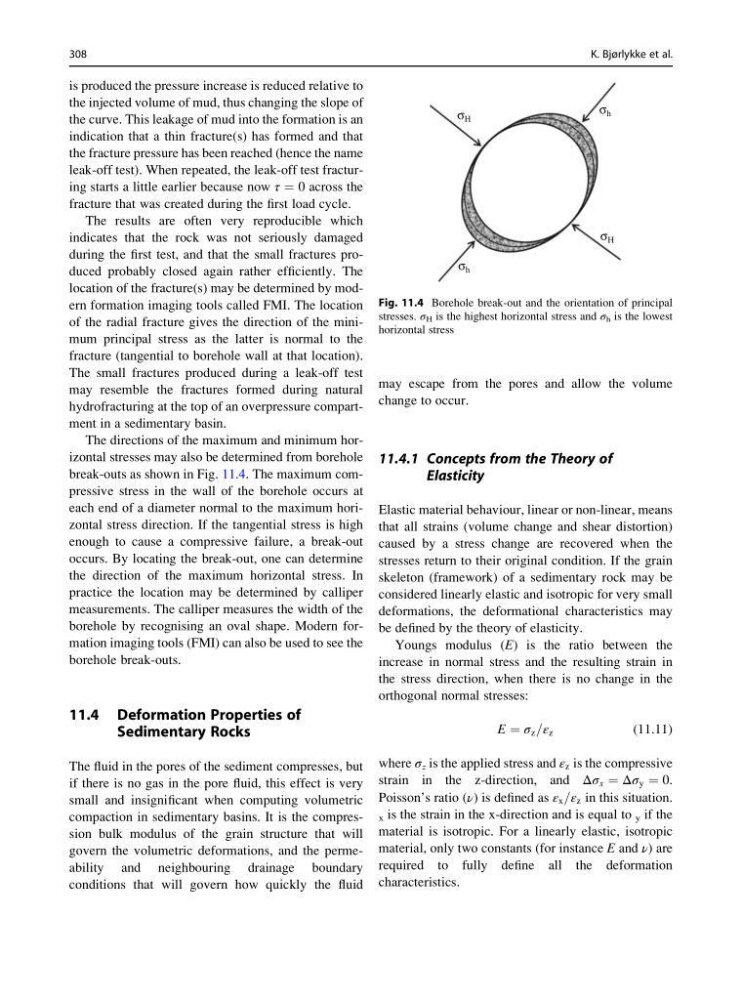
The directions of the maximum and minimum horizontal stresses may also be determined from borehole
break-outs as shown in Fig. 11.4. The maximum compressive stress in the wall of the borehole occurs at
each end of a diameter normal to the maximum horizontal stress direction. If the tangential stress is high
enough to cause a compressive failure, a break-out
occurs. By locating the break-out, one can determine
the direction of the maximum horizontal stress. In
practice the location may be determined by calliper
measurements. The calliper measures the width of the
borehole by recognising an oval shape. Modern formation imaging tools (FMI) can also be used to see the
borehole break-outs.
11.4 Deformation Properties of
Sedimentary Rocks
The fluid in the pores of the sediment compresses, but
if there is no gas in the pore fluid, this effect is very
small and insignificant when computing volumetric
compaction in sedimentary basins. It is the compression bulk modulus of the grain structure that will
govern the volumetric deformations, and the permeability and neighbouring drainage boundary
conditions that will govern how quickly the fluid
may escape from the pores and allow the volume
change to occur.
11.4.1 Concepts from the Theory of
Elasticity
Elastic material behaviour, linear or non-linear, means
that all strains (volume change and shear distortion)
caused by a stress change are recovered when the
stresses return to their original condition. If the grain
skeleton (framework) of a sedimentary rock may be
considered linearly elastic and isotropic for very small
deformations, the deformational characteristics may
be defined by the theory of elasticity.
Youngs modulus (E) is the ratio between the
increase in normal stress and the resulting strain in
the stress direction, when there is no change in the
orthogonal normal stresses:
E ¼ σ z =ε z
(11.11)
where σ z is the applied stress and ε z is the compressive
strain in the z-direction, and Δσ x ¼ Δσ y ¼ 0.
Poisson’s ratio (ν) is defined as ε x =ε z in this situation.
x is the strain in the x-direction and is equal to y if the
material is isotropic. For a linearly elastic, isotropic
material, only two constants (for instance E and ν) are
required to fully define all the deformation
characteristics.
σ H
σ h
σ H
σ h
Fig. 11.4 Borehole break-out and the orientation of principal
stresses. σ H is the highest horizontal stress and σ h is the lowest
horizontal stress
308
K. Bjørlykke et al.
the injected volume of mud, thus changing the slope of
the curve. This leakage of mud into the formation is an
indication that a thin fracture(s) has formed and that
the fracture pressure has been reached (hence the name
leak-off test). When repeated, the leak-off test fracturing starts a little earlier because now τ ¼ 0 across the
fracture that was created during the first load cycle.
The results are often very reproducible which
indicates that the rock was not seriously damaged
during the first test, and that the small fractures produced probably closed again rather efficiently. The
location of the fracture(s) may be determined by modern formation imaging tools called FMI. The location
of the radial fracture gives the direction of the minimum principal stress as the latter is normal to the
fracture (tangential to borehole wall at that location).
The small fractures produced during a leak-off test
may resemble the fractures formed during natural
hydrofracturing at the top of an overpressure compartment in a sedimentary basin.
The directions of the maximum and minimum horizontal stresses may also be determined from borehole
break-outs as shown in Fig. 11.4. The maximum compressive stress in the wall of the borehole occurs at
each end of a diameter normal to the maximum horizontal stress direction. If the tangential stress is high
enough to cause a compressive failure, a break-out
occurs. By locating the break-out, one can determine
the direction of the maximum horizontal stress. In
practice the location may be determined by calliper
measurements. The calliper measures the width of the
borehole by recognising an oval shape. Modern formation imaging tools (FMI) can also be used to see the
borehole break-outs.
11.4 Deformation Properties of
Sedimentary Rocks
The fluid in the pores of the sediment compresses, but
if there is no gas in the pore fluid, this effect is very
small and insignificant when computing volumetric
compaction in sedimentary basins. It is the compression bulk modulus of the grain structure that will
govern the volumetric deformations, and the permeability and neighbouring drainage boundary
conditions that will govern how quickly the fluid
may escape from the pores and allow the volume
change to occur.
11.4.1 Concepts from the Theory of
Elasticity
Elastic material behaviour, linear or non-linear, means
that all strains (volume change and shear distortion)
caused by a stress change are recovered when the
stresses return to their original condition. If the grain
skeleton (framework) of a sedimentary rock may be
considered linearly elastic and isotropic for very small
deformations, the deformational characteristics may
be defined by the theory of elasticity.
Youngs modulus (E) is the ratio between the
increase in normal stress and the resulting strain in
the stress direction, when there is no change in the
orthogonal normal stresses:
E ¼ σ z =ε z
(11.11)
where σ z is the applied stress and ε z is the compressive
strain in the z-direction, and Δσ x ¼ Δσ y ¼ 0.
Poisson’s ratio (ν) is defined as ε x =ε z in this situation.
x is the strain in the x-direction and is equal to y if the
material is isotropic. For a linearly elastic, isotropic
material, only two constants (for instance E and ν) are
required to fully define all the deformation
characteristics.
σ H
σ h
σ H
σ h
Fig. 11.4 Borehole break-out and the orientation of principal
stresses. σ H is the highest horizontal stress and σ h is the lowest
horizontal stress
308
K. Bjørlykke et al.