

(>3–4 km) there may be diagenetic changes such as
quartz cementation, which can make the fault plane
less permeable.
The displacement along faults can be both vertical
(normal faults) and horizontal (strike slip faults).
Reverse faults are faults where the hangingwall is
moved upwards relative to the footwall below the
fault plane. These are typical of areas with high horizontal stresses i.e. due to converging plate movements.
Growth faults are driven by gravity-sliding along
curved (listric) fault planes and are typical of sedimentary sequences such as deltas deposited with relatively
rapid sedimentation. The fault plane is often (though
not always) sealing and can stop oil and gas from
migrating further upward. However, oil traps are
equally often formed in anticlines on the upper side
of the fault plane. These are rollover anticlines.
Because the faulting is active during sedimentation,
the layers on the downthrown side will be thickest.
The name growth fault goes back to the early days of
oil exploration without seismic data. It was noticed
that the layers had “grown” in thickness in the wells on
the downthrown side of the fault. The displacement of
the beds decreases upwards along the fault plane.
Smaller, antithetic faults often develop in the opposite
direction in the beds which are turned inwards towards
the main fault plane. Growth faults tend to have low
permeability and may contribute greatly to reduced
porewater circulation in sedimentary basins, and we
often find undercompacted clay, which can turn into
clay diapirs in association with growth faults.
1.8.2 Stratigraphic Traps
These are traps which are partially or wholly due to
facies variation or unconformities, and not primarily
the result of tectonic deformation. Porous and permeable sands which pinch out up-dip in less permeable
rocks, e.g. shale (Figs. 1.11 and 1.12) are good
examples. Barrier islands often form stratigraphic
traps because they may be separated from the coast
by fine-grained lagoonal facies. The main types are:
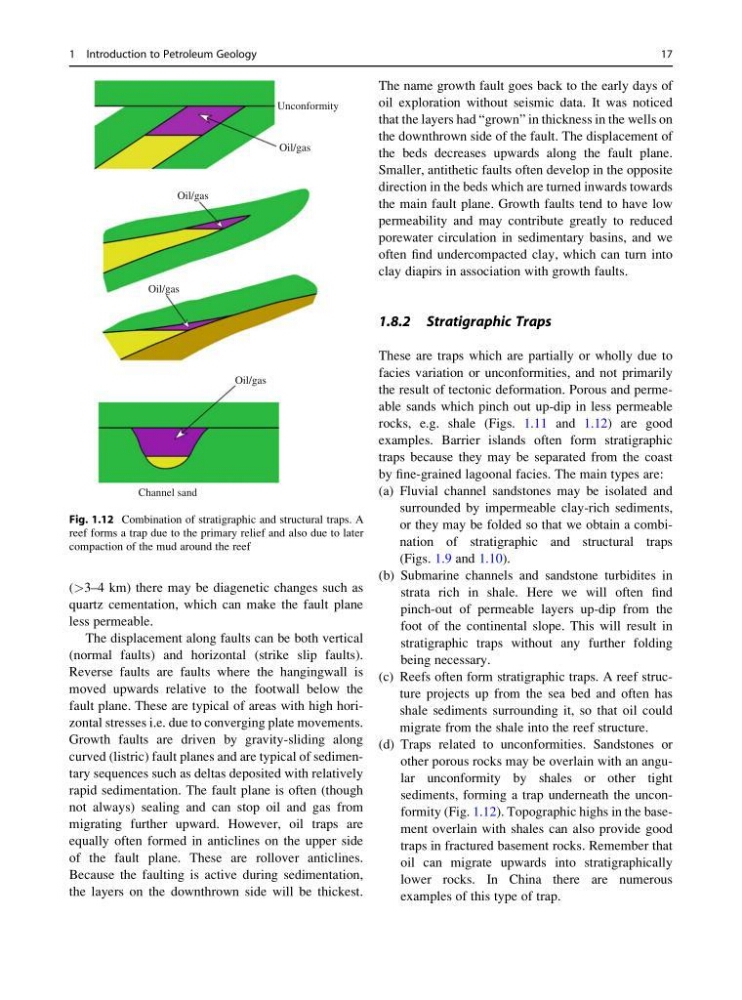
(a) Fluvial channel sandstones may be isolated and
surrounded by impermeable clay-rich sediments,
or they may be folded so that we obtain a combination of stratigraphic and structural traps
(Figs. 1.9 and 1.10).
(b) Submarine channels and sandstone turbidites in
strata rich in shale. Here we will often find
pinch-out of permeable layers up-dip from the
foot of the continental slope. This will result in
stratigraphic traps without any further folding
being necessary.
(c) Reefs often form stratigraphic traps. A reef structure projects up from the sea bed and often has
shale sediments surrounding it, so that oil could
migrate from the shale into the reef structure.
(d) Traps related to unconformities. Sandstones or
other porous rocks may be overlain with an angular unconformity by shales or other tight
sediments, forming a trap underneath the unconformity (Fig. 1.12). Topographic highs in the basement overlain with shales can also provide good
traps in fractured basement rocks. Remember that
oil can migrate upwards into stratigraphically
lower rocks. In China there are numerous
examples of this type of trap.
Oil/gas
Oil/gas
Oil/gas
Oil/gas
Channel sand
Unconformity
Fig. 1.12 Combination of stratigraphic and structural traps. A
reef forms a trap due to the primary relief and also due to later
compaction of the mud around the reef
1 Introduction to Petroleum Geology
17
quartz cementation, which can make the fault plane
less permeable.
The displacement along faults can be both vertical
(normal faults) and horizontal (strike slip faults).
Reverse faults are faults where the hangingwall is
moved upwards relative to the footwall below the
fault plane. These are typical of areas with high horizontal stresses i.e. due to converging plate movements.
Growth faults are driven by gravity-sliding along
curved (listric) fault planes and are typical of sedimentary sequences such as deltas deposited with relatively
rapid sedimentation. The fault plane is often (though
not always) sealing and can stop oil and gas from
migrating further upward. However, oil traps are
equally often formed in anticlines on the upper side
of the fault plane. These are rollover anticlines.
Because the faulting is active during sedimentation,
the layers on the downthrown side will be thickest.
The name growth fault goes back to the early days of
oil exploration without seismic data. It was noticed
that the layers had “grown” in thickness in the wells on
the downthrown side of the fault. The displacement of
the beds decreases upwards along the fault plane.
Smaller, antithetic faults often develop in the opposite
direction in the beds which are turned inwards towards
the main fault plane. Growth faults tend to have low
permeability and may contribute greatly to reduced
porewater circulation in sedimentary basins, and we
often find undercompacted clay, which can turn into
clay diapirs in association with growth faults.
1.8.2 Stratigraphic Traps
These are traps which are partially or wholly due to
facies variation or unconformities, and not primarily
the result of tectonic deformation. Porous and permeable sands which pinch out up-dip in less permeable
rocks, e.g. shale (Figs. 1.11 and 1.12) are good
examples. Barrier islands often form stratigraphic
traps because they may be separated from the coast
by fine-grained lagoonal facies. The main types are:
(a) Fluvial channel sandstones may be isolated and
surrounded by impermeable clay-rich sediments,
or they may be folded so that we obtain a combination of stratigraphic and structural traps
(Figs. 1.9 and 1.10).
(b) Submarine channels and sandstone turbidites in
strata rich in shale. Here we will often find
pinch-out of permeable layers up-dip from the
foot of the continental slope. This will result in
stratigraphic traps without any further folding
being necessary.
(c) Reefs often form stratigraphic traps. A reef structure projects up from the sea bed and often has
shale sediments surrounding it, so that oil could
migrate from the shale into the reef structure.
(d) Traps related to unconformities. Sandstones or
other porous rocks may be overlain with an angular unconformity by shales or other tight
sediments, forming a trap underneath the unconformity (Fig. 1.12). Topographic highs in the basement overlain with shales can also provide good
traps in fractured basement rocks. Remember that
oil can migrate upwards into stratigraphically
lower rocks. In China there are numerous
examples of this type of trap.
Oil/gas
Oil/gas
Oil/gas
Oil/gas
Channel sand
Unconformity
Fig. 1.12 Combination of stratigraphic and structural traps. A
reef forms a trap due to the primary relief and also due to later
compaction of the mud around the reef
1 Introduction to Petroleum Geology
17