

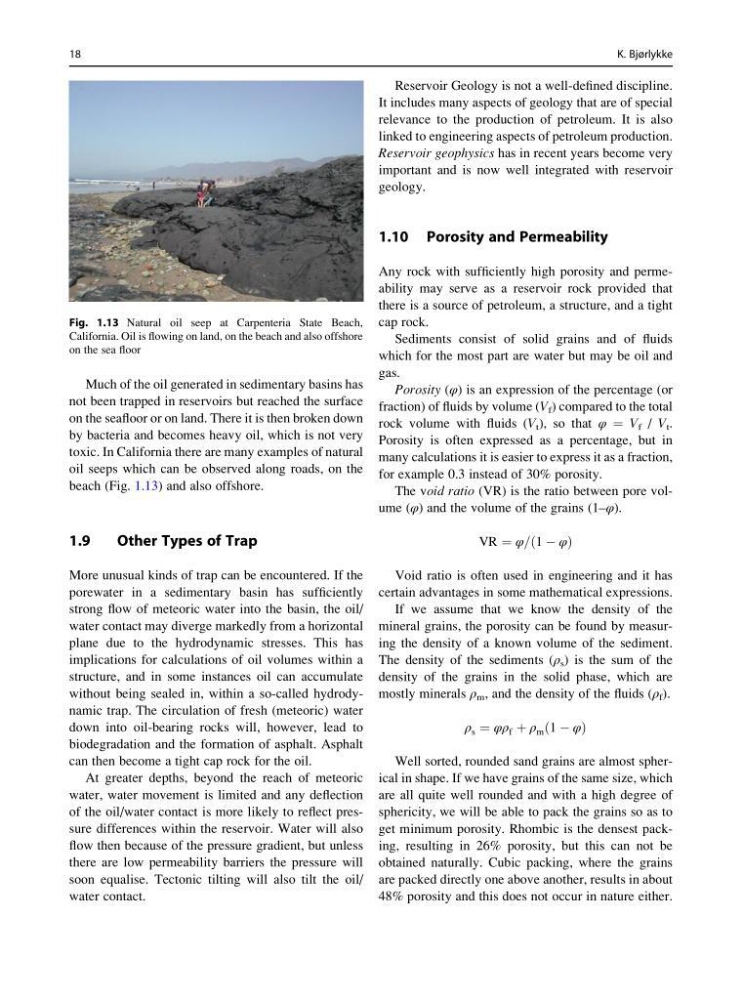
Much of the oil generated in sedimentary basins has
not been trapped in reservoirs but reached the surface
on the seafloor or on land. There it is then broken down
by bacteria and becomes heavy oil, which is not very
toxic. In California there are many examples of natural
oil seeps which can be observed along roads, on the
beach (Fig. 1.13) and also offshore.
1.9
Other Types of Trap
More unusual kinds of trap can be encountered. If the
porewater in a sedimentary basin has sufficiently
strong flow of meteoric water into the basin, the oil/
water contact may diverge markedly from a horizontal
plane due to the hydrodynamic stresses. This has
implications for calculations of oil volumes within a
structure, and in some instances oil can accumulate
without being sealed in, within a so-called hydrodynamic trap. The circulation of fresh (meteoric) water
down into oil-bearing rocks will, however, lead to
biodegradation and the formation of asphalt. Asphalt
can then become a tight cap rock for the oil.
At greater depths, beyond the reach of meteoric
water, water movement is limited and any deflection
of the oil/water contact is more likely to reflect pressure differences within the reservoir. Water will also
flow then because of the pressure gradient, but unless
there are low permeability barriers the pressure will
soon equalise. Tectonic tilting will also tilt the oil/
water contact.
Reservoir Geology is not a well-defined discipline.
It includes many aspects of geology that are of special
relevance to the production of petroleum. It is also
linked to engineering aspects of petroleum production.
Reservoir geophysics has in recent years become very
important and is now well integrated with reservoir
geology.
1.10 Porosity and Permeability
Any rock with sufficiently high porosity and permeability may serve as a reservoir rock provided that
there is a source of petroleum, a structure, and a tight
cap rock.
Sediments consist of solid grains and of fluids
which for the most part are water but may be oil and
gas.
Porosity (φ) is an expression of the percentage (or
fraction) of fluids by volume (V f ) compared to the total
rock volume with fluids (V t ), so that φ ¼ V f / V t .
Porosity is often expressed as a percentage, but in
many calculations it is easier to express it as a fraction,
for example 0.3 instead of 30% porosity.
The void ratio (VR) is the ratio between pore volume (φ) and the volume of the grains (1–φ).
VR ¼ φ= 1 À φ
ð
Þ
Void ratio is often used in engineering and it has
certain advantages in some mathematical expressions.
If we assume that we know the density of the
mineral grains, the porosity can be found by measuring the density of a known volume of the sediment.
The density of the sediments (ρ s ) is the sum of the
density of the grains in the solid phase, which are
mostly minerals ρ m , and the density of the fluids (ρ f ).
ρ s ¼ φρ f þ ρ m 1 À φ
ð
Þ
Well sorted, rounded sand grains are almost spherical in shape. If we have grains of the same size, which
are all quite well rounded and with a high degree of
sphericity, we will be able to pack the grains so as to
get minimum porosity. Rhombic is the densest packing, resulting in 26% porosity, but this can not be
obtained naturally. Cubic packing, where the grains
are packed directly one above another, results in about
48% porosity and this does not occur in nature either.
Fig. 1.13 Natural oil seep at Carpenteria State Beach,
California. Oil is flowing on land, on the beach and also offshore
on the sea floor
18
K. Bjørlykke
not been trapped in reservoirs but reached the surface
on the seafloor or on land. There it is then broken down
by bacteria and becomes heavy oil, which is not very
toxic. In California there are many examples of natural
oil seeps which can be observed along roads, on the
beach (Fig. 1.13) and also offshore.
1.9
Other Types of Trap
More unusual kinds of trap can be encountered. If the
porewater in a sedimentary basin has sufficiently
strong flow of meteoric water into the basin, the oil/
water contact may diverge markedly from a horizontal
plane due to the hydrodynamic stresses. This has
implications for calculations of oil volumes within a
structure, and in some instances oil can accumulate
without being sealed in, within a so-called hydrodynamic trap. The circulation of fresh (meteoric) water
down into oil-bearing rocks will, however, lead to
biodegradation and the formation of asphalt. Asphalt
can then become a tight cap rock for the oil.
At greater depths, beyond the reach of meteoric
water, water movement is limited and any deflection
of the oil/water contact is more likely to reflect pressure differences within the reservoir. Water will also
flow then because of the pressure gradient, but unless
there are low permeability barriers the pressure will
soon equalise. Tectonic tilting will also tilt the oil/
water contact.
Reservoir Geology is not a well-defined discipline.
It includes many aspects of geology that are of special
relevance to the production of petroleum. It is also
linked to engineering aspects of petroleum production.
Reservoir geophysics has in recent years become very
important and is now well integrated with reservoir
geology.
1.10 Porosity and Permeability
Any rock with sufficiently high porosity and permeability may serve as a reservoir rock provided that
there is a source of petroleum, a structure, and a tight
cap rock.
Sediments consist of solid grains and of fluids
which for the most part are water but may be oil and
gas.
Porosity (φ) is an expression of the percentage (or
fraction) of fluids by volume (V f ) compared to the total
rock volume with fluids (V t ), so that φ ¼ V f / V t .
Porosity is often expressed as a percentage, but in
many calculations it is easier to express it as a fraction,
for example 0.3 instead of 30% porosity.
The void ratio (VR) is the ratio between pore volume (φ) and the volume of the grains (1–φ).
VR ¼ φ= 1 À φ
ð
Þ
Void ratio is often used in engineering and it has
certain advantages in some mathematical expressions.
If we assume that we know the density of the
mineral grains, the porosity can be found by measuring the density of a known volume of the sediment.
The density of the sediments (ρ s ) is the sum of the
density of the grains in the solid phase, which are
mostly minerals ρ m , and the density of the fluids (ρ f ).
ρ s ¼ φρ f þ ρ m 1 À φ
ð
Þ
Well sorted, rounded sand grains are almost spherical in shape. If we have grains of the same size, which
are all quite well rounded and with a high degree of
sphericity, we will be able to pack the grains so as to
get minimum porosity. Rhombic is the densest packing, resulting in 26% porosity, but this can not be
obtained naturally. Cubic packing, where the grains
are packed directly one above another, results in about
48% porosity and this does not occur in nature either.
Fig. 1.13 Natural oil seep at Carpenteria State Beach,
California. Oil is flowing on land, on the beach and also offshore
on the sea floor
18
K. Bjørlykke