

halotectonic movements have formed dome structures
in the Chalk, for example in the Ekofisk area.
(c) Growth Anticlines
These are dome-like structures formed when part of a
basin subsides more slowly than its surroundings,
resulting in least sedimentation on the highest part.
The sediment thickness decreases towards the dome
centre, which also compacts less than the adjacent
thicker sediments and thus contributes to the formation of an anticlinal structure. Growth anticlines form
contemporaneously with sediment accumulation, not
through later folding.
Growth anticlines can be formed above salt domes,
reefs or buried basement highs, through differential
compaction.
(d) Fault Traps
In fault traps, the fault plane forms part of the structure
trapping the oil and hindering its further upward
migration. The fault plane must therefore be sealing
for vertical flow of petroleum in order to function as a
barrier and a cap rock for the reservoir rocks. If the
reservoir rock is juxtaposed against a sandstone or
other permeable rocks the fault must also be impermeable for flow across the fault plane. Most frequently,
however, the reservoir rock is faulted against a tight
shale or mudrock and the fault is then in most cases
sealing (Fig. 1.9). When there is sandstone on both
sides of the fault plane, the permeability across it will
amongst other things depend on how much clay has
been smeared along the junction fault plane from
adjacent clays during faulting. At greater depths
I
II
III
Organic
matter
Sea level
rise
Reservoir
rock (trap)
Migration of
hydrocarbons
Source rocks
>100°C
Water
Sand
Clay
Clay
Ox
Barrier
sand island
Lagoon
Sand
Red
Sea level
Deposition of 2–3 km of sediments
Oil
Sand grains
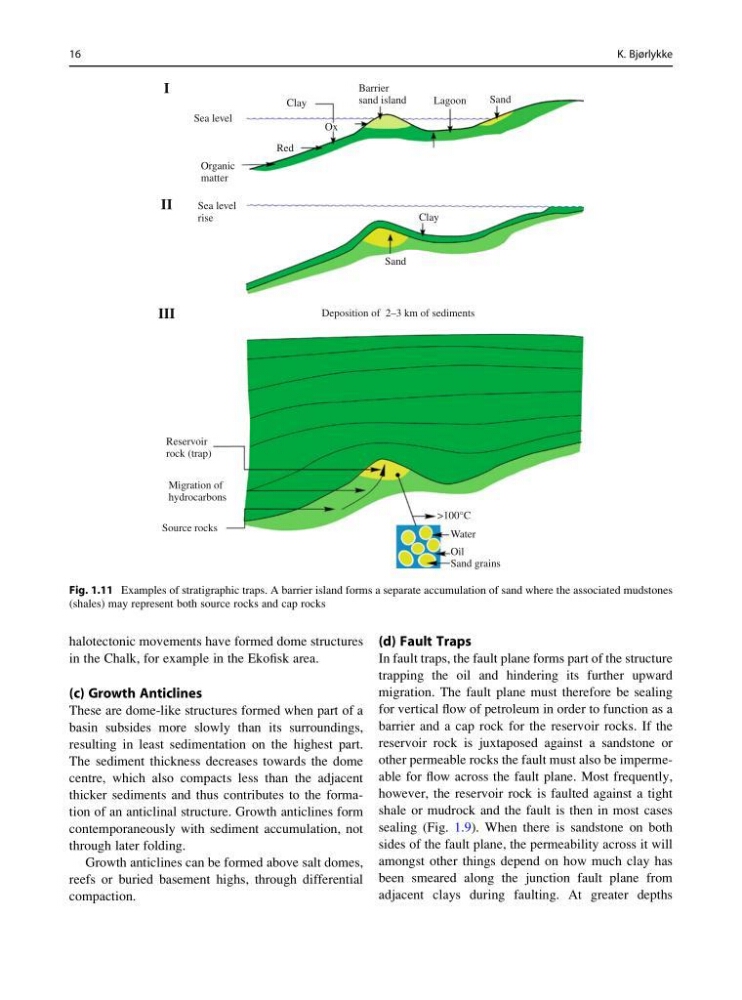
Fig. 1.11 Examples of stratigraphic traps. A barrier island forms a separate accumulation of sand where the associated mudstones
(shales) may represent both source rocks and cap rocks
16
K. Bjørlykke
in the Chalk, for example in the Ekofisk area.
(c) Growth Anticlines
These are dome-like structures formed when part of a
basin subsides more slowly than its surroundings,
resulting in least sedimentation on the highest part.
The sediment thickness decreases towards the dome
centre, which also compacts less than the adjacent
thicker sediments and thus contributes to the formation of an anticlinal structure. Growth anticlines form
contemporaneously with sediment accumulation, not
through later folding.
Growth anticlines can be formed above salt domes,
reefs or buried basement highs, through differential
compaction.
(d) Fault Traps
In fault traps, the fault plane forms part of the structure
trapping the oil and hindering its further upward
migration. The fault plane must therefore be sealing
for vertical flow of petroleum in order to function as a
barrier and a cap rock for the reservoir rocks. If the
reservoir rock is juxtaposed against a sandstone or
other permeable rocks the fault must also be impermeable for flow across the fault plane. Most frequently,
however, the reservoir rock is faulted against a tight
shale or mudrock and the fault is then in most cases
sealing (Fig. 1.9). When there is sandstone on both
sides of the fault plane, the permeability across it will
amongst other things depend on how much clay has
been smeared along the junction fault plane from
adjacent clays during faulting. At greater depths
I
II
III
Organic
matter
Sea level
rise
Reservoir
rock (trap)
Migration of
hydrocarbons
Source rocks
>100°C
Water
Sand
Clay
Clay
Ox
Barrier
sand island
Lagoon
Sand
Red
Sea level
Deposition of 2–3 km of sediments
Oil
Sand grains
Fig. 1.11 Examples of stratigraphic traps. A barrier island forms a separate accumulation of sand where the associated mudstones
(shales) may represent both source rocks and cap rocks
16
K. Bjørlykke