

1.8.1 Structural Traps
(a) Anticlinal Domes
Domes formed by diapirism or other processes may
form closures in all directions (four-way closure). A
simple anticline is not sufficient to trap oil. Anticlines
with an axial culmination are needed to provide fourway closure. This means that the fold axis must be
dipping in both directions (Fig. 1.9).
Anticlinal traps can form in association with
faulting. This is especially true in connection with
growth faults (roll-overs) (see below), but also with
thrust zones.
(b) Salt Domes
Salt domes are formed because salt (specific gravity
c.1.8–2.0) is lighter than the overlying rock, and the
salt therefore “floats” up due to buoyancy. The
quantitatively most important salt minerals are halite
(NaCl – density 2.16 g/cm
3 ), gypsum (CaSO 4 . 2H 2 O –
density 2.32 g/cm
3 ). Anhydrite (CaSO 4 – density
2.96 g/cm
3 ) is too dense to contribute to the formation
of diapirs.
In order for the salt to move upwards and form a
salt dome, a certain thickness of overburden is
required and the salt beds themselves must be at least
100–200 m thick. The upward movement of salt
through the overlying sequence, and the resultant
deformation of the latter, is called halokinetics or salt
tectonics.
The rate of salt movement is extremely slow and a
dome may take several million years to form.
Movements of the Earth’s surface may, however,
also be recorded in recent history as is the case onshore
Denmark. Salt may break right through the overlying
rocks and rise to the surface, or form intrusions in
younger sediments. If gypsum has been deposited,
this will be altered into anhydrite at about 1 km burial
depth, with a consequent 40% compaction and the
increase in density will remove the buoyancy relative
to the surrounding sediments. A comparable expansion occurs when rising anhydrite comes into contact
with groundwater and reverts to gypsum.
Traps may be created (1) in the layers above the salt
dome, (2) in the top of the salt dome (cap rock), (3) in
the beds which are faulted and turned up against the
salt structure and (4) through stratigraphic pinching
out of beds round the salt dome. Reservoirs may form
by solution and brecciation at the top of salt domes.
Salt tectonics is of great importance in many oilbearing regions where there are thick salt deposits in
the passive margin sequences of the South Atlantic
and the Gulf of Mexico. In the eastern USA we find
extensive tracts with Silurian salt, and in Texas and
New Mexico we have Permian salt.
Salt layers are the ideal cap rock because of salt’s
low permeability and ductile properties, which prevent
fracturing and leakage.
Salt deposits are particularly common in the
Permo-Triassic around the Atlantic. This is because
prior to the opening of the Atlantic there were vast
areas with fault-controlled basins (rifts) in the middle
of a supercontinent (America + Europe, Asia and
Africa) with little precipitation. We find similar
conditions today around the Red Sea and the Dead
Sea. The Permian Zechstein salt in Germany and
Denmark continues below the North Sea, and
R
e s e r v o i r
r
o c k
Shale
Oil
Onlap
Fractured basement
Structural trap
Gas
Oil /gas
contact
Oil /water
contact
Oil
Water
Spill point
Shale
Salt diapir
Oil/gas
“Turtle back”
Closure
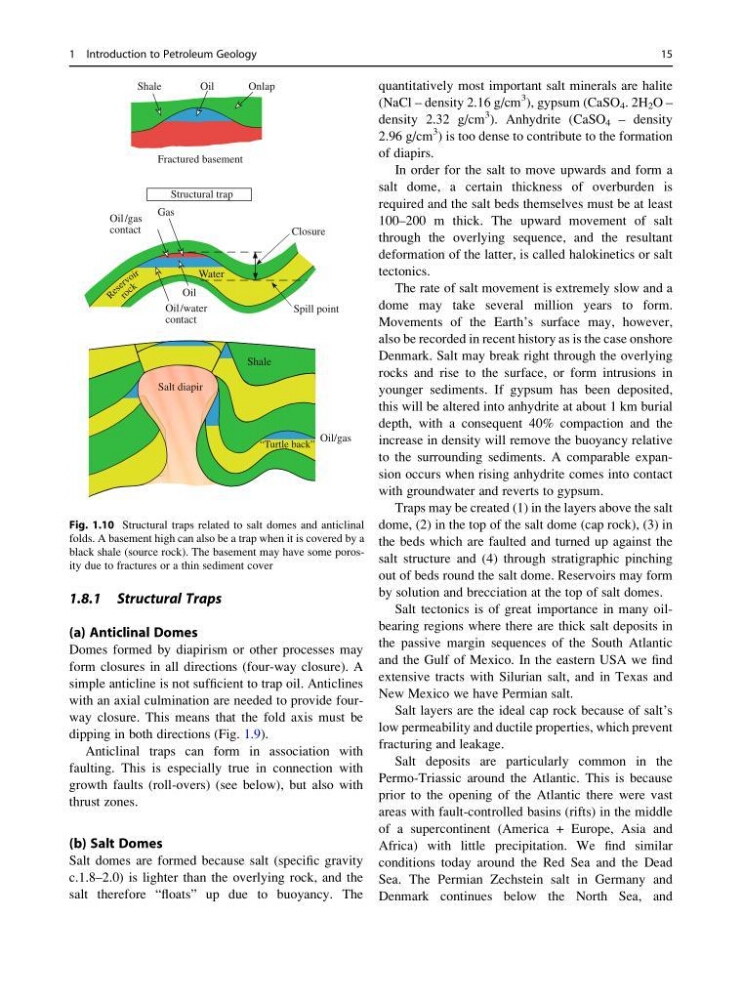
Fig. 1.10 Structural traps related to salt domes and anticlinal
folds. A basement high can also be a trap when it is covered by a
black shale (source rock). The basement may have some porosity due to fractures or a thin sediment cover
1 Introduction to Petroleum Geology
15
(a) Anticlinal Domes
Domes formed by diapirism or other processes may
form closures in all directions (four-way closure). A
simple anticline is not sufficient to trap oil. Anticlines
with an axial culmination are needed to provide fourway closure. This means that the fold axis must be
dipping in both directions (Fig. 1.9).
Anticlinal traps can form in association with
faulting. This is especially true in connection with
growth faults (roll-overs) (see below), but also with
thrust zones.
(b) Salt Domes
Salt domes are formed because salt (specific gravity
c.1.8–2.0) is lighter than the overlying rock, and the
salt therefore “floats” up due to buoyancy. The
quantitatively most important salt minerals are halite
(NaCl – density 2.16 g/cm
3 ), gypsum (CaSO 4 . 2H 2 O –
density 2.32 g/cm
3 ). Anhydrite (CaSO 4 – density
2.96 g/cm
3 ) is too dense to contribute to the formation
of diapirs.
In order for the salt to move upwards and form a
salt dome, a certain thickness of overburden is
required and the salt beds themselves must be at least
100–200 m thick. The upward movement of salt
through the overlying sequence, and the resultant
deformation of the latter, is called halokinetics or salt
tectonics.
The rate of salt movement is extremely slow and a
dome may take several million years to form.
Movements of the Earth’s surface may, however,
also be recorded in recent history as is the case onshore
Denmark. Salt may break right through the overlying
rocks and rise to the surface, or form intrusions in
younger sediments. If gypsum has been deposited,
this will be altered into anhydrite at about 1 km burial
depth, with a consequent 40% compaction and the
increase in density will remove the buoyancy relative
to the surrounding sediments. A comparable expansion occurs when rising anhydrite comes into contact
with groundwater and reverts to gypsum.
Traps may be created (1) in the layers above the salt
dome, (2) in the top of the salt dome (cap rock), (3) in
the beds which are faulted and turned up against the
salt structure and (4) through stratigraphic pinching
out of beds round the salt dome. Reservoirs may form
by solution and brecciation at the top of salt domes.
Salt tectonics is of great importance in many oilbearing regions where there are thick salt deposits in
the passive margin sequences of the South Atlantic
and the Gulf of Mexico. In the eastern USA we find
extensive tracts with Silurian salt, and in Texas and
New Mexico we have Permian salt.
Salt layers are the ideal cap rock because of salt’s
low permeability and ductile properties, which prevent
fracturing and leakage.
Salt deposits are particularly common in the
Permo-Triassic around the Atlantic. This is because
prior to the opening of the Atlantic there were vast
areas with fault-controlled basins (rifts) in the middle
of a supercontinent (America + Europe, Asia and
Africa) with little precipitation. We find similar
conditions today around the Red Sea and the Dead
Sea. The Permian Zechstein salt in Germany and
Denmark continues below the North Sea, and
R
e s e r v o i r
r
o c k
Shale
Oil
Onlap
Fractured basement
Structural trap
Gas
Oil /gas
contact
Oil /water
contact
Oil
Water
Spill point
Shale
Salt diapir
Oil/gas
“Turtle back”
Closure
Fig. 1.10 Structural traps related to salt domes and anticlinal
folds. A basement high can also be a trap when it is covered by a
black shale (source rock). The basement may have some porosity due to fractures or a thin sediment cover
1 Introduction to Petroleum Geology
15