

isotherms will also result from sloping beds because
the heat flux is reflected when the conductivity of the
beds varies, but this effect is also normally quite small.
From the equation above we see that the flow rates are
a function of the isotherm slope, as well as a function
of the height of the convection cell which often is
equal to the thickness of a sandstone bed. The thickness of the sandstone beds (H) or the distance between
the low permeability shales, will normally define the
height of the convection cells and in most sedimentary
sequences the distance between thin shales or even
clay laminae is only a few metres or less. Although
non-Rayleigh convection nearly always occurs to
some degree it is probably rather insignificant in
most cases in terms of the transport of solids in
solution in sedimentary basins. This is because the
low slopes of the isotherms and the low vertical permeability result in very low flow rates, mostly inside
rather thin sandstones separated by shales. These are
probably not very significant in terms of solid transport in connection with diagenetic processes. Around
igneous or hydrothermal intrusions, however, the lateral change in geothermal gradients and the slope of
the isotherms may be very high and then thermal
convection is very important. Also around salt domes
geothermal gradients may change due to the higher
conductivity. Inverse salinity gradients will increase
the drive for thermal convection, while normal salinity
gradients will make the porewater more stable. Even
moderate salinity gradients strongly influence fluid
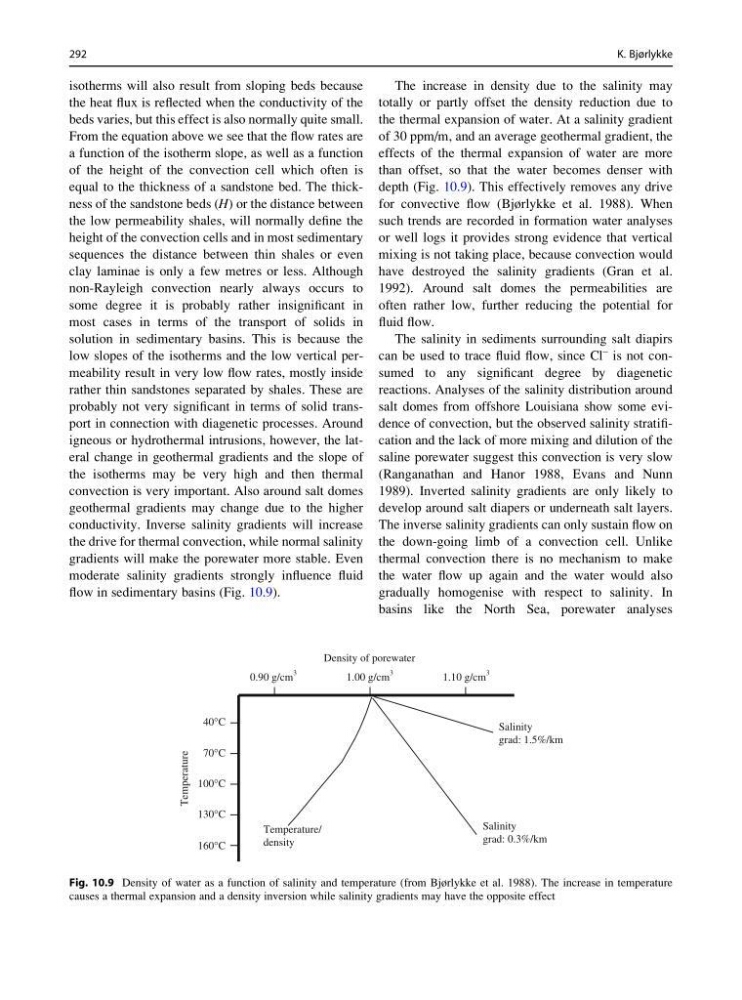
flow in sedimentary basins (Fig. 10.9).
The increase in density due to the salinity may
totally or partly offset the density reduction due to
the thermal expansion of water. At a salinity gradient
of 30 ppm/m, and an average geothermal gradient, the
effects of the thermal expansion of water are more
than offset, so that the water becomes denser with
depth (Fig. 10.9). This effectively removes any drive
for convective flow (Bjørlykke et al. 1988). When
such trends are recorded in formation water analyses
or well logs it provides strong evidence that vertical
mixing is not taking place, because convection would
have destroyed the salinity gradients (Gran et al.
1992). Around salt domes the permeabilities are
often rather low, further reducing the potential for
fluid flow.
The salinity in sediments surrounding salt diapirs
can be used to trace fluid flow, since Cl
– is not consumed to any significant degree by diagenetic
reactions. Analyses of the salinity distribution around
salt domes from offshore Louisiana show some evidence of convection, but the observed salinity stratification and the lack of more mixing and dilution of the
saline porewater suggest this convection is very slow
(Ranganathan and Hanor 1988, Evans and Nunn
1989). Inverted salinity gradients are only likely to
develop around salt diapers or underneath salt layers.
The inverse salinity gradients can only sustain flow on
the down-going limb of a convection cell. Unlike
thermal convection there is no mechanism to make
the water flow up again and the water would also
gradually homogenise with respect to salinity. In
basins like the North Sea, porewater analyses
0.90 g/cm
3
1.00 g/cm
3
1.10 g/cm
3
40°C
70°C
100°C
130°C
160°C
Temperature/
density
Salinity
grad: 1.5%/km
Salinity
grad: 0.3%/km
Density of porewater
Temperature
Fig. 10.9 Density of water as a function of salinity and temperature (from Bjørlykke et al. 1988). The increase in temperature
causes a thermal expansion and a density inversion while salinity gradients may have the opposite effect
292
K. Bjørlykke
the heat flux is reflected when the conductivity of the
beds varies, but this effect is also normally quite small.
From the equation above we see that the flow rates are
a function of the isotherm slope, as well as a function
of the height of the convection cell which often is
equal to the thickness of a sandstone bed. The thickness of the sandstone beds (H) or the distance between
the low permeability shales, will normally define the
height of the convection cells and in most sedimentary
sequences the distance between thin shales or even
clay laminae is only a few metres or less. Although
non-Rayleigh convection nearly always occurs to
some degree it is probably rather insignificant in
most cases in terms of the transport of solids in
solution in sedimentary basins. This is because the
low slopes of the isotherms and the low vertical permeability result in very low flow rates, mostly inside
rather thin sandstones separated by shales. These are
probably not very significant in terms of solid transport in connection with diagenetic processes. Around
igneous or hydrothermal intrusions, however, the lateral change in geothermal gradients and the slope of
the isotherms may be very high and then thermal
convection is very important. Also around salt domes
geothermal gradients may change due to the higher
conductivity. Inverse salinity gradients will increase
the drive for thermal convection, while normal salinity
gradients will make the porewater more stable. Even
moderate salinity gradients strongly influence fluid
flow in sedimentary basins (Fig. 10.9).
The increase in density due to the salinity may
totally or partly offset the density reduction due to
the thermal expansion of water. At a salinity gradient
of 30 ppm/m, and an average geothermal gradient, the
effects of the thermal expansion of water are more
than offset, so that the water becomes denser with
depth (Fig. 10.9). This effectively removes any drive
for convective flow (Bjørlykke et al. 1988). When
such trends are recorded in formation water analyses
or well logs it provides strong evidence that vertical
mixing is not taking place, because convection would
have destroyed the salinity gradients (Gran et al.
1992). Around salt domes the permeabilities are
often rather low, further reducing the potential for
fluid flow.
The salinity in sediments surrounding salt diapirs
can be used to trace fluid flow, since Cl
– is not consumed to any significant degree by diagenetic
reactions. Analyses of the salinity distribution around
salt domes from offshore Louisiana show some evidence of convection, but the observed salinity stratification and the lack of more mixing and dilution of the
saline porewater suggest this convection is very slow
(Ranganathan and Hanor 1988, Evans and Nunn
1989). Inverted salinity gradients are only likely to
develop around salt diapers or underneath salt layers.
The inverse salinity gradients can only sustain flow on
the down-going limb of a convection cell. Unlike
thermal convection there is no mechanism to make
the water flow up again and the water would also
gradually homogenise with respect to salinity. In
basins like the North Sea, porewater analyses
0.90 g/cm
3
1.00 g/cm
3
1.10 g/cm
3
40°C
70°C
100°C
130°C
160°C
Temperature/
density
Salinity
grad: 1.5%/km
Salinity
grad: 0.3%/km
Density of porewater
Temperature
Fig. 10.9 Density of water as a function of salinity and temperature (from Bjørlykke et al. 1988). The increase in temperature
causes a thermal expansion and a density inversion while salinity gradients may have the opposite effect
292
K. Bjørlykke