

demonstrate that the porewater is at least stratified in a
crude way with respect to its composition. The salinity
increases downwards towards the Permian salts, effectively ruling out large scale convection and excursions
of compaction-driven flow from the deeper parts of the
basin into the overlying sequence (Gran et al. 1992).
There is also a trend towards more positive δ
18 O
values with depth, which again confirms some degree
of porewater stratification (Moss et al. 2003). The
vertical salinity gradients and the isotopic composition
of the porewater confirm that the porewater is not
undergoing convection on a large scale and that there
is no large flow of porewater from the deeper part of
the basin to shallower depths. This has important
consequences for diagenetic models in connection
with fluid transport of solids in solution.
10.7 Compaction-Driven Porewater
Flow
As sediments compact they lose porosity and the
excess porewater has to be expelled. This is the driving
force for compaction-driven flow. The rate of porosity
loss is a function of effective stress, lithology, temperature and time. The porosity/depth functions observed
in sedimentary basins may be very complex,
depending on the lithologies. At the transition between
two lithologies the porosity may increase with depth
but for a uniform lithology the porosity will decrease
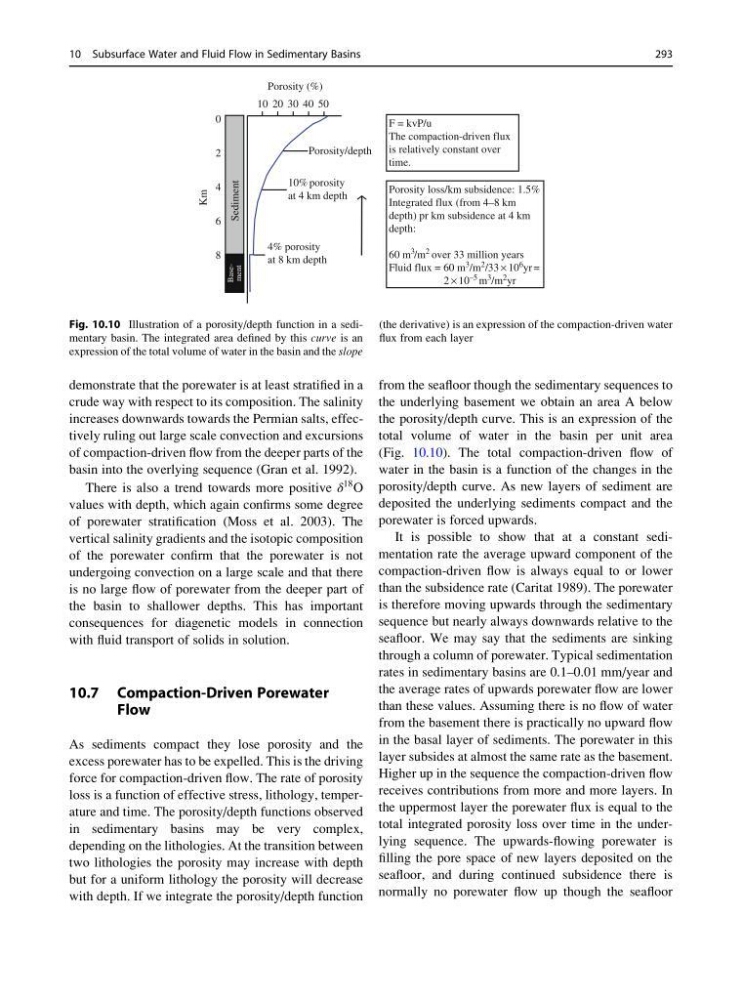
with depth. If we integrate the porosity/depth function
from the seafloor though the sedimentary sequences to
the underlying basement we obtain an area A below
the porosity/depth curve. This is an expression of the
total volume of water in the basin per unit area
(Fig. 10.10). The total compaction-driven flow of
water in the basin is a function of the changes in the
porosity/depth curve. As new layers of sediment are
deposited the underlying sediments compact and the
porewater is forced upwards.
It is possible to show that at a constant sedimentation rate the average upward component of the
compaction-driven flow is always equal to or lower
than the subsidence rate (Caritat 1989). The porewater
is therefore moving upwards through the sedimentary
sequence but nearly always downwards relative to the
seafloor. We may say that the sediments are sinking
through a column of porewater. Typical sedimentation
rates in sedimentary basins are 0.1–0.01 mm/year and
the average rates of upwards porewater flow are lower
than these values. Assuming there is no flow of water
from the basement there is practically no upward flow
in the basal layer of sediments. The porewater in this
layer subsides at almost the same rate as the basement.
Higher up in the sequence the compaction-driven flow
receives contributions from more and more layers. In
the uppermost layer the porewater flux is equal to the
total integrated porosity loss over time in the underlying sequence. The upwards-flowing porewater is
filling the pore space of new layers deposited on the
seafloor, and during continued subsidence there is
normally no porewater flow up though the seafloor
10
40
30
20
50
Porosity (%)
Sediment
Basement
0
2
4
6
8
Km
Porosity/depth
10% porosity
at 4 km depth
4% porosity
at 8 km depth
F = kvP/u
The compaction-driven flux
is relatively constant over
time.
Porosity loss/km subsidence: 1.5%
Integrated flux (from 4–8 km
depth) pr km subsidence at 4 km
depth:
60 m
3 /m
2 over 33 million years
Fluid flux = 60 m
3 /m
2 /33 × 10
6 yr =
2 × 10
–5 m
3 /m
2 yr
Fig. 10.10 Illustration of a porosity/depth function in a sedimentary basin. The integrated area defined by this curve is an
expression of the total volume of water in the basin and the slope
(the derivative) is an expression of the compaction-driven water
flux from each layer
10 Subsurface Water and Fluid Flow in Sedimentary Basins
293
crude way with respect to its composition. The salinity
increases downwards towards the Permian salts, effectively ruling out large scale convection and excursions
of compaction-driven flow from the deeper parts of the
basin into the overlying sequence (Gran et al. 1992).
There is also a trend towards more positive δ
18 O
values with depth, which again confirms some degree
of porewater stratification (Moss et al. 2003). The
vertical salinity gradients and the isotopic composition
of the porewater confirm that the porewater is not
undergoing convection on a large scale and that there
is no large flow of porewater from the deeper part of
the basin to shallower depths. This has important
consequences for diagenetic models in connection
with fluid transport of solids in solution.
10.7 Compaction-Driven Porewater
Flow
As sediments compact they lose porosity and the
excess porewater has to be expelled. This is the driving
force for compaction-driven flow. The rate of porosity
loss is a function of effective stress, lithology, temperature and time. The porosity/depth functions observed
in sedimentary basins may be very complex,
depending on the lithologies. At the transition between
two lithologies the porosity may increase with depth
but for a uniform lithology the porosity will decrease
with depth. If we integrate the porosity/depth function
from the seafloor though the sedimentary sequences to
the underlying basement we obtain an area A below
the porosity/depth curve. This is an expression of the
total volume of water in the basin per unit area
(Fig. 10.10). The total compaction-driven flow of
water in the basin is a function of the changes in the
porosity/depth curve. As new layers of sediment are
deposited the underlying sediments compact and the
porewater is forced upwards.
It is possible to show that at a constant sedimentation rate the average upward component of the
compaction-driven flow is always equal to or lower
than the subsidence rate (Caritat 1989). The porewater
is therefore moving upwards through the sedimentary
sequence but nearly always downwards relative to the
seafloor. We may say that the sediments are sinking
through a column of porewater. Typical sedimentation
rates in sedimentary basins are 0.1–0.01 mm/year and
the average rates of upwards porewater flow are lower
than these values. Assuming there is no flow of water
from the basement there is practically no upward flow
in the basal layer of sediments. The porewater in this
layer subsides at almost the same rate as the basement.
Higher up in the sequence the compaction-driven flow
receives contributions from more and more layers. In
the uppermost layer the porewater flux is equal to the
total integrated porosity loss over time in the underlying sequence. The upwards-flowing porewater is
filling the pore space of new layers deposited on the
seafloor, and during continued subsidence there is
normally no porewater flow up though the seafloor
10
40
30
20
50
Porosity (%)
Sediment
Basement
0
2
4
6
8
Km
Porosity/depth
10% porosity
at 4 km depth
4% porosity
at 8 km depth
F = kvP/u
The compaction-driven flux
is relatively constant over
time.
Porosity loss/km subsidence: 1.5%
Integrated flux (from 4–8 km
depth) pr km subsidence at 4 km
depth:
60 m
3 /m
2 over 33 million years
Fluid flux = 60 m
3 /m
2 /33 × 10
6 yr =
2 × 10
–5 m
3 /m
2 yr
Fig. 10.10 Illustration of a porosity/depth function in a sedimentary basin. The integrated area defined by this curve is an
expression of the total volume of water in the basin and the slope
(the derivative) is an expression of the compaction-driven water
flux from each layer
10 Subsurface Water and Fluid Flow in Sedimentary Basins
293