

sink into the less dense water below. The condition
required for such overturning can be expressed in
terms of a critical Rayleigh number. In the case of
thermal convection of water the Rayleigh number can
be defined as follows (Bjørlykke et al. 1988):
R ¼ gβΔTHk=κμ
Here, g is acceleration due to gravity, β is the
coefficient of thermal expansion of the fluid (water),
ΔT is the temperature difference between the upper
and lower boundaries of the convection cell, H is the
thickness of the layers, k is the permeability, κ is the
thermal diffusivity and μ is the viscosity. Assuming
reasonable values for the properties of water the equation can be expressed in a simpler form (Bjørlykke
et al. 1988):
R ¼ 1:2 Â 10
À2 krTH
The critical Rayleigh number which must be
exceeded for Rayleigh convection to occur is about
40. We see that the most critical factors are the height
of the water column and the permeability of the rocks.
If the permeability is 1 Darcy and the geothermal
gradient 30
C/km, the thickness (H) of the permeable
layer (sandstone) must exceed about 300 m for the
critical Rayleigh number to be exceeded so that thermal convection can occur. Sedimentary rocks, though,
are rarely uniform and the vertical permeability typically changes abruptly in a sequence of sandstones and
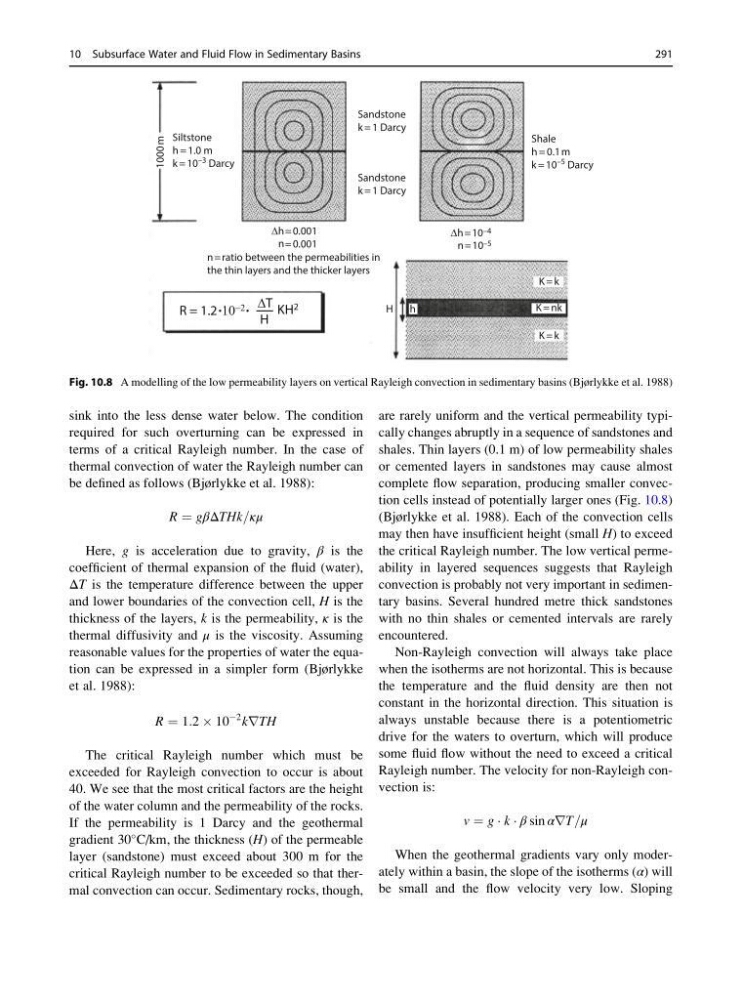
shales. Thin layers (0.1 m) of low permeability shales
or cemented layers in sandstones may cause almost
complete flow separation, producing smaller convection cells instead of potentially larger ones (Fig. 10.8)
(Bjørlykke et al. 1988). Each of the convection cells
may then have insufficient height (small H) to exceed
the critical Rayleigh number. The low vertical permeability in layered sequences suggests that Rayleigh
convection is probably not very important in sedimentary basins. Several hundred metre thick sandstones
with no thin shales or cemented intervals are rarely
encountered.
Non-Rayleigh convection will always take place
when the isotherms are not horizontal. This is because
the temperature and the fluid density are then not
constant in the horizontal direction. This situation is
always unstable because there is a potentiometric
drive for the waters to overturn, which will produce
some fluid flow without the need to exceed a critical
Rayleigh number. The velocity for non-Rayleigh convection is:
v ¼ g Á k Á β sin αrT=μ
When the geothermal gradients vary only moderately within a basin, the slope of the isotherms (α) will
be small and the flow velocity very low. Sloping
Siltstone
h = 1.0 m
k = 10
–3 Darcy
Shale
h = 0.1 m
k = 10
–5 Darcy
Sandstone
k = 1 Darcy
Sandstone
k = 1 Darcy
Δh= 0.001
n= 0.001
Δh = 10 –4
n = 10 –5
K = k
K = nk
h
H
K = k
n = ratio between the permeabilities in
the thin layers and the thicker layers
1000 m
R = 1.2•10 −2 •
H
KH 2
ΔT
Fig. 10.8 A modelling of the low permeability layers on vertical Rayleigh convection in sedimentary basins (Bjørlykke et al. 1988)
10 Subsurface Water and Fluid Flow in Sedimentary Basins
291
required for such overturning can be expressed in
terms of a critical Rayleigh number. In the case of
thermal convection of water the Rayleigh number can
be defined as follows (Bjørlykke et al. 1988):
R ¼ gβΔTHk=κμ
Here, g is acceleration due to gravity, β is the
coefficient of thermal expansion of the fluid (water),
ΔT is the temperature difference between the upper
and lower boundaries of the convection cell, H is the
thickness of the layers, k is the permeability, κ is the
thermal diffusivity and μ is the viscosity. Assuming
reasonable values for the properties of water the equation can be expressed in a simpler form (Bjørlykke
et al. 1988):
R ¼ 1:2 Â 10
À2 krTH
The critical Rayleigh number which must be
exceeded for Rayleigh convection to occur is about
40. We see that the most critical factors are the height
of the water column and the permeability of the rocks.
If the permeability is 1 Darcy and the geothermal
gradient 30
C/km, the thickness (H) of the permeable
layer (sandstone) must exceed about 300 m for the
critical Rayleigh number to be exceeded so that thermal convection can occur. Sedimentary rocks, though,
are rarely uniform and the vertical permeability typically changes abruptly in a sequence of sandstones and
shales. Thin layers (0.1 m) of low permeability shales
or cemented layers in sandstones may cause almost
complete flow separation, producing smaller convection cells instead of potentially larger ones (Fig. 10.8)
(Bjørlykke et al. 1988). Each of the convection cells
may then have insufficient height (small H) to exceed
the critical Rayleigh number. The low vertical permeability in layered sequences suggests that Rayleigh
convection is probably not very important in sedimentary basins. Several hundred metre thick sandstones
with no thin shales or cemented intervals are rarely
encountered.
Non-Rayleigh convection will always take place
when the isotherms are not horizontal. This is because
the temperature and the fluid density are then not
constant in the horizontal direction. This situation is
always unstable because there is a potentiometric
drive for the waters to overturn, which will produce
some fluid flow without the need to exceed a critical
Rayleigh number. The velocity for non-Rayleigh convection is:
v ¼ g Á k Á β sin αrT=μ
When the geothermal gradients vary only moderately within a basin, the slope of the isotherms (α) will
be small and the flow velocity very low. Sloping
Siltstone
h = 1.0 m
k = 10
–3 Darcy
Shale
h = 0.1 m
k = 10
–5 Darcy
Sandstone
k = 1 Darcy
Sandstone
k = 1 Darcy
Δh= 0.001
n= 0.001
Δh = 10 –4
n = 10 –5
K = k
K = nk
h
H
K = k
n = ratio between the permeabilities in
the thin layers and the thicker layers
1000 m
R = 1.2•10 −2 •
H
KH 2
ΔT
Fig. 10.8 A modelling of the low permeability layers on vertical Rayleigh convection in sedimentary basins (Bjørlykke et al. 1988)
10 Subsurface Water and Fluid Flow in Sedimentary Basins
291