

variations along the bedding due to sedimentary
structures.
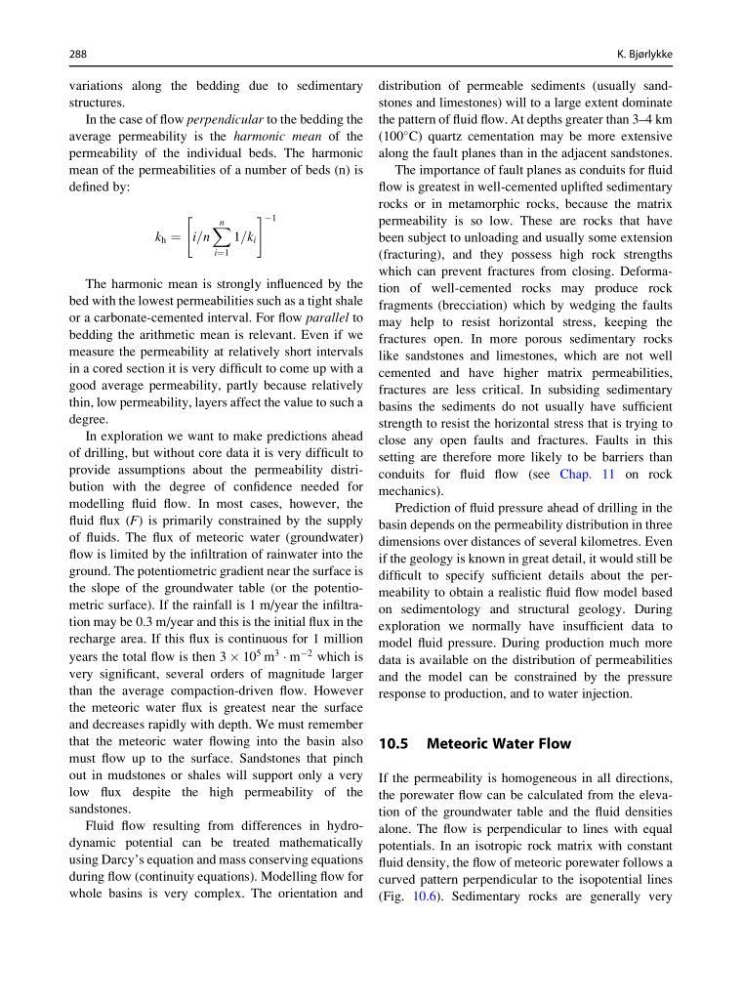
In the case of flow perpendicular to the bedding the
average permeability is the harmonic mean of the
permeability of the individual beds. The harmonic
mean of the permeabilities of a number of beds (n) is
defined by:
k h ¼ i=n
X n
i¼1
1=k i
"
# À1
The harmonic mean is strongly influenced by the
bed with the lowest permeabilities such as a tight shale
or a carbonate-cemented interval. For flow parallel to
bedding the arithmetic mean is relevant. Even if we
measure the permeability at relatively short intervals
in a cored section it is very difficult to come up with a
good average permeability, partly because relatively
thin, low permeability, layers affect the value to such a
degree.
In exploration we want to make predictions ahead
of drilling, but without core data it is very difficult to
provide assumptions about the permeability distribution with the degree of confidence needed for
modelling fluid flow. In most cases, however, the
fluid flux (F) is primarily constrained by the supply
of fluids. The flux of meteoric water (groundwater)
flow is limited by the infiltration of rainwater into the
ground. The potentiometric gradient near the surface is
the slope of the groundwater table (or the potentiometric surface). If the rainfall is 1 m/year the infiltration may be 0.3 m/year and this is the initial flux in the
recharge area. If this flux is continuous for 1 million
years the total flow is then 3 Â 10
5 m
3
Á m
À2 which is
very significant, several orders of magnitude larger
than the average compaction-driven flow. However
the meteoric water flux is greatest near the surface
and decreases rapidly with depth. We must remember
that the meteoric water flowing into the basin also
must flow up to the surface. Sandstones that pinch
out in mudstones or shales will support only a very
low flux despite the high permeability of the
sandstones.
Fluid flow resulting from differences in hydrodynamic potential can be treated mathematically
using Darcy’s equation and mass conserving equations
during flow (continuity equations). Modelling flow for
whole basins is very complex. The orientation and
distribution of permeable sediments (usually sandstones and limestones) will to a large extent dominate
the pattern of fluid flow. At depths greater than 3–4 km
(100
C) quartz cementation may be more extensive
along the fault planes than in the adjacent sandstones.
The importance of fault planes as conduits for fluid
flow is greatest in well-cemented uplifted sedimentary
rocks or in metamorphic rocks, because the matrix
permeability is so low. These are rocks that have
been subject to unloading and usually some extension
(fracturing), and they possess high rock strengths
which can prevent fractures from closing. Deformation of well-cemented rocks may produce rock
fragments (brecciation) which by wedging the faults
may help to resist horizontal stress, keeping the
fractures open. In more porous sedimentary rocks
like sandstones and limestones, which are not well
cemented and have higher matrix permeabilities,
fractures are less critical. In subsiding sedimentary
basins the sediments do not usually have sufficient
strength to resist the horizontal stress that is trying to
close any open faults and fractures. Faults in this
setting are therefore more likely to be barriers than
conduits for fluid flow (see Chap. 11 on rock
mechanics).
Prediction of fluid pressure ahead of drilling in the
basin depends on the permeability distribution in three
dimensions over distances of several kilometres. Even
if the geology is known in great detail, it would still be
difficult to specify sufficient details about the permeability to obtain a realistic fluid flow model based
on sedimentology and structural geology. During
exploration we normally have insufficient data to
model fluid pressure. During production much more
data is available on the distribution of permeabilities
and the model can be constrained by the pressure
response to production, and to water injection.
10.5 Meteoric Water Flow
If the permeability is homogeneous in all directions,
the porewater flow can be calculated from the elevation of the groundwater table and the fluid densities
alone. The flow is perpendicular to lines with equal
potentials. In an isotropic rock matrix with constant
fluid density, the flow of meteoric porewater follows a
curved pattern perpendicular to the isopotential lines
(Fig. 10.6). Sedimentary rocks are generally very
288
K. Bjørlykke
structures.
In the case of flow perpendicular to the bedding the
average permeability is the harmonic mean of the
permeability of the individual beds. The harmonic
mean of the permeabilities of a number of beds (n) is
defined by:
k h ¼ i=n
X n
i¼1
1=k i
"
# À1
The harmonic mean is strongly influenced by the
bed with the lowest permeabilities such as a tight shale
or a carbonate-cemented interval. For flow parallel to
bedding the arithmetic mean is relevant. Even if we
measure the permeability at relatively short intervals
in a cored section it is very difficult to come up with a
good average permeability, partly because relatively
thin, low permeability, layers affect the value to such a
degree.
In exploration we want to make predictions ahead
of drilling, but without core data it is very difficult to
provide assumptions about the permeability distribution with the degree of confidence needed for
modelling fluid flow. In most cases, however, the
fluid flux (F) is primarily constrained by the supply
of fluids. The flux of meteoric water (groundwater)
flow is limited by the infiltration of rainwater into the
ground. The potentiometric gradient near the surface is
the slope of the groundwater table (or the potentiometric surface). If the rainfall is 1 m/year the infiltration may be 0.3 m/year and this is the initial flux in the
recharge area. If this flux is continuous for 1 million
years the total flow is then 3 Â 10
5 m
3
Á m
À2 which is
very significant, several orders of magnitude larger
than the average compaction-driven flow. However
the meteoric water flux is greatest near the surface
and decreases rapidly with depth. We must remember
that the meteoric water flowing into the basin also
must flow up to the surface. Sandstones that pinch
out in mudstones or shales will support only a very
low flux despite the high permeability of the
sandstones.
Fluid flow resulting from differences in hydrodynamic potential can be treated mathematically
using Darcy’s equation and mass conserving equations
during flow (continuity equations). Modelling flow for
whole basins is very complex. The orientation and
distribution of permeable sediments (usually sandstones and limestones) will to a large extent dominate
the pattern of fluid flow. At depths greater than 3–4 km
(100
C) quartz cementation may be more extensive
along the fault planes than in the adjacent sandstones.
The importance of fault planes as conduits for fluid
flow is greatest in well-cemented uplifted sedimentary
rocks or in metamorphic rocks, because the matrix
permeability is so low. These are rocks that have
been subject to unloading and usually some extension
(fracturing), and they possess high rock strengths
which can prevent fractures from closing. Deformation of well-cemented rocks may produce rock
fragments (brecciation) which by wedging the faults
may help to resist horizontal stress, keeping the
fractures open. In more porous sedimentary rocks
like sandstones and limestones, which are not well
cemented and have higher matrix permeabilities,
fractures are less critical. In subsiding sedimentary
basins the sediments do not usually have sufficient
strength to resist the horizontal stress that is trying to
close any open faults and fractures. Faults in this
setting are therefore more likely to be barriers than
conduits for fluid flow (see Chap. 11 on rock
mechanics).
Prediction of fluid pressure ahead of drilling in the
basin depends on the permeability distribution in three
dimensions over distances of several kilometres. Even
if the geology is known in great detail, it would still be
difficult to specify sufficient details about the permeability to obtain a realistic fluid flow model based
on sedimentology and structural geology. During
exploration we normally have insufficient data to
model fluid pressure. During production much more
data is available on the distribution of permeabilities
and the model can be constrained by the pressure
response to production, and to water injection.
10.5 Meteoric Water Flow
If the permeability is homogeneous in all directions,
the porewater flow can be calculated from the elevation of the groundwater table and the fluid densities
alone. The flow is perpendicular to lines with equal
potentials. In an isotropic rock matrix with constant
fluid density, the flow of meteoric porewater follows a
curved pattern perpendicular to the isopotential lines
(Fig. 10.6). Sedimentary rocks are generally very
288
K. Bjørlykke