

water associated with uplift will cause a thermal contraction which is greater than the expansion due to
pressure reduction, so that the porewater becomes
denser.
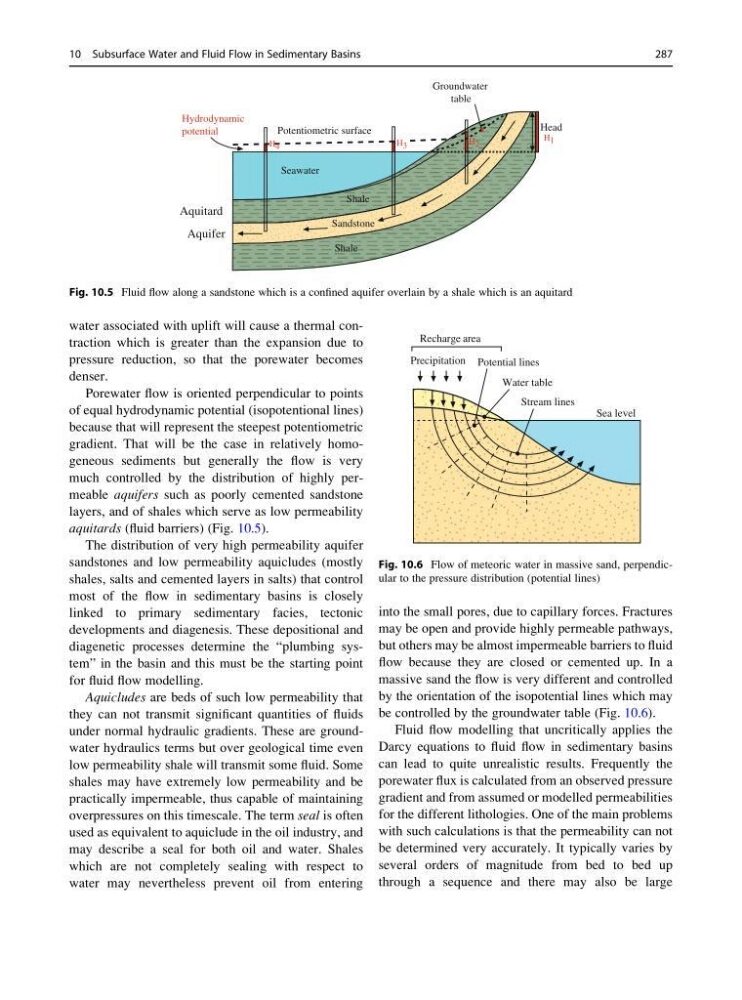
Porewater flow is oriented perpendicular to points
of equal hydrodynamic potential (isopotentional lines)
because that will represent the steepest potentiometric
gradient. That will be the case in relatively homogeneous sediments but generally the flow is very
much controlled by the distribution of highly permeable aquifers such as poorly cemented sandstone
layers, and of shales which serve as low permeability
aquitards (fluid barriers) (Fig. 10.5).
The distribution of very high permeability aquifer
sandstones and low permeability aquicludes (mostly
shales, salts and cemented layers in salts) that control
most of the flow in sedimentary basins is closely
linked to primary sedimentary facies, tectonic
developments and diagenesis. These depositional and
diagenetic processes determine the “plumbing system” in the basin and this must be the starting point
for fluid flow modelling.
Aquicludes are beds of such low permeability that
they can not transmit significant quantities of fluids
under normal hydraulic gradients. These are groundwater hydraulics terms but over geological time even
low permeability shale will transmit some fluid. Some
shales may have extremely low permeability and be
practically impermeable, thus capable of maintaining
overpressures on this timescale. The term seal is often
used as equivalent to aquiclude in the oil industry, and
may describe a seal for both oil and water. Shales
which are not completely sealing with respect to
water may nevertheless prevent oil from entering
into the small pores, due to capillary forces. Fractures
may be open and provide highly permeable pathways,
but others may be almost impermeable barriers to fluid
flow because they are closed or cemented up. In a
massive sand the flow is very different and controlled
by the orientation of the isopotential lines which may
be controlled by the groundwater table (Fig. 10.6).
Fluid flow modelling that uncritically applies the
Darcy equations to fluid flow in sedimentary basins
can lead to quite unrealistic results. Frequently the
porewater flux is calculated from an observed pressure
gradient and from assumed or modelled permeabilities
for the different lithologies. One of the main problems
with such calculations is that the permeability can not
be determined very accurately. It typically varies by
several orders of magnitude from bed to bed up
through a sequence and there may also be large
Potentiometric surface
Hydrodynamic
potential
Seawater
Aquitard
Aquifer
Head
H 1
H 2
H 4
Groundwater
table
Shale
Shale
Sandstone
H 3
Fig. 10.5 Fluid flow along a sandstone which is a confined aquifer overlain by a shale which is an aquitard
Sea level
Recharge area
Precipitation Potential lines
Water table
Stream lines
Fig. 10.6 Flow of meteoric water in massive sand, perpendicular to the pressure distribution (potential lines)
10 Subsurface Water and Fluid Flow in Sedimentary Basins
287
pressure reduction, so that the porewater becomes
denser.
Porewater flow is oriented perpendicular to points
of equal hydrodynamic potential (isopotentional lines)
because that will represent the steepest potentiometric
gradient. That will be the case in relatively homogeneous sediments but generally the flow is very
much controlled by the distribution of highly permeable aquifers such as poorly cemented sandstone
layers, and of shales which serve as low permeability
aquitards (fluid barriers) (Fig. 10.5).
The distribution of very high permeability aquifer
sandstones and low permeability aquicludes (mostly
shales, salts and cemented layers in salts) that control
most of the flow in sedimentary basins is closely
linked to primary sedimentary facies, tectonic
developments and diagenesis. These depositional and
diagenetic processes determine the “plumbing system” in the basin and this must be the starting point
for fluid flow modelling.
Aquicludes are beds of such low permeability that
they can not transmit significant quantities of fluids
under normal hydraulic gradients. These are groundwater hydraulics terms but over geological time even
low permeability shale will transmit some fluid. Some
shales may have extremely low permeability and be
practically impermeable, thus capable of maintaining
overpressures on this timescale. The term seal is often
used as equivalent to aquiclude in the oil industry, and
may describe a seal for both oil and water. Shales
which are not completely sealing with respect to
water may nevertheless prevent oil from entering
into the small pores, due to capillary forces. Fractures
may be open and provide highly permeable pathways,
but others may be almost impermeable barriers to fluid
flow because they are closed or cemented up. In a
massive sand the flow is very different and controlled
by the orientation of the isopotential lines which may
be controlled by the groundwater table (Fig. 10.6).
Fluid flow modelling that uncritically applies the
Darcy equations to fluid flow in sedimentary basins
can lead to quite unrealistic results. Frequently the
porewater flux is calculated from an observed pressure
gradient and from assumed or modelled permeabilities
for the different lithologies. One of the main problems
with such calculations is that the permeability can not
be determined very accurately. It typically varies by
several orders of magnitude from bed to bed up
through a sequence and there may also be large
Potentiometric surface
Hydrodynamic
potential
Seawater
Aquitard
Aquifer
Head
H 1
H 2
H 4
Groundwater
table
Shale
Shale
Sandstone
H 3
Fig. 10.5 Fluid flow along a sandstone which is a confined aquifer overlain by a shale which is an aquitard
Sea level
Recharge area
Precipitation Potential lines
Water table
Stream lines
Fig. 10.6 Flow of meteoric water in massive sand, perpendicular to the pressure distribution (potential lines)
10 Subsurface Water and Fluid Flow in Sedimentary Basins
287